 |
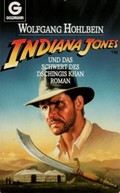
Indiana Jones
The Sword of Genghis Khan
Novel
Written by Wolfgang
Hohlbein
Cover by Oliviero Berni
1991
(Page numbers come from the
paperback edition
of
Indiana Jones und das
Schwert des Dschingis Khan,
2nd
printing, 1992)
|
The Soviets and many others are on the
trail of the sword of Genghis Khan and if its legend is true, if
found, the Mongols will once again rule their former empire.
Notes from the Indiana Jones chronology
Though no year date is given in this novel, it said by the
Indiana Jones
Wiki to take place in Summer 1941.
Didja Know?
This is a study of the German novel Indiana Jones
und das Schwert des Dschingis Khan (Indiana
Jones and the Sword of Genghis Khan).
This novel does not have labeled chapters.
The mythical Sword of Genghis Khan as described in this novel is
fictitious. There is no particular legend of such an artifact.
The concept of it may possibly have been inspired by the
eponymous artifact with similar properties to the one depicted
here in the 1967 novel
The Sword of Genghis Khan, part of the Mark Hood
espionage series published largely in Australia from 1965-1971.
Notes from
The Lost Journal of Indiana Jones
The Lost Journal of Indiana Jones is a 2008 publication
that
purports to be Indy's journal as seen throughout The
Young Indiana Chronicles
TV series
and the big screen Indiana
Jones movies. The publication is also annotated with notes
from a functionary of the
Federal Security
Service (FSB) of the Russian Federation, the successor
agency of the Soviet Union's KGB security agency. The KGB relieved Indy of his
journal in 1957 during the events of Indiana
Jones and the Kingdom of the Crystal Skull.
The notations imply the journal was released to other
governments by the FSB in the early 21st Century. However, some
bookend segments of The
Young Indiana Chronicles
depict Old Indy still in
possession of the journal in 1992. The discrepancy has never
been resolved.
The journal as published does not mention the events of this
novel, going from
entries about the events of
The Fate of Atlantis in
May 1939 to Indy's time working with Colonel George "Mac" McHale
during 1944. A five year gap seemingly left un-journaled.
Story Summary
Soviet officer Mikhail, a Cossack serving
unhappily in the Red Army, discovers a mysterious Mongol
encampment that has seemingly appeared overnight near the
border. When he attempts to investigate, his patrol is savagely
attacked by warriors armed with swords, spears, and bows who
fight with astonishing discipline and fearlessness. Despite his
tank's superior firepower, Mikhail's men are overwhelmed. The
attackers are soon joined by hundreds of mounted horsemen
shouting the name "Temujin" (the birth name of Genghis Khan).
Mikhail realizes he is facing something impossible—an army that
seems to have emerged from history itself. His tank is crippled,
his crew is killed, and the section ends with his apparent
defeat, establishing the supernatural mystery surrounding the
legendary Sword of Genghis Khan.
Indiana Jones attends a reception at the
Soviet embassy, where he meets the striking Soviet archaeologist
and political commissar Tamara Jaglova. She reveals she has
sought him out because she needs his archaeological expertise
for a confidential expedition to Mongolia. Before she can
explain, Soviet security agents abruptly interrupt the reception
following intelligence that someone intends to assassinate
Tamara and steal important documents in her possession. Indy
instinctively reacts to the danger, helping Tamara escape what
appears to be a terrorist attack. Amid the confusion, it becomes
clear that multiple international interests are converging
around a secret involving Genghis Khan and an ancient relic.
Tamara finally explains the purpose of her
mission. Soviet researchers have uncovered evidence suggesting
that the legendary Sword of Genghis Khan may actually exist.
Ancient prophecy claims that whoever possesses the sword can
unite the Mongol peoples and restore the Mongol Empire. Although
Indy dismisses much of the prophecy as folklore, the
archaeological evidence is compelling enough that he agrees to
accompany Tamara. Unknown to them, rival intelligence
agencies—including Japanese, German, and Chinese operatives—have
also learned of the sword and begin pursuing them.
Indy and Tamara travel to Hong Kong, hoping
to follow the first archaeological clues before their rivals.
Instead they find themselves surrounded by spies, criminal
organizations, and competing expeditions. Their search for
manuscripts, maps, and historical records repeatedly turns into
ambushes, chases, and narrow escapes.
Indy gradually comes to trust Tamara despite their political
differences, while suspecting that even she and her Soviet
bosses are not
telling him everything.
Following a new trail into
Japanese-occupied Manchuria, the expedition uncovers additional
clues pointing toward the resting place of Genghis Khan's
legendary weapon. Japanese military intelligence becomes
increasingly aggressive, believing the sword could be exploited
as both a symbolic and political weapon. Indy realizes the
legend is inspiring fanatical devotion among various Mongolian
factions, making the search far more dangerous than a typical
archaeological expedition (though maybe not more than a typical
Indiana Jones expedition).
Near the Great Wall, Indy and his
companions infiltrate heavily guarded territory while attempting
to stay ahead of rival expeditions. They uncover more evidence
that someone has already begun assembling forces dedicated to
restoring the Mongol Empire. Ancient inscriptions and hidden
sites strengthen the possibility that the sword truly exists
rather than being merely legendary. The race becomes
increasingly desperate as the multiple factions close in on the same
destination: the legendary and mystical Shambala in the
Himalayan Mountains.
The expedition reaches the remote fortress
of the Mongol leader Dzo-Lin, whose followers deeply
believe in the prophecy surrounding the sword. Indy and his
friends uncover crucial historical information
explaining how the sword disappeared centuries earlier and why
so many governments fear its rediscovery.
The search accelerates into a full-scale
international contest. German, Japanese, Soviet, Chinese, and
Mongolian forces all converge as betrayals and shifting
alliances complicate every decision. Indy finds that
archaeological reasoning alone is no longer enough; survival
depends upon outwitting trained soldiers, spies, and fanatics
who all believe they deserve the sword.
As the expedition reaches hidden Shambala
where the final clues point, the supernatural aspects of the
legend become increasingly difficult to dismiss. The myth of
Genghis Khan's return appears to possess a psychological—and
perhaps mystical—power over those who seek the sword. Ancient defenses,
treacherous terrain, and human greed prove equally deadly. Indy
must separate historical truth from myth while preventing the
sword from becoming a tool to be used for political domination.
The climax unfolds in when the Sword of Genghis Khan is finally revealed.
Every faction attempts to seize it, convinced it will grant
legitimacy or supernatural authority. The resulting conflict
destroys many of the competing forces. As in many of Indy's past
brushes with ancient mystic artifacts, the greatest danger
ultimately comes from human ambition rather than the artifact
itself. Indy succeeds in ensuring that the sword cannot be
exploited to fulfill the ancient prophecy, although not without
considerable sacrifice and loss and
another reminder that some discoveries are too dangerous to
possess.
The surviving characters reflect on the
extraordinary events surrounding the sword. The legend of
Genghis Khan remains unresolved enough to preserve its mystery,
while the artifact itself is once again removed from the grasp
of governments and conquerors...hidden in plain site as an 11th
Century Mongolian sword of unknown provenance in the Moscow
Museum.
Characters appearing or mentioned in this story
Mikhail (presumed killed in this novel)
Soviet soldiers
Fyodor
(presumed killed in this novel)
Mongolian soldiers
T32 driver
(presumed killed in this novel)
Indiana Jones
Russian embassy partygoers
party wait staff
Tamara Jaglova
Count Dimitri Sverlovsk
Russian secret service agents
Marcus Brody
Russian embassy staff
museum worker
truck driver
Paul Webber
Nancy
taxi driver
Indy's Hong Kong friends (mentioned only)
tea freighter captain
Toshiro Moto (dies in this novel)
Japanese servants
Chinese thugs
General Dzo-Lin
(dies in this novel)
Japanese soldiers
Major Hondo
(dies in this novel)
Lobsang
Tsangpo
(dies in this novel)
King Kong (Japanese soldier,
dies in this novel)
Japanese military pilot
Japanese military camp commander
ninjas
Didja Notice?
On page 5, Mikhail is said to be a Cossack standing in the
open turret hatch of a T32.
Cossacks are members of various ethnic groups living in the
Great Eurasian Steppe, mostly within the regions of modern
day southern Russia and the Ukraine. A T32 is a
Czechoslovakian tankette.
Page 7 informs us that the Bolsheviks had put a price
on the heads of men like Mikhail.
The Bolsheviks were a radical Marxist faction of the Russian
Social Democratic Labour Party, who had become the Communist
Party of the Soviet Union during the October Revolution of
1917 and now ruled that country.
Mikhail is a soldier in the Red
Army."Red
Army" has been the popular name of the Russian Army since
the Russian Civil War of 1918-1922, named for the
traditional color of the workers' movement in Russia at the
time.
On page 9, Tungus and
Kyrgyz are people of the Tunguska region of Russia and the
Soviet nation of Kyrgyzstan, respectively.
On page 15, the Kalashnikov is a popular line of Russian
automatic rifles, the most commonly known of which is the
AK-47, designed by Mikhail Kalashnikov.
Also on page 15, SMG is an abbreviation for Sarah Michelle
Gellar. Er, I mean, "submachine gun".
On page 16, the Huns were a nomadic people of the 4th and
6th centuries AD in Central Asia, the Caucasus, and Eastern
Europe.
On page 18, Temujin is the real name of Genghis
Khan.
"Genghis Khan" (meaning Great Emperor) was the title given
to Temujin, the son of a 12th Century leader of the Mongols,
who went on to found the Mongol Empire by uniting many of
the nomadic tribes of the region and building a powerful
army from them.
Page 20 opens at the Russian Embassy in Washington, D.C.
Washington, D.C. is
the capital of the United States.
Page 22 mentions, Indiana had
had a life that was more adventurous than most of his
friends even suspected.
On page 23, Indy obliquely compares himself to Allan
Quatermain.
Allan Quatermain is a character appearing in a series of
adventure novels and short stories from 1885-1927 by H.
Rider Haggard, who in turn was one of the inspirations for
George Lucas' character of Indiana Jones.
On page 23, faux pas is
French for "false step". It has taken on the meaning in the
Western world of an embarrassing or tactless blunder.
On page 24, Tamara Jaglova is described as having the body
of a Venus of Moscow. The "Venus of Moscow" is a famous
moniker applied to Princess Natalya Petrovna Golitsyna
(1741-1838), a Russian noblewoman and one of the most
celebrated beauties of the late 18th century.
Moscow
is the capital of Russia.
Indy thinks that with a woman like Jaglova, no man had a
chance with her who didn't have at least the appearance of Tyrone
Power, the intelligence quotient of Albert Einstein, and the
bank account of Howard Hughes. Tyrone Power (1914-1958) was
an American actor and leading man.
Dr. Albert Einstein (1879-1955) is the renowned German
theoretical physicist who refused, during a visit to
America, to return to Germany after Hitler came into power,
and became an American citizen. Howard Hughes (1905-1976)
was one of the richest men in the world during his lifetime.
On page 25, the Austrian K.u.K.
was the Austro-Hungarian Navy from 1867-1918. "K.u.K." is an
abbreviation for "kaiserliche und königliche",
German for "Imperial and Royal".
On page 29, Tsarevich (or Zarewitsch) is the title
for the son of a Tsar.
On page 34, Indy calls a Russian secret service man "Tovarisch."
This is Russian for "comrade".
On page 38, Indy thinks of Tamara as an "atheist Russian
woman". This is because the tenets of communism refute
religion as a competitor against the communist party for the loyalty
of the people.
On page 44, the Supreme Soviet was the highest level of
state authority in the Soviet Union from
1922-1991.
On page 45, Indy thinks of the
Sword of Genghis Khan alongside the legends of Excalibur,
Barbarossa's tomb, and the Ark of the Covenant. Indy has
encountered two versions of Excalibur in
The Legacy of Avalon
and "The Sword of
Excalibur" (Indy even acknowledges the existence of two
Excaliburs here, telling Tamara, "Every Mongolian knows the
legend, just as every Briton knows the Excaliburs."). I'm
not sure what the deal is about Barbarossa's tomb, the
commonly known tomb being the tomb of Hayreddin Barbarossa,
the 16th Century Ottoman corsair and later Ottoman Navy
admiral, a known mausoleum in
Beşiktaş,
a district of Istanbul, Turkey. The Ark of the Covenant is a
wooden, gold-covered chest that carries the Ten Commandants,
as stated in the Bible; it was discovered by Indy in
Raiders of the Lost
Ark.
Page 49 reveals that Marcus is a fan of opera and indulges
in seeing it at every opportunity. He was in the middle of
enjoying Mozart's The Magic Flute when he was
whisked away and taken to see President Franklin D.
Roosevelt in the White House. The Magic Flute is a
1791 opera by Austrian composer Wolfgang Amadeus Mozart.
Franklin D. Roosevelt was president of the United States
from 1933-1945. The
White
House is the official home of the U.S. President.
Page 52 reveals that Indy is currently in charge of an
exhibition of Asian grave finds at the Washington Museum.
This appears to be a fictitious museum, possibly the
Washington, D.C. branch of the National Museum, Indy's
regular patron of artifact finds.
On page 57, Tamara sees Indy in his adventuring togs for the
first time and realizes he is not just a dusty scholar but
and adventurer, perhaps a man like Scott or Amundsen and a
bit of Sinbad the Sailor. "Scott" probably refers to Scott
of the Antarctic, the epithet of Captain Robert Scott
(1868–1912), a British Royal Navy officer and Antarctic
explorer. Roald Amundsen (1872-1928) was a Norwegian
explorer of the polar regions. Sinbad is a
fictitious sailor of an Arab story cycle of seven fantastic
voyages around the seas south of Asia and east of Africa.
On page 58, Indy looks out the window of his small quarters
in the museum and sees men he believes must be CIA or FBI.
The CIA is the Central
Intelligence Agency,
one of the major intelligence agencies of the United States
government.
The FBI is the Federal
Bureau of Investigation,
which investigates federal crime and provides internal
intelligence for the federal government of the United
States.
On page 59, "plasticine" is a putty-like modeling clay.
On page 61, "USSR" stands for "Union of Soviet Socialist
Republics", another name for the Soviet Union.
Pages 67-69 show that Indy somehow knows a second charter
airplane pilot, Paul Webber, who likes to keep a pet snake
with him named Nancy! An earlier pilot, Jock Lindsey, and his pet
boa constrictor, Reggie, were introduced in
Raiders of the Lost
Ark, and Jock also appeared in
"Tomb of the Gods" Part
2 and "Island of Peril".
Like Jock, who had admonished Indy to show some backbone in
regards to his snake, Paul tells Indy not to be so squeamish
about them.
Webber flies Indy and Tamara to
San Francisco.
On page 74, the man with the Charlie Chaplin mustache
mentioned by Indy is, of course, Adolf Hitler. Chaplin
(1889-1977) was a British comedic actor and filmmaker. Both
Chaplin and Hitler sported the toothbrush style mustache.
On page 75 Tamara and Indy remark on the fact that the
German soldiers are often called "Huns".
The "Hun" reference is not as well-recognized today, but
"Hun" was a term sometimes used (especially in Allied
propaganda) for the Germans, comparing them to the
"barbarian hordes" of Attila the Hun, the 5th Century
warlord. And, of course, the original Huns of the 4th-6th
centuries AD are said to be genetically related to native
Mongolians, who are feared to rise up in rebellion against
the Soviet Union as one of the communist nations's satellite
countries.
From San Francisco, Indy books
passage on a tea freighter for himself and Tamara to
Hong Kong.
Page 76 remarks on the Japanese attacks on Manchuria. This
does not seem quite accurate for the time. Japan had already
conquered and occupied Manchuria by 1932. The only real
military offensives there around 1941 would have been actions
within the occupied territory against Chinese communist and
nationalist resistance groups that remained active in parts
of Manchuria.
Indy and Tamara arrive at the distinguished
Excelsior Hotel in Hong Kong. As far as I can tell, there
was no hotel by that name in the city around this time
(there was a later one that existed from 1973-2019).
The lobby of the hotel is
described as having a noise level that exceeded that of
London Central Station at rush hour. There was no London
Central Station in the city of London at this time. It seems
likely that author Hohlbein uses it as a generic term for
his German readers, to suggest a bustling train station in
England.
On page 83, Moto, an amateur archeologist (though he turns
out to be much more), says he
recognized Dr. Indiana Jones by his hat and famous whip.
Moto and his acquaintance give Indy and Tamara a ride in a
Daimler-Benz
(now Mercedes-Benz) automobile.
Indy accepts Moto's offer for he and Tamara to stay with him
as his guests for the duration in Hong Kong, in fear that
the Japanese man might commit seppuko. Seppuko
(or seppuku or harakiri) is a Japanese
ritual suicide by disembowelment with sword, committed for a
perceived failure of honor or act of cowardice.
Page 88 mistakenly refers to the aforementioned Daimler-Benz
automobile as a Mercedes.
On page 89, Tamara asks Moto if the Tenno owns the
fortress-like home they've been brought to. Tennō
is Japanese for "emperor".
On page 91, Indy slams into an intruder said to have the hardness
and weight of the Rock of Gibraltar as he is going through a
doorway. The Rock of Gibraltar is a gigantic limestone
promontory on the tip of the Iberian Peninsula near the
entrance of the Mediterranean Sea.
Page 98 features the use of shuriken or throwing stars.
These are a traditional Japanese weapon with sharpened
points or blades which could be concealed
in the hand and thrown.
Moto is revealed to be a modern day samurai. Samurai were
members of pre-industrial Japan's professional warrior
class, obliged by the rules of Bushido. Bushido,
meaning "way of the warrior", is a moral code adhered to by
the Japanese samurai of the Edo period.
On page 101, Indy angrily tells Moto that he insists "that
you finally pour me pure wine!" The phrase "pour me pure
wine" is translated from a German saying that means "to tell
the whole truth". Normally, this is not a phrase that Indy,
as an English speaker, would say. It is an artifact of the
novel having been written in German that the German idiom is
used.
The Chinese general Dzo-Lin, a follower of Chiang Kai-Chek,
is also on the trail of the sword. Chiang Kai Shek was the
revolutionary leader of the Republic of China from
1928-1949.
Moto and Indy travel to
Shenyang, the capital of the Liaoning province of China
to rescue Tamara from the clutches of General Dzo-Lin.
The Japanese military unit in Shenyang is preparing for a
top-secret commando operation near the
Great Wall of China against rebellious general Dzo-Lin and his
guerrilla army.
On page 110, Indy observes that nothing seemed to be left of
the proverbial joie de vivre and cheerfulness of
the Chinese in the Japanese-occupied portions of the
country. Joie de vivre is French for "joy of
living."
On page 126, Indy mentally identifies the gigantic Japanese
soldier he must face off against as half King Kong.
King Kong, of course, is the gigantic ape who's appeared in
a number of films and other media since his debut in the
classic 1933 film King
Kong.
On page 129, Indy's opponent
suddenly seems to move slowly, "like a Hollywood movie run at
the wrong speed". Hollywood is a neighborhood of Los Angeles
known mostly for its film and television production studios.
On page 130, "Schlagetot technique" (from the
German Schlagetot, literally "beat-to-death") is a
term used to describe a reckless brawler or a ruthless
warrior.
Page 141 describes the Great Wall of China's length as more
than six thousand kilometers. In actuality, the entirety of
the barrier called the Great Wall is over twenty-one
thousand kilometers, but that includes portions that are
trenches and natural barriers such as hills and rivers. If
you count only the actual built wall, the length is still
about 8,850 kilometers.
On page 146, Moto concludes that the only way of sneaking
into Dzo-Lin's mountain fortress is to parachute in and asks
Indy if he has any experience in that, which Indy responds
to evasively with, "I'm capable of learning." On page 147,
during the actual jump, Indy is reflecting, "It wasn't
really his first jump, but there was a difference between
doing something like this for pure pleasure and on a sunny
summer's day over flat terrain or being in a situation like
now." Of course,
in the PopApostle chronology, Indy does have more
adventurous parachuting experience, as seen in
"The Fokker Agenda",
The Temple of Doom
(sort of), "The Devil's
Cradle", "Tower of Tears",
and
The Labyrinth of Horus.
Throughout this novel, a ninja
(or shinobi) served primarily as a spy and infiltrator in
feudal Japan, with modern descendants depicted here.
Although popular culture has long depicted ninja as
professional assassins, historical records provide little
evidence that assassination was their primary function.
Page 149 opens at Dzo-Lin's mountain fortress 150 miles
north of Paiyünopa. Paiyünopa appears to be a fictitious
location in China.
On page 169, "the dark, choppy rattle of an MP volley tore
the night apart." Here, "MP" is probably a reference to an
MP 40 submachine gun, used by Axis forces during WWII.
On page 177, Indy and the ninjas come upon a half life-size
Buddha statue in the mountain temple/fortress. Buddha was
the 5th-6th century BC Indian spiritual teacher Siddhārtha
Gautama whose teaching began the Buddhist religion.
On page 185,
Huehot is the capital of Inner Mongolia.
Lobsang claims the sword was taken to a place called
Shambala. In Tibetan Buddhist tradition, Shambala is a
legendary spiritual kingdom of peace, wisdom, and prosperity
generally thought to be in the Himalayas. Indy previously
visited similar kingdoms, those of Ra-Lundi in
"The City of
Yesterday's Forever" and
Chanri-Ha in
"Thunder in the Orient" Part 4.
On page 201, Indy sees a couple of Japanese Zeros parked on
the tarmac of the military camp's improvised runway. "Zero" was the Allied force's unofficial
name for the Japanese
Imperial Navy's
Mitsubishi
A6M long-range fighter aircraft used throughout WWII.
Page 229 brings Indy and friends to somewhere in the
Himalayas. This refers to the Himalayan Mountain Range in
Asia which hosts the world's highest peaks.
On page 236, Santa Claus, of course, is the folkloric figure
who brings gifts to children around the world on Christmas
Eve.
On page 237, Indy and friends' location is referred to as
the "roof of the world". This is a metaphoric epithet often
applied to the high-mountain region of Asia, including the
Himalayas.
On page 264, Indy tries to put some schadenfreude in
his voice when sees that Moto may have a problem.
Schadenfreude
is a German term, now used in English as well, for
the experience of pleasure or joy at the misfortune of
others.
The ninjas, Indy, and Moto
encounter what may be a Yeti.
The Yeti is a cryptozoological, ape-like creature said to
inhabit the Himalayan Mountains separating India and Tibet.
It has often been referred to in the west as the Abominable
Snowman. The Yeti is somewhat analogous to the Sasquatch (or
Bigfoot) said by some to exist in the Pacific Northwest of the United States. Indy
doesn't acknowledge it here, but he had some passing brushes
with the alleged beast in
The Child Lama and the
2-part "The Search for Abner"
story.
When Indy first denies the existence
of Yeti, but then they see one seconds later, Moto chides
him, "What kind of scientist are you, Dr. Jones? One who
works with coffee grounds and crystal balls?" So-called
"fortune tellers" have been known to use both in their
divinations. Reading coffee grounds is similar to the more
well-known reading of tea leaves and is called "tasseography".
On page 268, Moto is disgusted with his men for becoming a
bunch of trembling idiots because of a ghost. Indy somewhat
derisively reminds him it wasn't a ghost, but a Yeti. But
Indy has also seen ghosts in his adventures, e.g. in
The Ghostly Riders
and The Emperor's Tomb
(and possibly
Raiders of the Lost Ark with the wraiths that
emerge from the Ark during the climax).
After Indy is left stranded at the bottom of a crevasse due
to the avalanche, he reasons that he was not in any condition
to climb up his whip cord Tarzan style at the moment.
Tarzan, of course, is the world-renowned character created
by Edgar Rice Burroughs in 1912, a British boy who was lost
in the African jungle and raised by apes.
Though the Yeti seen here turns out be faked (Lobsang in a costume to
scare Moto and his men away from Shambala), when Indy
examines the costume it has both identifiable parts (llama
fur, etc.) and parts Indy, though not a zoologist, is unable
to identify to an existing creature from which the skin of
the face and the predatory jaw were obtained. So, it
may be that Lobsang (or another lama) constructed part of the
costume from a partial corpse of an actual Yeti.
It's not clear by the end of the novel whether Indy's
prediction comes true, but on page 308, "he could remember
very little of what had happened in Shambala. It was as if
there was something that prevented him from remembering too
clearly. And he was suddenly almost certain that it would
not be long before he had simply forgotten his experience
here on the roof of the world and even the knowledge of the
existence of this monastery. The idea filled him with
regret, but at the same time with the sure feeling that it
was right." A similar forgetting occurred at the
end of The Seven Veils,
with his memory of
the lost city of Z and Colonel Fawcett wiped
from his mind.
On page 308, "Cyrillic"
refers to the Cyrillic alphabet, a variation of which is
used officially by Russia (originally developed in Bulgaria
in the 10th century).
On page 309, the Kremlin is the official home of the Russian
President.
At the end of the novel, Indy flies from Moscow to
Paris
and there catches another plane to
New York.
On page 311, though there are a number of museums in Moscow,
one called the "Moscow Museum" appears to be fictitious for
the time.
From an idea by Indy, Tamara arranges secretly for the sword
of Genghis Khan to be displayed in the Moscow Museum as an
unidentified sword with the legend:
"Sword. Mongolian.
Probably 11th century.
Location unknown."
Back to Indiana Jones Episode
Studies
