 |
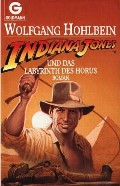
Indiana Jones
The Labyrinth of Horus
Novel
Written by Wolfgang
Hohlbein
Cover by Oliviero Berni
1993
(Page numbers come from the
Kindle digital English edition
of Indiana Jones
and the
Labyrinth of Horus,
1st printing, 2013)
|
A fellow professor who once saved Indy's
life now needs help on the quest of a lifetime.
Notes from the Indiana Jones chronology
This novel takes place in
May-June 1941.
Didja Know?
This is a study of the German novel Indiana Jones
und das
Labyrinth des Horus (Indiana
Jones and the
Labyrinth of Horus). This study is based on
the English translation by Icybro.
This novel does not have labeled chapters.
Notes from
The Lost Journal of Indiana Jones
The Lost Journal of Indiana Jones is a 2008 publication
that
purports to be Indy's journal as seen throughout The
Young Indiana Chronicles
TV series
and the big screen Indiana
Jones movies. The publication is also annotated with notes
from a functionary of the
Federal Security
Service (FSB) of the Russian Federation, the successor
agency of the Soviet Union's KGB security agency. The KGB relieved Indy of his
journal in 1957 during the events of Indiana
Jones and the Kingdom of the Crystal Skull.
The notations imply the journal was released to other
governments by the FSB in the early 21st Century. However, some
bookend segments of The
Young Indiana Chronicles
depict Old Indy still in
possession of the journal in 1992. The discrepancy has never
been resolved.
The journal as published does not mention the events of this
novel, going from
entries about the events of
The Fate of Atlantis in
May 1939 to Indy's time working with Colonel George "Mac" McHale
during 1944. A five year gap seemingly left un-journaled.
Story Summary
The story opens in Casablanca in 1941
with Indy fleeing through crowded streets in a battered truck
while pursued by armed desert warriors after stealing a sacred
golden artifact known as the Face of the Goddess Mohk. The chase
is chaotic and violent before Indy barely reaches a departing
ship at the harbor. There he reunites with his pompous academic
associate, Mr. Grisswald, who criticizes Indy’s recklessness and
sense of responsibility. Indy reveals that he successfully
recovered the artifact for their expedition but abruptly
abandons the voyage, diving into the harbor to flee the ship and
swim back to shore to find alternate transportion to Istanbul
after receiving an urgent summons by telegram from his former
mentor, Professor Basil Smith.
The journey to Istanbul is difficult
because of the WWII raging across the Mediterranean. It is
revealed that Basil Smith once saved Indy’s life years earlier
during an expedition in Yucatán, creating a deep sense of
loyalty between them. Smith later became a famous archaeologist
but had recently disappeared from public attention after a
series of failed and financially disastrous expeditions.
When Indy arrives in Istanbul, he visits a
shady antiquities dealer named Yassir Al-Kassah, an old
acquaintance who still resents Indy for exposing one of his
illegal operations years before. Al-Kassah explains that Smith
had recently been in Istanbul searching for what he described as
the greatest archaeological discovery in history, supposedly
somewhere in Egypt. Smith had been studying ancient writings
connected to Herodotus and references to a gigantic lost
labyrinth. Al-Kassah repeatedly extorts Indy by forcing him to
buy worthless artifacts and trinkets in exchange for
information, and the meeting eventually erupts into violence
when the dealer tries to trap Indy using armed guards. Indy
escapes after another frantic chase through the city.
Indy eventually locates the hotel suite
where he expects to find Basil Smith, only to discover he has
been lured into a staged ambush. He defeats two hired attackers
and meets Smith’s children, Raymond and Liz. Raymond is awkward,
excitable, and obsessed with archaeology, while Liz is
intelligent, sharp-tongued, and openly skeptical of Indy. The
siblings confess that Basil Smith has disappeared and that
British officials informed them he died during a military
operation in Egypt. Refusing to believe he is dead, they forged
the telegram in Smith’s name because they believed only Indy
could help them find him. Although furious at being manipulated,
Indy agrees to help because of the debt he still feels he owes
Basil Smith.
The trio investigates Smith’s recent
activities and discovers that he had spent time studying ancient
manuscripts in Bursa. They visit the library of collector Pierre
Dumont, where they uncover writings attributed to Herodotus
describing a colossal labyrinth in Egypt larger than all the
monuments of Greece combined. According to the text, the
underground chambers of the labyrinth contain the grave of "the
last god to walk the earth." The writings also mention a pyramid
connected to the labyrinth and suggest that the chambers could
only be navigated using a floor mosaic located in the Palace of
Knossos on Crete. The discovery convinces Indy that Smith had
likely found genuine clues to the legendary structure.
Their investigation is interrupted by
mysterious bald monks dressed in orange robes who attack the
library. The monks murder Dumont and his servant before setting
the building on fire. Indy is wounded during a sword fight while
Raymond nearly causes disaster with clumsy attempts at heroism
involving a pistol. They barely escape the burning library with
several manuscript pages. The appearance of the monks introduces
a sinister new element to the mystery, especially because they
seem intent on destroying any clues connected to the labyrinth.
Back in Istanbul, Indy translates the
rescued manuscripts and learns more about the labyrinth. The
writings describe an enormous structure hidden near an ancient
city associated with crocodiles and connected to a hidden
underground chamber where a dead god lies buried. Indy concludes
that the floor mosaic at Knossos must contain the key to
navigating the labyrinth safely. The group then travels to Crete
during the German invasion of the island. Their arrival
coincides with anti-aircraft fire and airborne assaults by
German paratroopers. They survive a terrifying landing and
receive help from a Greek soldier named Dimitrios, who guides
them toward Knossos.
At Knossos they meet Professor Green, an
archaeologist who confirms that Basil Smith had studied one
specific floor mosaic intensely before disappearing. However,
before the group can fully examine it, the orange-robed monks
attack again. Indy discovers that the mosaic truly represents
the layout of the labyrinth, but the monks destroy it with
explosives before the group can preserve the information. Indy
is severely injured in the explosion and nearly dies. While
recovering, he learns that Raymond and Professor Green managed
to preserve older sketches of the mosaic, meaning the plans to
the labyrinth are not entirely lost.
As German forces overrun Crete, the group
attempts to escape the island. They survive bombardments, naval
attacks, and a desperate escape involving a hijacked glider and
aerial combat before eventually reaching Egypt. Once in Cairo,
they meet Sergeant Finnley of British intelligence, who has been
investigating Basil Smith’s disappearance. Finnley explains that
Smith had convinced the British Army to support an expedition
into the Sahara because the labyrinth supposedly possessed
strategic military value due to an underground water source.
Only one soldier from the expedition ever returned alive,
mentally shattered and obsessed with the name Horus. That
soldier was later murdered in a hospital before he could explain
what happened.
Finnley also reveals that Basil Smith
survived the expedition and later burglarized museums searching
for three ancient statues of the Egyptian god Horus, which were
supposedly required to open the labyrinth’s final chamber. The
orange-robed monks appear connected to these same artifacts and
have already stolen one of the statues from another museum.
Shortly afterward, Liz briefly encounters her father alive in
Cairo. He appears exhausted, frightened, and emotionally
distant, carrying a small Horus statue beneath his coat. He
tells her to meet him the following morning at the Great Pyramid
before disappearing again into the city.
When the group arrives at the Great Pyramid
the next morning, Indy discovers Basil Smith dead at the summit
with the Horus statue beside him. No clear cause of death can be
determined. After the funeral, Finnley shares Smith’s notebook,
which confirms that the professor really did locate the
labyrinth and entered its underground chambers. The notes
explain that the final chamber could only be opened using three
specific Horus statues, one located in Cairo, another hidden in
the Valley of the Kings, and a third located in Khartoum.
However, the most important pages describing what happened
inside the labyrinth have been torn out.
The group enters the Valley of the Kings
near Luxor. Guided by Smith’s notes, they discover a hidden
chamber containing hieroglyphics referencing Horus and a recess
where one of the statues had once been stored. Evidence shows
that the orange-robed monks reached the chamber before them and
stole the artifact. Indy and the others realize they are racing
against a secretive religious order that seems determined to
protect the labyrinth and whatever terrifying secret lies buried
within it.
The group sets out into the Sahara to find
the labyrinth. They unexpectedly come upon a fortrees-like
structure which Indiana infiltrates and discovers is the monks'
hidden monastery. There he discovers the remaining Horus
statues, but he and his companions are captured. The monks
explain that Basil Smith betrayed their trust, murdered one of
their brothers, and forced his way into the labyrinth. They
believe the final chamber contains the dormant power of Horus,
and that opening it would unleash catastrophe upon humanity.
Before the monks can execute Indy and the others to protect the
secret, British soldiers suddenly storm the monastery and
massacre many of the monks. These soldiers turn out to be
survivors of Basil’s original expedition, now acting under his
influence.
The group is then brought to the labyrinth
itself, where Indy discovers that Basil Smith is alive after
all. Basil reveals that he deliberately manipulated everyone
into gathering the three Horus statues for him. He possesses
disturbing supernatural powers, including the ability to
mentally dominate the surviving soldiers. Basil believes he is
destined to resurrect Horus and gain ultimate knowledge and
power. Indy realizes that the labyrinth has corrupted Basil’s
mind completely.
The climax occurs at the sealed final
chamber deep within the labyrinth. Basil opens the chamber using
the three statues, unleashing an ancient supernatural force. He
undergoes a horrifying transformation as the spirit or essence
of Horus attempts to take over his body. The process goes wrong
because Indy had secretly substituted one of the real Horus
statues with a replica from the museum. As a result, the
resurrection fails. Horus cannot fully enter the world and
becomes trapped behind the closing doorway, disintegrating while
screaming in rage. Raymond, who had secretly been assisting his
father all along, dies in the process.
In the aftermath, Indiana and Finnley
escape the collapsing labyrinth with the wounded Liz. The
surviving monks reclaim the statues, and Indy promises never to
reveal the labyrinth’s secrets to the world. The novel closes
with Indy reflecting that what they experienced was less an
archaeological expedition and more a nightmare involving ancient
forces humanity was never meant to awaken.
Characters appearing or mentioned in this story
Casablanca citizens and tourists
Indiana Jones
Bedouins
Rick Blaine (mentioned only)
street musicians
customs officer
telegram boy
Dr. Grisswald
Dean of Barnett College (mentioned only)
Professor Basil Smith (dies in this novel)
Istanbul street urchins
Istanbul taxi drivers
Yassir Al-Kassah
Regency porter
Regency page
Regency guest
hired goons
Raymond Smith
(dies in this novel)
Elizabeth "Liz" Smith
waiter
British Embassy attaché
monks
Pierre Dumont
(dies in this novel)
Yusuf the house servant (dies in this novel)
Henry Jones, Sr.
(mentioned only)
Yusuf (cousin of the Regency porter, pilot)
Dimitrios (dies in this novel)
Greek soldiers
Greek military officer
Greek commander
British soldier
German soldiers
Mira
Professor Green
Knossos monk
Cretan doctor
glider pilot
Heinrich (mentioned only)
Sergeant Finnley
Sergeant Willard
(mentioned only)
British soldier from Smith's expedition (mentioned only,
deceased)
Bates
Egyptian Museum employee
Suleiman
Didja Notice?
The novel opens in
Casablanca,
Morocco, with Indy fleeing in a truck from the mounted warriors
of a desert tribe (later revealed as Bedouin) from whom he has stolen
the Face of the Goddess Mohk, a gold death mask with eyes made
of rubies. It is noted that he feels no guilt about the theft, as
the tribe ancestors had plundered it from a temple of the burning
city of Timbuktu generations ago. The relic appears to be
fictitious, as does the goddess associated with it. Timbuktu is an
ancient city in Mali. The
Bedouin are an Arab ethnic group, formerly mostly desert nomadic
tribes, now mostly settled. At the time of this story there would
still have been numerous Bedouin tribes roaming the Sahara desert.
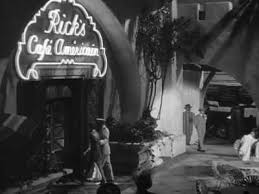
| On page 7, Indy's truck zooms past
some workers carrying a barrel of liquor into a bar called
Rick’s Café Americain. This is the bar that appears in the
1942 film Casablanca, owned by Rick Blaine,
portrayed by Humphrey Bogart. |
 |
On page 9, one of the pursuing desert warriors jumps from his
horse onto the side of Indy's truck and begins moving towards the
cab, pulling himself from beam to beam along the outside of the
truck. Indy thinks the guy had obviously seen one too many pirate
movies with Errol Flynn. Of course, Indy pulled this same stunt on a
Nazi truck in
Raiders
of the Lost Ark. Errol Flynn
was a popular film actor from 1933-1958, known for his
swashbuckling, sword-wielding roles.
Also on page 9, a fat Arab woman carrying laundry leaps back from
the path of Indy's barreling truck in "a long jump worthy of the
Olympics."
The modern Olympic
Games (inspired
by the ancient Greek Olympics c. 776 BC - 393 AD) began in 1896,
featuring amateur athletes engaged in numerous sports competitions
in representation of their home countries.
Page 12 states that Indy's fedora is of leather, but most sources
state it to be a felt fedora, as most fedoras are.
Page 15 states that Casablanca was seen as a neutral and
relatively safe haven during the war that was raging with intensity
in other parts of North Africa and throughout the Mediterranean. In
the real world, this is largely a myth embraced in the modern day, spread by
the popularity of the movie Casablanca. France had fallen to German
occupation in 1940, so the French territory of Morocco was
controlled by Vichy France,
the collaborative role of the nominal
government of
Vichy, France
with the German occupiers in WWII, though the city of Casablanca
itself tried to maintain
some degree of autonomy.
Also on page 15, some Arab street musicians are performing
versions of "In the Mood" or "Lili Marleen" to earn a few coins. "In
the Mood" is a big band song from 1939, popularized by American band
leader Glenn Miller. "Lili Marleen" is a 1939 German love song based
on a 1915 poem by Hans Leip.
On page 20, a boy who is a member of the
street musician troupe, asks Indy if they can play a song for him,
such as the American national anthem. Indy gives the kid a dime and
asks instead for the French anthem, "Marseillaise", in order to
distract the French customs officials who are barring his entry to
the passenger liner at the harbor. "Le Marseillaise" was written in
1792 by Claude Joseph Rouget de Lisle after the declaration of war
by France against Austria. It was adopted as the French national
anthem in 1795. The American national anthem is "The Star-Spangled
Banner", from the 1814 poem "The Defence of Fort M'Henry" by Francis
Scott Key and adopted as the national anthem in 1931.
The street band halts its performance of "I’m
Dreaming of A White Christmas" to play the anthem. While often
referred to as such, this song's actual title is just "White
Christmas". But it was not released until July 1942, so they
couldn't be playing it at the time of this story.
Indy reunites with Dr. Grisswald aboard the passenger liner.
Grisswald was introduced in passing in
The Legacy of Avalon
as the Dean of Barnett College. Yet, here, he is described as an
associate of the dean of the college, rumored to be the leading
candidate for the next dean.
On page 26, Indy is said to be carrying a
Colt pistol on
his Moroccan adventure. He loses it in the harbor waters in an
entanglement with a Bedouin while hanging from the railing of the
passenger liner in his attempt to board. Later on, he somehow
acquires another Colt, a 1911 A1.
On page 27, Indy thinks of Washington and how people in power
often take out their failings on underlings who had nothing to do
with it. He is thinking, of course, of
Washington, D.C.
On page 31, Indy receives a telegram from the
University of
Washington.
Indy dives off the ship to swim back to shore to book passage to
Istanbul at
the telegram request of his friend Professor Basil Smith, who
reminded him of the promise he made in Yucatan.
Yucatan is a state on the Yucatan peninsula of Mexico.
On page 31, the
Bosphorus Strait connects the Black Sea to the Sea of Marmara
through the Turkish city of Istanbul.
The country of Turkey was neutral through most of WWII, as
implied here.
Page 38 states that Indy had once been to Istanbul years
ago, long before the outbreak of the war. But in the PopApostle
chronology, he has been to the city several times in
The Secret City,
"Mask of Evil",
The Emperor's Tomb, and
The Staff of Kings.
Seeing Indy for the first time in years on page 40,
Yassir Al-Kassah exclaims, "By all the jinn
and spirits of the desert!"
A jinn (or djinn)
is a supernatural being of Arab folklore, also known as a genie.
Yassir Al-Kassah's fuller greeting to Indy is a bit reminiscent
of the one Han Solo (also portrayed by Harrison Ford) received from
Lando Calrissian on Cloud City in Star Wars: The Empire Strikes
Back.
Lando Calrissian: "You slimy, double-crossing no good
swindler! You've got a lot of nerve coming here after what
you pulled!"
Yassir Al-Kassah: "You ill-bred son of a mangy hyena! You
worthless descendant of a shabby sand flea! Let the vultures
pick
the flesh from your bones and leave the rest to the worms!
That you actually have the audacity to show your face again!
I should have you skinned alive. But that would be an
insufficient punishment, after what you pulled!" |
On page 42,
Yassir refers to "peace-loving citizens" as if he were one of
them, prompting Indy to think, If Al-Kassah was referring to
himself, Attila was a pioneer of Social Democracy. Indy is
presumably thinking of Attila the Hun, a notorious and brutal 5th
Century warlord.
On page 48, Al-Kassah tells Indy that Smith had supposedly found
some evidence in Bursa of unbelievable treasures in Egypt, if only
he could get funding for an expedition.
Bursa is the
fourth most populous city in Turkey.
On pages 54-55, Indy visits a number of world class hotels in
Istanbul, searching for Smith: Marriott, Regency, Astoria, Sheraton,
Admiral, Excelsior, Abu Simbel, and Hilton. These are all real world
hotel chains, but Marriott and Regency did not exist at the time,
and others did not have locations in Istanbul in 1941.
On page 55, the
Ku Klux Klan is an American far-right extremist organization that
promotes ideas of white supremacy and anti-immigration, among other
concepts of intolerance.
On page 57, Indy wonders if the
perfume of the elderly female guest at the Regency violated any
number of chemical weapons bans. Various types of chemical weapons
have been banned under various treaties since 1925, in response to
their use in WWI.
Raymond tells Indy he's studying archeology at
Trinity
College in
Oxford.
On pages 71-72, German Field Marshal Rommel, the Desert Fox, was
a real world figure who led forces in northern Africa from 1941-43.
On page 73, Crete is one of the Greek islands of the
Mediterranean. It was the center of the Minoan civilization from
2700-1402 BC.
Liz mentions that she thinks her father was particularly
interested in the writings of Herodotus. Herodotus was a real
historical figure in ancient times (BC) who wrote the 9-volume
The Histories. Raymond goes to say that Herodotus traveled the
known world (mostly true) and that he met the historical figures
Croesus, Cyros, Darius, and Xerxes (not true, as
Croesus and Cyros died decades before he was born, and he would have
been extremely young to have met Darius and Xerxes, though he did
write about all these figures based on oral traditions,
documentation, and observations from his travels).
At the hotel restaurant, Raymond orders a plate of spinach,
saying, "The perfect food for all real
men. Spinach is strength!" and Indy thinks he's seen too many
cartoons. He is thinking of the Popeye the Sailor cartoons
produced by Fleischer Studios from 1933-1942. The character of
Popeye was known for eating spinach to boost his strength.
On page 81, Anatolia is the West Asian peninsula bounded by the
Mediterranean Sea, the Aegean Sea, the Turkish Straits, and the
Black Sea, making up the largest part of the land of Turkey.
On page 83, Dumont tells Indy and Raymond that the collection at
his library included copies, not originals, of documents written by
Livy, Plato, Strabo, and Diodorus, plus Herodotus. These were all
historians in ancient times.
On page 85, Assyria was a major Mesopotamian civilization from
the 14th to 7th centuries BC.
Finding Herodotus' travel book on Egypt, Indy reads of a
labyrinth in the desert on the edge of Moiris Lake, near a city
named for the crocodile. Herodotus did actually describe
Moiris Lake as having a vast labyrinth nearby of around 3,000
rooms. Moiris Lake is a large freshwater lake
about 25 miles west of the Nile River in Egypt. The Greek settlement
of Crocodilopolis along the Nile that Indy is reminded of was an
actual ancient settlement near what is now the city of Faiyum.
In later discussion with the kids, Indy says that no one
knows where the ancient Moiris Lake was
located. What is widely considered to be the much smaller
remnants of the lake are known today as the hypersaline Lake Qarun.
On page 103, Raymond remarks that whoever rediscovers the
labyrinth will be a second Schliemann.
Heinrich Schliemann (1822-1890) was a German amateur archeologist
who excavated the ground of what is now believed to be the site of
the ancient city of Troy.
Indy guesses that the desert referred to
as the location of the labyrinth is the Sahara. The Sahara is a
desert in northern Africa, the largest hot desert in the world (only
the frozen deserts of Antarctica and the Arctic being larger).
On page 104, Indy reflects on having gazed upon the surface of
the Ark of the Covenant and held the Holy Grail. These reflections,
of course, refer to
Raiders
of the Lost Ark and
The Last Crusade.
The text on page 104 also comments, "In
recent years, he [Indy] had more than once come into
contact with ancient artifacts, which often served forces far beyond
human comprehension. And if the legends and lore were to be
believed, they were all ultimately the legacies of ancient gods, in
one way or another. But if so, they were mostly disastrous legacies,
two-faced objects that promised both power and terror, like
Pandora’s Box. But mankind was not ready for such mysteries, and
perhaps never would be. Often, it was all Indy could do just to
prevent such objects from falling into the wrong hands."
"Pandora's Box" refers to the Greek myth of Pandora, the first woman
on Earth, given a box (or jar) by the Olympian gods and told never
to open it. Her curiosity got the better of her and she opened it
anyway, releasing all the evils of the world (similar to the Bible's
story of Eve and the forbidden fruit). The term "Pandora's Box" has
come to stand for any seemingly small action performed by a person
that results in widespread negative consequences.
On page 105, Liz refuses to believe
there is a god buried in the labyrinth as stated in the copy of
Herodotus' writings, adamantly stating, "If anyone’s buried there at
all, it’s just a regular man. Men throughout the ages have
convinced others to worship them as gods. I think there might even
be one in Germany right now." The man in Germany she refers to is
presumably Adolf Hitler, the evil Chancellor of Germany from
1933-1945.
Page 106 refers to Indy's teaching job being in Washington
(D.C.), but he never taught there as far as is known in his
timeline. At this time, he was teaching at the fictitious Barnett
College in Fairfield, New York. Indy refers to his "university in
Washington" on page 137 and, obliquely, on page 247, as well. And so does Sergeant Finnley on page
204.
On page 106, in Herodotus' writings, he wonders if there is more
in the labyrinth's underground chambers than in those of the Palace of
Knossos.
Knossos is
a Bronze Age archeological site from the Minoan civilization on the
island of
Crete. It is known in
Greek mythology as the site of an underground labyrinth hosting the
minotaur. Indy
previously visited Knossos in 1936 in "The
Grecian Earn" and in 1939 in
"The Fate of Atlantis" Part
3.
Herodotus' writings say that the
pyramid at one corner of the labyrinth is 40 fathoms high. Raymond
then remarks "a seventy- to one-hundred-and-twenty-meter-high
pyramid,
depending on how you measure a fathom." The unit of measurement
known as a "fathom" has never been officially standardized
internationally. Historically, it was simply the length from
fingertip-to-fingertip of a man's outstretched arms. Since men come
is different sizes, this was an imprecise measurement. From the 12th
Century onward, the British imperial fathom has been established as
6 feet.
On page 107, Raymond asks if Herodotus could be referring to Lake
Chad when he described the immense Lake Moiris. Indy thinks it
unlikely, since Herodotus would have been referring to an Egyptian
lake. Lake Chad is a freshwater lake at the four
corners junction of the north-central African nations of Chad,
Cameroon, Niger, and Nigeria.
The floor mosaic at Knossos that Indy describes on page 108 that
maps the infamous Knossos labyrinth is fictitious as far as the
normal sense of the terms "map" and "labyrinth". It's mostly a
romantic idea inspired by the later mythology of the Knossos
labyrinth and its minotaur.
Indy's estimate of about 500 miles between Istanbul and Crete on
page 110 is a fair one. As the crow flies, it would be about 445
miles over land and ocean.
The invasion of Yugoslavia by Germany and speculation about an
invasion of Crete on page 110 is true to what actually happened at
this time. In fact, the Battle of Crete began on May 20, 1941, the
day Indy and friends arrive at Crete here in the novel.
Oddly, this novel has two characters named Yusuf. The first is
the house servant of Pierre Dumont in Bursa and is killed by the
monks at the house before any of our main characters meet him. The
second is the seventh cousin of the porter at the Regency Hotel
in Istanbul.
Yusuf attempts to land his plane carrying Indy and friends at
Maleme Airport on Crete. This is a real
airfield.
On page 134, Dimitrios lends Indy and his charges a Jeep to
escape the airport. This would have been an American Bantam Jeep,
made in 1940.
Dimitrios tells Indy that the news on the radio is that German
troops are in
Rethymnon and
Heraklion
and that the archeologists pulled out of the Knossos dig site when
the situation on Crete started to worsen, but he has heard that a
few professors may still be in a nearby small village called
Warwari. This appears to be a fictitious village.
The small, clay farmer's hut owned by the old woman who is
hosting Professor Green is adorned with hand-carved Madonnas.
"Madonna" refers to the Virgin Mary in Christian belief.
Professor Green tells Indy he came to Knossos from
Athens after
the local British School took over the excavation. By "British
School", Green is likely referring to the
British School at
Athens, a British International Research Institute of the
British
Academy, which has a branch at Knossos.
Green goes on to say that in the early years, he had the
honor of working with Sir Arthur Evans who discovered the palace at
the turn of the century, but who had to return to England for his
health in 1934. This is largely true, though it is an exaggeration
to suggest that Evans returned to England for good in '34. He
remained involved in Knossos both remotely and on site well into the
1930s, though his age reduced his physical involvement at the dig
sites.
Green has been listening to the radio news and learned that a
British brigade in Alexandria wiped out a convoy carrying supplies
for the airborne troops.
Alexandria
is a major port city of Egypt on the Mediterranean about 200 miles
southeast of Crete. While officially neutral, Egypt was essentially
in the pocket of Britain during the war.
Green remarks that if he were twenty years younger he would
go with Indy and his charges in their search for the missing Basil
Smith and the Horus labyrinth. At this, Indy inwardly wonders if
one day he would feel like the time had come when he was too old and
frail for the adventures that were up to now an indispensable part
of his life. Of course, we know that while he does slow down a bit
in his later years, Indy continues to get caught up in adventures
into his 60s and at least one adventure (The Dial of Destiny)
when he was 70.
The description of the controversial nature of Arthur Evans' work
in Knossos on pages 144-145 is accurate.
On page 145, Green explains that the locals around the Knossos
palace lost interest since there's no work to be done anymore with
the archeologists gone and they now find it uninteresting. Liz
remarks that she can sympathize. To this, Raymond grouses,
"Philistines!" "Philistine" is a term used to insinuate a person is
deficient in the liberal arts culture.
On page 152, Raymond is said to ridiculously imitate Edward G.
Robinson by pulling out his gun. Edward G. Robinson (1893-1973) was
a popular American screen actor in the 1930-40s, known for playing
gangsters.
On page 157, Indy reflects on Nietzsche's words, "What doesn’t
kill us, makes us stronger." Friedrich Nietzsche (1844-1900) was a
German philosopher. In his 1888 work
Twilight of the Idols and later in Ecce Homo: How One
Becomes What One Is he wrote, "Out of life's school of
war—what doesn't kill me, makes me stronger."
After the explosion at the palace site, Indy is unconscious for a
few days and awakens in bed in Mira's hut with a doctor looking
after him, feeling extreme pain whenever he tries to get up. Indy
painfully reflects on that he had done to himself over the last
few minutes a Thai torturer could
not have done better, the pain taking forever to decline enough to
allow rational thought. The nation of Thailand underwent a
revolution in 1932 that deposed the absolute monarchy, but led to
the rise of authoritarian military leadership and the use of harsh
interrogation techniques and even outright torture at times of
criminals and political dissidents in the 1930s and 40s.
On pages 164-165, Indy rewrites a passage of the Book of
Revelation in his mind: "And I looked,
and beheld! A fourth horse, and its rider bore the name of Raymond,
and the power was given unto him to annoy people and to banish peace
from the earth..." The Book of Revelation in the Christian
Bible foretells the coming of an apocalypse, which it describes
as the complete and final destruction of the world. The original
quote from Revelation is: "And I looked, and behold a pale
horse: and his name that sat on him was Death, and Hell followed
with him. And power was given unto them over the fourth part of the
earth, to kill with sword, and with hunger, and with death, and with
the beasts of the earth."
On page 167, "Mussolini" was the fascist ruler of Italy from
1922-1943.
Page 170 mentions that all three airports on Crete were now
firmly in German hands. Crete did, in fact, have three airports in
1941, Maleme, Heraklion, and Rethymno.
On page 171, Indy spies a German aircraft on the Heraklion field,
a DFS-230, a model he does not recognize. This was a transport
glider used by the Germans during the war. Indy soon sees the
aircraft being towed for launch by a Ju 52. This is a German
transport aircraft manufactured by Junkers; it is one of the airplanes
that was typically used to tow a DFS-230. This combination was used
in reality quite effectively by the Germans in the Battle of Crete.
When Indy punches the glider pilot on page 179, he finds it is
like hitting the Wailing Wall.
The Wailing Wall is a retaining wall on the Temple Mount of
Jerusalem built in 19 B.C., with successive layers added in the
following centuries. The Wailing Wall is but one of many names
applied to it, in this case for the Jewish practice of coming to the
wall to mourn the destruction of the ancient Temple that was there.
As the battered glider dives towards
the sea on page 192, Raymond finds only two parachutes for the three
of them, plus the German pilot, and Indy determines "it simply had
to be enough...he had made do with far less in similar situations
before — one time, with a self-inflating raft." The use of a self-inflating raft in lieu of parachutes incident occurred in
The Temple of Doom, when
he saved his own as well as Short Round and Willie Scott's lives
by baling out of Lao Che's transport plane on top of the raft with his two
companions.
After being fished out of the Mediterranean by the British Navy,
Indy and his charges are taken to
Cairo, Egypt.
On page 210, Finnley reports on a British soldier who was found
badly dehydrated and insane by a caravan near
Luxor.
On pages 210-211, Raymond explains to Liz that Horus was an
ancient Egyptian deity and that tradition has it that he may have
been one of the first rulers of Egypt. Horus was the hawk-headed god of the sky
and of protection; he was the son of the original gods, Osiris and
Isis.
Finnley gets Indy and his charges rooms at the Cleopatra Hotel in
Cairo. This appears to be a fictitious hotel for the time, though a
hotel by that name has been there since 1962.
On page 216, Finnley informs Indy that he's just been told that
the Cairo National Museum was broken into last night by Basil Smith.
There is no Cairo National Museum, though it seems Finnley may be
using a common name for the
Museum of
Egyptian Antiquities, from the
description of it on page 217 as "a T-shaped building...just a few
steps away
from the eastern bank of the Nile — just across from the island of
Gezira with its magnificent gardens."
After having accidentally bumped into her missing father near the
Cleopatra Hotel, Liz tells Indy she is to meet her father at the
foot of the Great Pyramid of Giza. The
Great Pyramid, is the largest of the pyramids on the
Giza Plateau, said to have served as the tomb of pharaoh Khufu
(Cheops). Indy inwardly scoffs at the idea that the pyramid was
built by Khufu, but the text doesn't explain why. While some few
researchers have tried to claim the pyramid is far older than the
time of Khufu and he just "inherited" it, mainstream scholars argue
the evidence is weighted towards the time of Khufu.
Page 231 describes the nose of the
Great Sphinx of Giza as having been blown off by the target practice
of thoughtless and unscrupulous Mamluks in the 14th century, and
not, as was often claimed, by cannon fire during the Napoleonic
campaign in Africa. The Napoleon explanation is a popular
tale that is demonstrably untrue since there are paintings and
writings from well before his time that depict the nose already
missing. Napoleon, of course, was the high
general, First Consul, and Emperor of France from 1799-1814.
The explanation for the damage presented here, that it was done by
the Mamluks, is one of the theories, but there is no proof of
exactly what happened and who might be at fault.
When Liz erroneously refers to the Sphinx as "she", Raymond tells her
that only the Greek sphinxes were female, this one is male.
In Ancient Greek mythology, a sphinx referred to a
female of the creature, androsphinx
a male.
On page 232, Finnley assures Liz that her father doesn't know him
from Adam. This idiom is often used to emphasize that someone cannot
be expected to trust or know you because you have no prior
acquaintance. "Adam" refers to the Biblical Adam, the first man, who
lived so long ago in history that no one would recognize him if he
were seen today.
Harun al-Rashid, caliph of the Abbasid Caliphate from 786-809 CE,
ordered an entrance cut into the Great Pyramid (around 820 CE), just
as stated on page 234.
On page 235, St. Elmo's Fire is an electrical weather phenomenon
that is known to create a glowing plasma field around a grounded
object.
Believing he sees Basil at the top, Indy climbs the stones of the
Great Pyramid, careful of his footing as there had been dozens of
people who tried to climb to the top, only to fall to their deaths.
Climbing the pyramid was relatively common by tourists in the 19th
and early 20th centuries due to loose control of the site, and a
number of falls and fatalities are known to have occurred.
Page 238 mentions that when separated from his beloved usual
outfit, Indy turned into an average, almost shy man, exuding about
as much flair as an adventurous teller at the
Bank of
England.
At Basil's funeral on page 239, a Coptic priest delivers a short
eulogy. The
Coptic
Orthodox Church is the largest Christian church in Egypt and the
Middle East.
Basil's research indicated he needed three specific statuettes of
Horus to enter the final chamber of the labyrinth. The first one was
the one located in the museum in Cairo, a second in a grave chamber
in the Valley of the Kings, and the third in a museum in Khartoum.
The Valley of the Kings is a real world archaeological site where
the Pharaohs of the Egyptian New Kingdom (16-11th Centuries BC) were
entombed. Khartoum is the capital city of
Sudan.
On page 248, Indy remarks that he dreads to
think what the Nazis would do with what they might find in the
labyrinth, and goes on to say, "A couple of times I’ve been able to
prevent such barbarism, but just barely." By "a couple times" he is
probably referring to the events of
Raiders
of the Lost Ark (1936) and
The Last Crusade
(1938), though he has also encountered and obstructed them a number
of other times since first encountering them in 1930 in
"The Viking Scroll".
As stated on page 253, Ramses, Thutmose,
Amenhotep, and Tut-ankh-Amun were all Egyptian pharaohs whose mummies
were buried in the Valley of Kings.
On page 254, the statement that, in the
Middle Ages, the grinding up of mummies into powder to render a
miracle cure is true of the time.
The Necropolis of Thebes mentioned on page
254 is the larger ritual burial place of Ancient Egypt, encompassing
the Valley of Kings, Valley of Queens, and more. Thebes is the
ancient name for the modern city of Luxor.
On page 256, Liz peers into the necropolis
tunnel "as if into the depths of the Ganges." The Ganges is a river
in India and Bangladesh, considered the most sacred of the rivers in
Hinduism.
| On page 257,
Indy sees repeated hawk symbols in the hieroglyphics of the
tablet in the recently-opened chamber as the mark of Horus.
Horus' name in hieroglyphics was represented by: |
 |
On page 259, the ancient stone tablet discovered by Napoleon's
soldiers (in 1799) is the stele known as the Rosetta Stone.
Indy interprets an Egyptian hieroglyph of a baboon-like creature
holding two long, slender knives in it's outstretched arms as
representative of "danger". But there is no known hieroglyph of that
design. Danger was usually represented by snakes, crocodiles, or
gods associated with disorder.
On page 263, near the monastery of the violence-prone monks, Indy
announces he's going to approach the monastery himself, telling a
concerned Liz, "Honestly, I don’t know what I’ll do next. I hardly
ever do." This would seem to be a play on his classic "I'm making
this up as a I go," line from
Raiders
of the Lost Ark.
On their expedition into the Sahara desert, Indy, Finnley, and
the kids have taken two Land Rovers.
Land Rover is
a British maker of 4-wheel drive vehicles. However, Land Rover did
not exist until 1948.
On page 275, Indy tries to swing on
his whip from a rafter beam to catch a monk off guard, but slams
into a pillar instead, leaving him with a throbbing head and the two
bruises, on his forehead and the back of his head, which his
unsuccessful Tarzan act had earned him. Tarzan, of course, is the
world-famous character created by Edgar Rice Burroughs in 1912, a
British boy who was lost in the African jungle and raised by apes,
known for swinging from vines in the jungle.
Page 277 reveals it was 16 years ago (1925) that Basil had saved
Indy's life in the Yucatan.
On page 287, the head monk tells Indy and his team, "Do you not
know the ancient prophecies, which say that Horus will rise again at
the end of time? He will soar up to become the ruler of the world,
crush the nations under his feet, and lead the people to eternal
damnation. And none will
oppose him! Thus it is written..." leading Finnley to offer that it
would be the Apocalypse. The Book of Revelation in the Christian
Bible foretells the coming of an apocalypse, which it describes as
the complete and final destruction of the world.
On page 315, Basil makes his soldiers dance the Kazachok. This is
a traditional Russian, Belarusian, and Ukrainian quick-paced folk
dance that originated with the 16th century Cossacks famed for
its squatting, fast-paced kicks (though the kicks are only a small
part of the entire dance movements).
Basil parts an opening in a stone wall of the labyrinth with a
mere gesture and exclaims, "Voilà!" This is French for
"So!"
Back to Indiana Jones Episode
Studies
