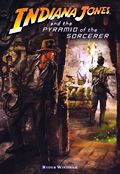
CHAPTER ONE
As the story opens, Indiana Jones is in Peru on an archeological
dig when a Quechuan porter brings him a wanted poster of Indy
himself that the man found hanging on a wall in town. The
Quechuan people are the indigenous of Peru.
The wanted poster says the Peruvian Museum Council has accused
Indy of being a huaqero (tomb robber). The
Peruvian Museum Council is a fictitious entity, soon revealed to
have been created by US Army Intelligence to bring Indy to
ground to recruit him for a mission.
Page 3 states that Peru and its neighbor Ecuador were at war.
This is true. In 1941, the two countries were engaged in a
border war from May-October, which ended with the Talara Accord
in October and the Rio Protocol that established formal borders
between the two nations in January 1942.
Page 4 states that Indy had hated snakes ever since he was 13
years old. This refers to the incident
on a circus train where he fell into a crateful of snakes in "The Cross
of Coronado" and the experience seemingly caused his
ophidiophobia (fear of snakes) from that time onward. But he had
also voiced a hatred of snakes when he was 9 years old in "My
First Adventure" (as
well as in a few other
Young Indy adventures).
Indy has discovered four small, gold
figurines in the Incan dig site representing the Mayan god
Kukulcan, the feathered serpent: a vulture, a lizard, a fish,
and an ear of corn.
Kukulcan is an actual deity in Mesoamerican culture. However,
there is no particular association of Kukulcan with the vulture,
a lizard, a fish, or corn.
Fleeing from the Peruvian soldiers, Indy decides to trek through
the jungle into Ecuador to the province of
El Oro
and then to
Puerto Bolívar, where he hopes to catch a ride on a banana
boat. Ecuador is the world's leading exporter of bananas.
CHAPTER TWO
On page 10, a Peruvian soldier tells Indy, "Vamos."
This is Spanish for "Come on."
On page 11, a soldier shouts, "Para!"
This is Spanish for "Stop!"
On page 13, gringo is a
term referring to any English-speaking foreigner in a Spanish
language country.
On page 18, "Fuego! Fuego!" is Spanish for "Fire!
Fire!"
|
In General Delgado's office, Indy is reintroduced to Colonel
Musgrove, who along with Major Eaton, had given Indy the
assignment to find the lost Ark of the Covenant for the
United States in
Raiders of the Lost Ark. |
 |
CHAPTER THREE
Page 28 reveals that Indy had occasionally hung out and spoke
with Sir Reginald Brooksbank at the Manhattan location of the
Explorers Club.
The Explorers
Club is
an international professional society of explorers and
researchers founded in 1904, currently with 34 chapters around
the world, including
New York City, of which Manhattan is a
part. In 1933, in
The Philosopher's Stone,
Marcus was said to want to introduce Indy to the club.
Musgrove informs Indy that the
mission this time is locating the Akashic Hall of Records, which
he says Brooksbank had discovered in Bimini.
In the religion of theosophy, the Akashic records are a
compendium of everything that has ever happened, is happening,
or will happen, to everything in the universe, living or dead.
Bimini is a chain of three main islands and several islets and
cays that together make up the westernmost district of the
Bahamas in the Caribbean Sea near Florida and Cuba.
Indy brushed up against an artifact called the Omega
Book in
Secret of the Sphinx,
an object which was
said to contain the records of every person on Earth from the
beginning to the end of humanity.
Page 31 has Indy thinking if there's one thing he hates more
than snakes, it was Nazis.
CHAPTER FOUR
Indy and company take what is said to
be a Douglas DC-2 to Panama for refueling and then to Costa
Rica. This was a real world airplane manufactured from
1934-1939.
When Indy sees that a projector and film reel has been set up on
the plane by Nichols and Musgrove for his viewing, he remarks,
"It better not be Gone With the Wind because I've seen
that one before." This refers to the 1938 historical romance
film starring Clark Gable, a blockbuster for its time.
The five headlines on pages 34-35 that Indy says were all events
that took place in May-June of that year are correct. Indy was
even present for the first one, the Battle of Crete in May in
the course of his adventure in
The Labyrinth of Horus.
Page 38 refers to Indy's association with Sophia Hapgood and
their discovery of the ruins of Atlantis in the
The Fate of Atlantis.
Musgrove asks Indy if he knows of any
connection between Atlantis and the Akashic Hall of Records and
Indy responds there is none he is aware of. In the fan-produced
(but excellent) novelization of
The Fate of Atlantis,
Sophia does mention to him that
Atlantean libraries did not contain books, but instead crystals
which can store untold volumes of information, referring to it
as the akashic record, a telepathic compendium of universal
knowledge, located in the Hall of Wisdom.
On page 39, Edgar Cayce and Charles
Webster Leadbetter (sic) are discussed. Cayce (1877-1945) was an
American clairvoyant and prophet who claimed the ability
to diagnose diseases in others and find recommended treatments
while he was asleep, which many of his supporters attributed to
an ability to access the Akashic Records.
Leadbeater (1854-1934) was a British author on occult subjects
and member of the
Theosophical
Society who also claimed to be clairvoyant and able to
access a non-physical repository of records that has widely come
to be associated with the Akashic Records concept.
Indy is correct on page 40 when he says the word "akashic" is
derived from the Sanskrit word "akasha" meaning "sky" or "space"
and was only coined in the modern era (by writers associated
with the Theosophical Society in the late 19th Century).
Also on page 40, the Library of Alexandria existed from roughly
the 3rd Century BC to the 3rd Century AD in the Egyptian city of
Alexandria. It was said to be one of the most significant
libraries in the world. Indy seems to be incorrect in saying
that it was established by Alexander the Great (356-323 BC), a
Macedonian king who ruled one of the largest empires of the
ancient world. The library is generally believed to have been
founded by Ptolemy I and established by Ptolemy II. The library
is believed to have been lost in stages over several centuries
through fire that destroyed records, war damage, and political
neglect over time.
Musgrove remarks to Indy that he seems to be dismissing the
Akashic Hall of Records as fantasy due to its association with
psychics, to which Indy responds, "Let me put it this way. I've
had some bizarre experiences, even a few things I would consider
fantastic...things I don't believe will ever be
explained by science. But when it comes to psychics, I can't
overlook the financial angle[...]Maybe it's just me, but until a
psychic can tell me exactly how I got this scar on my chin or
accurately predict the scores of the next World Series, I'm
going to assume every last one of them is a huckster." Indy's
chin scar, of course, was obtained when he amateurishly tried to
use a bullwhip against a lion when he was 13 years old in
"The Cross of Coronado".
The World Series is Major League Baseball's annual championship
series of games in the United States and Canada.
On page 41, Musgrove and Nichols play a film reel for Indy that
was made by his friend Brooksbank on July 26, 1941. This tells
us the events of this novel must take place post-July 26. Page 3
told us only that Indy was at the Peruvian dig site in late
July.
Pages 42-43 reveal, via Brooksbank's statements in the flim
reel, that Musgrove truly regrets what happened with his
agreement with Indy regarding the disposition of the Ark of the
Covenant (again, back in 1936 in
Raiders of the Lost Ark).
On page 43, Brooksbank, on the film reel, tells Indy how he got
the scar on his chin and that it was the same day he got his
hat. However, a young Indy was said to have given away his original
fedora to the child lama
Dentsen in
The Child Lama.
But, as PopApostle argued in that novel's study, it may be
that the sensitive lama came to realize how
important the hat was to the erstwhile adventurer and gave it
back to him at some point.
The information given on page 44 about the 1941 World Series is
correct.
The Brooksbank film tells Indy to go to Palmar Sur and find the
Three Sisters. Palmar Sur is a town in the Osa region of Costa
Rica. The stone spheres called the Three Sisters appear to be a
fictitious name, but many stone spheres ranging in size from about 3
cenitmeters to over 2 meters have been found in Costa Rica,
believed to have been made by the pre-Columbian Diquis culture from 300-1550
AD. The purpose of these spheres is unknown, but it has been
speculated that the different sized spheres may represent the
solar system or assorted nodes of the sun and moon, perhaps
aligned with roads and paths leading to the homes of chiefs.
On page 45, Amalgamated Fruit Industries is a fictitious company.
CHAPTER FIVE
On page 48, the United States Army Air Corps 32 Pursuit Group
was an actual air unit assigned to Rio Hato Army Air Base,
Panama to protect the Panama Canal Zone, just as stated here. It
was based there from 1940-1943. It is now known as the 32nd Air
Expeditionary Group of the U.S. Air Force in Europe.
Rio Hato Army Air Base is now the Scarlett Martínez
International Airport.
At
Rio Hato, Indy sees several Curtiss P-36s and
Boeing P-26
Peashooters parked at the airfield. These were actual American
fighter aircraft of the time.
CHAPTER SIX
On page 63, Nichols' use of "K.O." in a sentence would seem to
be a non-standard usage of abbreviation for "Commanding
Officer", which would normally be "C.O." It may be intended as a
clue that Nichols is not an American, but German, as he is later
revealed to be. In a German military context, "K.O."
could be shorthand for "Kommandierender
Offizier" (commanding officer).
Indy, disguised a U.S. Army sergeant, drives Musgrove and
Nichols off the base in a battered
Ford military
car to the nearby town of Santa Clara. Santa Clara is an actual
village about 5 miles from the former location of the base.
As Indy says on page 65, el Martillo is Spanish for
"the Hammer", the nickname of his friend who owns a cantina in
the village.
On page 66, Yanquis is Spanish for "Yankees", persons
from the United States.
CHAPTER SEVEN
On page 73, "Buenas tardes," is Spanish for "Good
afternoon."
Bert refers to the two men she hired to watch the place while
she was gone, Tomás and Geraldo, as "Tom and Jerry".
This is a reference to the cartoons about a cat, Tom, and a
mouse, Jerry, produced by MGM at various times since 1940.
Bert tells Indy that Palma Sur is
about 300 miles away. That is about the correct flying distance
from Santa Clara, Panama to Palma Sur, Costa Rica.
On page 83, Indy asks some laborers at AFI if the stories he'd
heard about the discovery of strange stone spheres were true.
The conversation then goes, "Sí." "Qué distancia hay a las
Tres Hermanas?" "No está lejos." This is Spanish for:
"Yes." "How far is it to the Three Sisters?" "It's not far."
On page 84, the ditched Musgrove and Nichols think Indy might
have headed for
Panama City, the capital of Panama.
CHAPTER EIGHT
Page 89 states that some people believed the stone spheres may
have gold or gems hidden inside and would drill or explode some
spheres open seeking the treasure, which was never found. This
is one early speculation about the stones that occurred.
Holding the small keystone near the last of the Three Sisters,
Indy is presented with a vision of a Mayan ziggurat.
"Ziggurat" is actually a term used for the somewhat pyramidal
structures built in ancient Mesopotamia. The Mayan pyramids of
Central America that are somewhat similar to ziggurats are
usually just referred to as pyramids or temple-pyramids.
Indy realizes that he recognizes the pyramid in the vision as
one that he'd read about a few years earlier involving
excavations made by the Danish archeologist Franz Blom. Franz
Blom (1893-1963) was a Danish explorer, archaeologist, and
writer best known for his work in Mesoamerica, especially among
the ancient Maya.
| Indy asks Bert to fly him to Uxmal
in the Yucatán, about 45 miles south of Mérida, so he can
see the pyramid from his vision, which he recognized as one
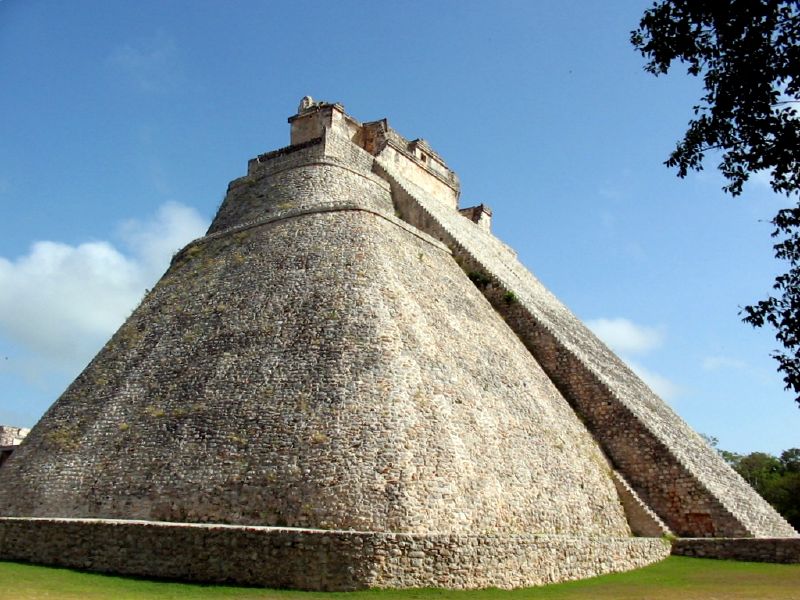
called the Pyramid of the Sorcerer. Uxmal is an ancient
Mayan city considered one of the most important
archeological sites of that culture and is a UNESCO World
Heritage Site.
Mérida
is the capital of Yucatán. The Pyramid of the Sorcerer is an
actual Mayan pyramid, but more commonly known as the Pyramid
of the Magician. |
 |
Indy's estimate that it is about 900 miles from Palma Sur to Uxmal
is correct.
Bert wants to know the truth about what Indy is doing flying all
over Central America with a wad a cash. She asks him to give her
the Reader's Digest version.
Reader's Digest
is a general interest magazine published in the U.S. and a few
other nations since 1922.
CHAPTER NINE
As part of their deception as a mail carrier and his fiance,
Bert decides to call Indy "Hank". Ironically, though she doesn't
know his real name is Henry, "Hank" is a common nickname for
"Henry".
CHAPTER TEN
Bert asks Indy who was the sorcerer of the
pyramid and he says it was said to have been a dwarf who built
it overnight. This is part of the legend of the pyramid.
Bert retorts that she bets the sorcerer didn't look
anything like Mickey Mouse in Fantasia. Mickey Mouse,
of course, is a cartoon character and official mascot of the
Walt Disney Company. Fantasia is a 1940 animated
musical anthology film which featured as one of it segments "The
Sorcerer's Apprentice" starring Mickey Mouse.
On page 119, looking at the Mayan ruins, Bert remarks that
they've let the place go to "H-E-double-toothpicks." This is a
more polite way of saying "hell".
On page 120, Indy tells Bert to go to the U.S. Consulate in
Mérida near the Parque del Centenario (Centennial Park). The
park Indy refers to is probably the Parque Zoológico del
Centenario, a park/zoo combination. Perhaps the
U.S. Consulate was close to it in 1941, but currently it is
about 5 miles away.
On page 125, Indy has a flashback vision of himself as a 6-year
old child when he and his parents lived in
Princeton, New Jersey.
Indy refers to his old friend Brooksbank as "Brookie".
CHAPTER ELEVEN
No notes.
EPILOGUE
Musgrove tells Indy that he believes it's inevitable that the
U.S. would be drawn into the war in Europe and he invites Indy
to work with Army Intelligence on an ongoing basis as that time
approaches. Indy says he'll think about it. This may be a
foreshadowing of work with the U.S. Office of Strategic Services
(OSS) as mentioned in The Kingdom of the Crystal Skull.
At the end of the epilogue, Indy gives Bert the note from
Brooksbank of the coming World Series scores so she can place
some bets for herself. He tells her he's not going to because "I
like the Dodgers too much." The note reveals that the New York
Yankees
will beat the Brooklyn
Dodgers
(now in Los Angeles) in the 1941 World Seres. When Indy was 8 years
old, his favorite baseball team was said to be the New York
Giants
(now in San Francisco).