 |
Indiana Jones
The Philosopher's Stone
Novel
Written by Max McCoy
Cover by Drew Struzan
1995
(Page numbers come from the mass
market paperback edition, 1st
printing, May 1995)
|
Indy attempts to translate the mysterious
Voynich Manuscript in order to find the fabled
philosopher's stone.
Read the summary of this novel at the
Indiana Jones Wiki
Notes from the Indiana Jones chronology
This novel takes place from March-May 1933.
Didja Know?
In this novel Indy has a position at
Princeton University.
Notes from
The Lost Journal of Indiana Jones
The Lost Journal of Indiana Jones is a 2008 publication
that
purports to be Indy's journal as seen throughout The
Young Indiana Chronicles
TV series
and the big screen Indiana
Jones movies. The publication is also annotated with notes
from a functionary of the
Federal Security
Service (FSB) of the Russian Federation, the successor
agency of the Soviet Union's KGB security agency. The KGB relieved Indy of his
journal in 1957 during the events of Indiana
Jones and the Kingdom of the Crystal Skull.
The notations imply the journal was released to other
governments by the FSB in the early 21st Century. However, some
bookend segments of The
Young Indiana Chronicles
depict Old Indy still in
possession of the journal in 1992. The discrepancy has never
been resolved.
The journal as published has a newspaper clipping taped
onto the page about Indy being wanted by the Honduran government
for the alleged theft of a "crystal quartz artifact" (the
Crystal Skull of Cozan) from an archeological site there. Indy
notes in an entry dated May 1933, that it is not a good start to
a new job, as he's moving back to Princeton "after all these
years" for a job he's been offered in the archeological
department of Princeton University. Yet, he previously had
worked for Princeton relatively recently in 1930 (The
Sky Pirates and The
White Witch).
There are approximately four pages missing from the journal
after this, with the next existing entries being from 1935 and
Indy's adventures as depicted in The Temple of Doom.
Characters mentioned in the journal, not in this episode
Dr. Jim Awe
Characters appearing or mentioned in this story
Indiana Jones
Bernabé
Sir Richard Francis Burton (mentioned only, deceased, historical
figure)
Tobias
(skeleton only)
Leonardo Sarducci
(dies in this novel)
Marco Volatore (dies in this novel)
flying boat pilot
flying boat co-pilot
Guatemalan revelers
Guatemalan girl
Marcus Brody
old woman
waiter
Harold Gruber
Penelope Angstrom
Agent Bieber
Agent Yartz
Major John M. Manly
Henry Jones, Sr. (mentioned only)
Hudson
York
Griffith
Dr. Charles Rufus Morey
Dr. Harold Dodds
(mentioned only)
Vilhjalmur Stefansson
Roy Chapman Andrews
(mentioned only)
Tommy Atkins
Roger Cadman
Benito Mussolini
Alistair Dunstin
(dies in this novel)
Italo Balbo
cabbie
Commander Alger Dresel
Crewman O'Toole
Macon crew chief
Mona Grimaldi
(mentioned only)
Mario Volatore (dies in this novel)
monoplane pilot
Sparrowhawk pilot
field operator
Alecia Dunstin
Edward Trimbly
Mr. and Mrs. Dunstin
(mentioned only, deceased)
Mrs. Grundy
(mentioned only)
Luigi Volatore
(dies in this novel)
atlantici
Alecia's neighbor couple
pub waitress
pub patrons
pub bully
garbage boat skipper
Snopes
motorboat driver
seaplane pilot
seaplane mechanics
Italian cab driver
Giuseppe Rinaldi
Caramia
Caramia's parents (mentioned only)
Caramia's ex-fiancé (mentioned only)
security guards
Sebastian
Nicholas Flamel
Perenelle Flamel
Mordecai Marlow
Ayesha Maru crew
Prince Farqhuar
bedouins
Sallah
tenente
Arcturus
American Museum acting director
(mentioned only)
Didja Notice?
This book is dedicated to the memory of Denholm Elliott
(1922-1994). Elliott is the actor who portrayed Marcus Brody
in Raiders of the Lost Ark and Indiana Jones
and the Last Crusade.
The book opens with two quotes from previously published
works. The first quote is, as stated there, from Hamlet
by William Shakespeare. The second quote, about the "true
students of noble alchemie", is attributed to the Vicar of
Malden here, but it's actual provenance seems unconfirmed,
as research indicates it attributed to a number of
different authors, and even to "anonymous".
Prologue: City of the Dead
The prologue takes place on March 31, 1933 in British
Honduras. British Honduras was a crown colony of the British
Empire in Central America from 1783-1981. It is now the
fully independent country of Belize.
As the story opens, Indy gazes at the emerging dawn between
two peaks of the Maya Mountains. This is an actual mountain
range in Belize and Guatemala.
Indy rediscovers the lost city of Cozán, previously
discovered and lost again by Sir Richard Francis Burton.
Cozán is a fictitious location, though possibly based on the
real world Copán, rediscovered around 1576 in Honduras
during the Spanish conquest of the Aztec Empire. Sir Richard Francis Burton
(1821-1890) was a famed British explorer and writer.
Burton's friend Tobias mentioned by Indy appears to be
fictitious.
Indy's Guatemalan guide,
Bernabé, thinks of him as a gringo. The term
refers to any English-speaking foreigner in Central America
(usually associated mostly with Mexico).
On page 2, Indy and
Bernabé are travelling along a sacbob through the
jungle. As noted in the text, this is an old Mayan road of
white stones.
On page 3, Indy and Bernabé traverse
the Street of the Dead in Cozán. The references to the
Street of the Dead and the Temple of the Serpent here make
it sound as if the fictitious Cozán is a stand-in for the
real world Mesoamerican city of Teotihuacan in Mexico.
Hearing howler monkeys in the near distance,
Bernabé tremblingly tells Indy that
they are the gods of writing and gatekeepers of the
underworld and that the souls of his people's priests came back as
howler monkeys. Howler monkeys were considered gods of
artisans, especially scribes and sculptors. I have not been
able to confirm the rest.
On page 10, Indy finds the skeleton of Tobias in his
Victorian era clothing. The Victorian era of England was
from 1837-1901, during the reign of Queen Victoria.
In the prologue, Indy carries a .38 caliber revolver.
Sarducci tosses it into the water of the cenote. Sarducci
himself carries a Mauser automatic pistol. Mauser was a
German firearms manufacturer founded in 1811 as Königlich
Württembergische Gewehrfabrik and went defunct in 2004,
spinning off into the two new firearms manufacturers, Mauser
Jagdwaffen GmbH for civilian weapons and Rheinmetall Waffen
Munition GmbH for military.
When Sarducci takes the crystal skull from Indy, he
pronounces it as being from an unknown civilization prior to
the Maya, one with superior skills to the Maya...and to our
own. This is quite similar to the pronunciation of the
crystal skulls that appear in the later Indy adventure,
The Kingdom of the Crystal Skulls. While there are real
world crystal skulls alleged to have been made by
pre-Columbian Mesoamerican civilization(s), modern
scientists and academics are extremely skeptical, with
research generally suggesting they were made in the
mid-1800s in Europe, when interest in relics from ancient
foreign cultures was very high.
Sarducci congratulates Indy on finally getting the respect
he desires, having attained a position at Princeton
University, an Ivy League school. The
Ivy League
is a system of private universities in the northeastern
United States, generally considered to be elite and
selective in admissions.
When Sarducci seems to admit to believing in the alleged
supernatural properties of the crystal skulls, Indy cracks
that he thought black magic went out with Paracelsus.
Paracelsus (1493–1541), was a Swiss alchemist, philosopher,
physician, and theologian of the German Renaissance. Some of
the skills he learned were considered "magic" by some who
lived at the time.
On page 14, Sarducci says, "Arrivederci,
Dr. Jones!" Arrivederci is Italian for "until we
meet again."
When Indy sees the 38-foot anaconda slithering behind Marco,
he yawps out, "Holy St. Patrick..." St. Patrick was a 5th
Century Irish bishop who has become known as the main patron saint
of Ireland. As far as the anaconda goes, the largest ever
found to date was about 29 feet.
The feeding habits of anacondas seem to be greatly
exaggerated here. The snake gulps down Marco in essentially
no time flat, then slithers into the water of the cenote
briefly and re-emerges "moving quickly", ready to make
another meal of Indy and
Bernabé. In reality, it would take about an hour or so for it to
swallow a large meal such as a person (or, more likely, a
ruminant or caiman) and it would only need to eat something
of that size around three times a year. After such a large
meal, it would be sluggish, not moving quickly.
Having survived their Cozán ordeal, on page 19 Indy and
Bernabé emerge from the jungle in San Pablo, Guatemala on
Thursday of Holy Week. This probably refers to the San Pablo
in Zacapa Department in Guatemala, as the closest to British
Honduras. Indy previously experienced part of Holy Week in
Rio de Janeiro in The
Seven Veils.
On page 21, Indy and
Bernabé witness a procession of Holy Week revelers acting out
scenes of Jesus, Judas, and the Roman soldiers. Indy is
confused that the crowd seems to cheer Judas, and
Bernabé explains that the mixture of Christianity and local
beliefs has Judas (the betrayer of Jesus) also assuming the
role of Maximón, a Mayan god who makes people fall in love.
This tradition in South America is essentially correct.
Chapter 1: Bits of Trash and Bone
As the chapter opens, Indy and Marcus are having a coffee at
the Tiger Coffee House across from the Princeton campus
while Indy reads the
New York
Times. Tiger Coffee House appears to be fictitious.
Marcus asks Indy what he knows about the
Voynich Manuscript and Indy says that, as he recalls, it is
currently on loan at the rare book collection at Yale. I've
been unable to confirm that the book was on loan to
Yale University
at this time, but it has been in the Yale Rare Books and
Manuscripts Library since 1969.
Indy goes on to say that the manuscript was written
in an unknown language by the alchemist Roger Bacon and is
reputed to hold the secret of the Philosopher's Stone. Bacon
(c. 1219/20 – c. 1292) is one of many speculated to have
been the author, but the book has been found to have been
written on vellum pages dating to the 15th Century, 200
years after Bacon. The true author remains unknown. The
Philosopher's Stone is a mythical alchemical substance
capable of transforming base elements into gold and as an
elixir of life (rejuvenation or immortality). The idea that
the Voynich Manuscript may contain the secret of the stone
is an invention of this novel's author, Max McCoy.
The actual Voynich Manuscript was
purchased by Polish rare book dealer Wilfrid Voynich in 1912
from the Jesuit College at Frascati near Rome, and that is
when it's existence first became publicly known. Besides
being written in an unknown, thus far undeciphered language,
the book features many unusual illustrations of unknown
plants and people.
The book is available in its entirety online at the
Yale Library's digital collection if you should care to
attempt to decipher it yourself:
Voynich Manuscript.
Marcus tells Indy that the Voynich Manuscript has been
stolen and U.S. government agents came to him looking for
Indy to help them locate it. Marcus says the theft has been
kept secret. Indeed, in the real world, the book has never
been stolen from its various owners as far as is known.
Page 24 states that for the past two years since Brody was
named director of special acquisitions for the
American Museum of Natural History in
New York, the
museum has quietly funded Indy's "research" to allow them to
acquire new pieces for the institution's collection.
On page 25, Nassau Street is an actual street that runs
along Princeton University.
On page 26, Marcus reminds Indy that archeology is not an
exact science. This is likely a callback by the author to
Belloq's line in Raiders of the Lost Ark,
"Archeology is not an exact science. It does not deal in
schedules."
On page 27, Marcus wants to introduce Indy to the Explorers
Club. The
Explorers Club is an international professional society
of explorers and researchers founded in 1904, currently with
34 chapters around the world.
On page 28, Indy sees the government men riding in a new V-8
Ford. This likely refers to the
Ford
Model 18, the first automobile to use
the Ford Flathead V8 engine, introduced in 1932.
Indy passes through the Fitz Randolph Gateway on page 28.
This is a wrought-iron and concrete gate that serves as the
official entrance to the grounds of Princeton University.
| Indy passes the Revolutionary War
big cannon on his way to McCormick Hall. There is a Big
Cannon and Little Cannon at Princeton from the American
Revolution against Great Britain. The Big Cannon is a
British cannon that was left behind by British forces when
they fled the city following the Battle of Princeton in
1777. McCormick Hall is an actual academic building on the
Princeton campus. (Photo of McCormick Hall from the
Princetoniana Museum website.) |
 |
Acting Chairman of the Department of Art and Architecture at
Princeton, Harold Gruber, is said to have a passion for
Machiavelli.
Niccolò Machiavelli (1469-1527) was the author of The
Prince,
a guide on how an individual may gain and maintain power.
Page 29 reveals that Indy's office in
McCormick Hall is 404E. Page 30 mentions that the
office has been locked up since Easter, now smelling as
musty as a tomb. This tells us that the story takes place
some time after the Easter holiday of 1933.
In his office, Indy has a human skull from the temple of
Angkor Wat and a plaster cast of the Rosetta Stone. Angkor
Wat is the largest religious complex in the world, located
in Cambodia and built in the 12th Century.
The Rosetta Stone is an Ancient Egyptian stele transcribed in
196 BC, featuring a text in ancient Egyptian hieroglyphs,
Demotic script, and ancient Greek, becoming a translation
tool for Egyptian hieroglyphics.
Page 31 describes Princeton's
Nassau Hall as having a cupola atop it with a bell. This is
correct.
This novel introduces Princeton's archaeology department
secretary,
Penelope Angstrom. She will appear again in The Dinosaur
Eggs.
When Indy realizes the meeting with
the government men is going to put him late to his class, he
notifies Miss Angstrom to inform his students and to tell
them to review the material on Troy until he gets there.
Troy was an ancient city from about 3600 BC to 85 AD in what
is now the nation of Turkey.
Indy refers to Major Manly as the country's best Chaucer
scholar and tells him he was impressed with his criticism of
Newbold's solution in the Speculum. Geoffrey
Chaucer (1340-1400) was an English poet, often called both
the father of English literature and the father of English
poetry. Manly (1865-1940) was an actual historical figure,
educated at the
University of Chicago, and who served as a cryptanalyst
in U.S. Army intelligence and was one of the foremost
Chaucer scholars. He published an article in
Speculum, a quarterly medieval studies journal,
that disproved William Romaine Newbold's deciphering of the
Voynich Manuscript. Newbold (1865–1926) was an American
philosopher who taught at the University of Pennsylvania.
On page 32, the Great War is the name commonly used at the
time for what is now known as World War I.
On page 32, Agent Bieber lights a Lucky Strike cigarette.
Lucky Strike is an American cigarette brand founded in 1871.
On page 36, Indy remarks that the superstition of crossing
the path of a black cat causes bad luck comes from the
Babylonians. Babylonia was an ancient city-state in
Mesopotamia from about 1894-539 BC. Though the Babylonians
considered black cats to be symbolic of serpents, I have not
found evidence that the culture originated the "crossing the
path of a black cat" superstition, which seems to have
arisen in European folklore.
On pages 36-38, Indy instructs his class on Heinrich
Schliemann. The information he imparts is accurate. The book
that Schliemann's father gave him for Christmas in 1829
which inspired him to find the lost city of Troy is
Illustrated History of the World by Ludwig Jerrer.
On page 37,
the Trojan War is a story in Ancient Greek mythology about a
war between the walled city of Troy in modern day Turkey and the Achaeans (Ancient Greece).
On page 38, one of Indy's
students relates that Wilhelm Dörpfeld realized in the 1890s
that there had been nine cities, one built atop the other,
at the site of Troy. This is true. Dörpfeld (1853-1940) was
a German archaeologist famed for his work on Bronze Age
sites, including Troy. As another student remarks, Carl
Blegen believed that one of the nine cities was the actual
legendary city of Troy. Blegen (1887-1971) was an American
archaeologist who was a member of the faculty of the
University of
Cincinnati.
Page 39 reveals that Miss Angstrom lives in an apartment on
Witherspoon Street, overlooking Palmer Square. These are
actual locations in
Princeton.
On page 40, Indy asks Miss Angstrom if she's heard from Dr.
Morey. She replies that she received a postcard from him and
he is keeping himself busy at the Vatican, but misses
Princeton badly. Charles
Rufus Morey (1877-1955) was the chairman of the Department
of Art and Archaeology at Princeton University from
1924-1945. He made numerous trips to the
Vatican in Rome to
develop and catalogue book collections there.
On page 41, Indy remarks to Angstrom that Ponce de Leon
thought the Fountain of Youth existed in Florida.
The Fountain of Youth is a myth that has been popular in
numerous cultures for thousands of years as a fresh water
spring that restores the youth of anyone who drinks from it.
Currently, it is most popularly known in the West as the
folly of Spanish conquistador Juan Ponce de Leon, who
allegedly searched for it in the New World in what is now
Florida; however, the story of de Leon's obsession with
finding the Fountain of Youth is now considered to be
largely apocryphal by historians.
On page 42, Dr. Gruber tells Indy
that he'd conferred with President Dodd (sic) and they agreed that
Indy should step down from his teaching position. Harold
Dodds (1889-1980) was the president of Princeton University
from 1933-1957.
Chapter 2: The Most Mysterious Manuscript
On page 43, 77th Street is one of the actual bounding
streets of the American Museum of Natural History in Manhattan.
Central Park is across the street from the museum on
Central Park West.
At the bottom of page 43, one taxi driver gives another "the
universal hand signal of ultimate disrespect." This likely
refers to the upraised middle finger.
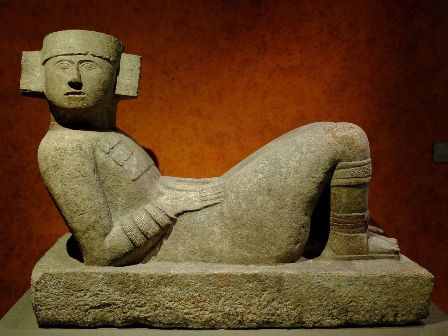 |
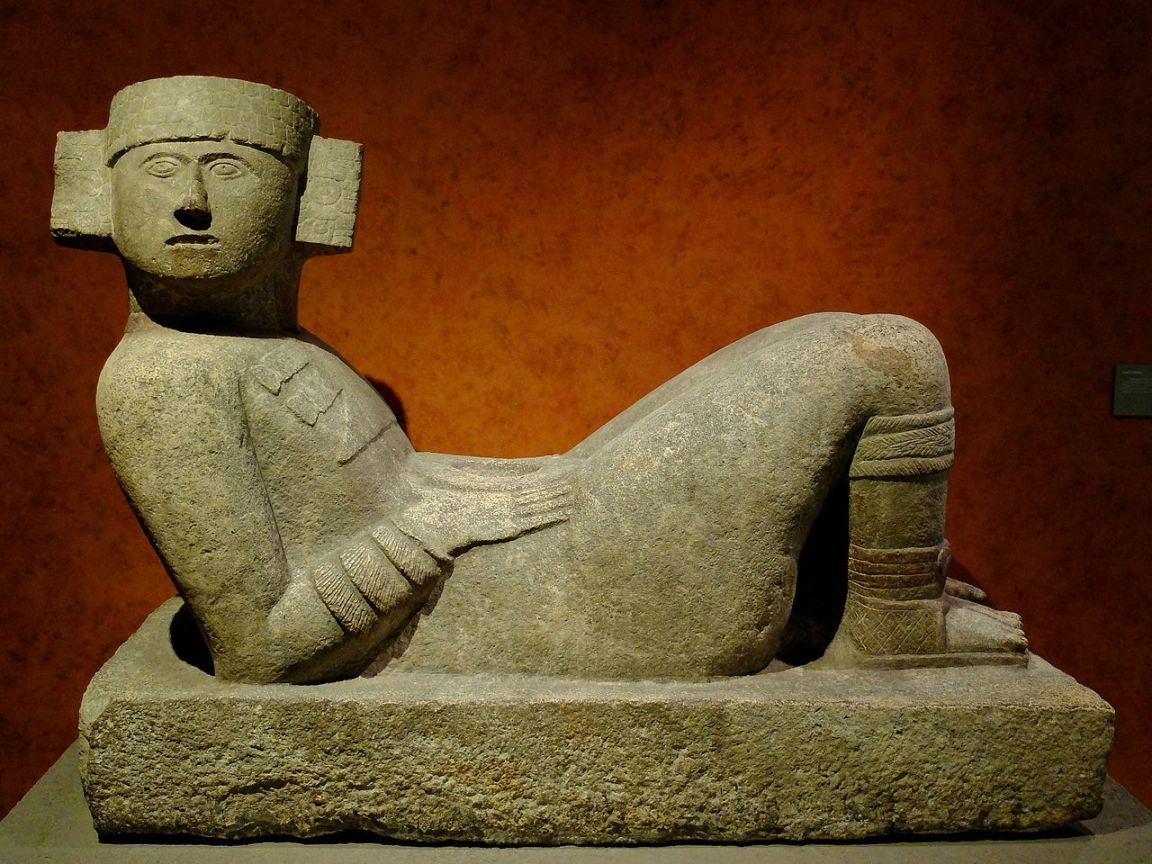
On page 45, Indy and Marcus take a
look at the American Museum's current Archaeology of Mexico
and Central America exhibit, which includes some of Indy's
recent finds and a plaster copy of a curious reclining
figure from Chichén Itzá.
Chichén Itzá was a pre-Columbian city of the Maya people
in Yucatán, Mexico. The reclining figure mentioned is
probably this famed chacmool to the left. |
Marcus introduces Indy to Vilhjalmur Stefansson, president
of the Explorers Club, in front of the Majestic Apartments
on 72nd Street in Manhattan. Stefansson (1879-1962) was the
president of the club from 1919–1922 and 1937–1939, so he
would not have been the president at the time of this novel
(1933). He was known for having said "An adventure is a sign
of incompetence...", just as he does to Indy here. The
actual president of the club at the time was Roy Chapman
Andrews (who is believed by some to have been one of the
inspirations for the character of Indiana Jones!). Chapman
"and his damned expedition to the Gobi" is mentioned by
Stefansson here. The Gobi Desert is a large, cold desert
region of northern China and southern Mongolia. Chapman led
several Gobi expeditions in the 1920s.
After their less-than-pleasant encounter with Stefansson,
Marcus and Indy have dinner at Carmine's. Carmine's is a
famous Italian restaurant in New York City, established in
1906.
On page 48, Indy tells Marcus he left his bags in a locker
at Penn Station and needs to go back and pick them up. Penn
Station is the major railway station in NYC. In 1933,
it sprawled from 31st to 33rd streets, just as stated on
page 65.
On pages 49-50, Indy has a conversation
with a one-legged British veteran calling himself Tommy
Atkins. "Tommy Atkins" is a British slang term for a
soldier, especially during WWI. The passage in the book
gives the impression that it is the man's actual name, and
Indy doesn't seem to recognize (or, at least, acknowledge)
the British term.
Atkins tells Indy he lost his leg in the Argonne.
The Argonne is a forest in northeastern France which was
the site of much trench warfare during WWI.
On page 51, Indy discovers Cadman's Rare Books at 611 W.
41st Street, in a building that looks as if it was from a
Dickens novel. This appears to be a fictitious business.
Charles Dickens (1812-1870) was an English writer and social
critic who is often called the greatest novelist of the
Victorian era.
A sign hanging above the front door of Cadman's Rare Books
reads, "A good book is like a good friend" - Martin Tupper.
The "good book" phrase is well known and has been attributed to a
number of individuals in the past. Martin Farquhar Tupper
(1810-1889) was an English novelist and poet.
On page 52, Cadman threatens to drop the A-L volume of the
Oxford Unabridged on Indy's foot. This is a reference to the
Oxford English Dictionary, considered the principal
historical dictionary of the English language, first
published in 1884.
On page 54, Cadman tells Indy he was visited by some
Italians in fascist uniforms and he told them if they needed
another book to burn they should consider some of that awful
stuff Mussolini writes.
This is a reference to the fascist dictator Benito
Mussolini, who ruled Italy from 1922-1943. He wrote several
essays and books.
The information about the history
of the Voynich Manuscript Cadman gives on page 56 is
accurate.
On page 61, Cadman attributes the maxim "That which is above
is below" to the classical alchemists. The phrase appears in
its original known form as "Quod est superius est sicut
quod inferius, et quod inferius est sicut quod est superius"
("That which is above is like to that which is below, and
that which is below is like to that which is above") in the
8th-9th century Emerald Tablet, a Hermetic text existing in
various translations from the European and Arab worlds.
On page 62, Cadman remarks on Jung's term "synchronicity", a
meaningful coincidence. Swiss analytical psychologist Carl Jung
(1875-1961) defined synchronicity as "circumstances that
appear meaningfully related yet lack a causal connection."
Indy met Jung in "The
Perils of Cupid".
On page 63, Lord Rutherford, Ernest Rutherford, 1st Baron
Rutherford of Nelson (1871-1937), was a New Zealand
physicist often called the father of nuclear physics. Though
long credited with the first transmutation of nitrogen into
oxygen, as Cadman remarks here, since 2017 science history
texts have begun to credit Patrick Blackett with it instead;
Blackett performed the actual experiments, with some help
and advice from Rutherford.
Cadman tells Indy that Alistair Dunstin is probably the
world's leading authority on alchemy and he has a position
at the British Museum.
The British Museum was
established in 1753 and is one of the most prestigious
museums in the world.
Chapter 3: Lords of the Sky
On page 65, the
FBI, of course, is the Federal
Bureau of Investigation,
which investigates federal crime and provides internal
intelligence for the U.S. government.
Entering Penn Station to retrieve his belongings, Indy
reflects that the stairway leading to the main entrance was
made from the same kind of cream-colored stone as the
Colosseum.
On page 65, Indy sees a headline on the front page of the
New York Journal: "Balbo Air Armada Leaves in
Triumph, Bound for Europe." The New York Journal
was an actual daily newspaper under a few different names
over the decades from 1882-1966; it was technically called
the New York (Morning) American in 1933. "Balbo"
was a term used for a large formation of aircraft in the
1930s-40s, named for Italian flying ace Italo Balbo. I have
not been able to confirm whether this headline ever actually
appeared in the paper. Another mention of Italo Balbo
himself and his visit to
Chicago
appears on page 77. As seen later in the novel, Balbo was
also Governor-General or Libya under Italian rule
(1933-1940).
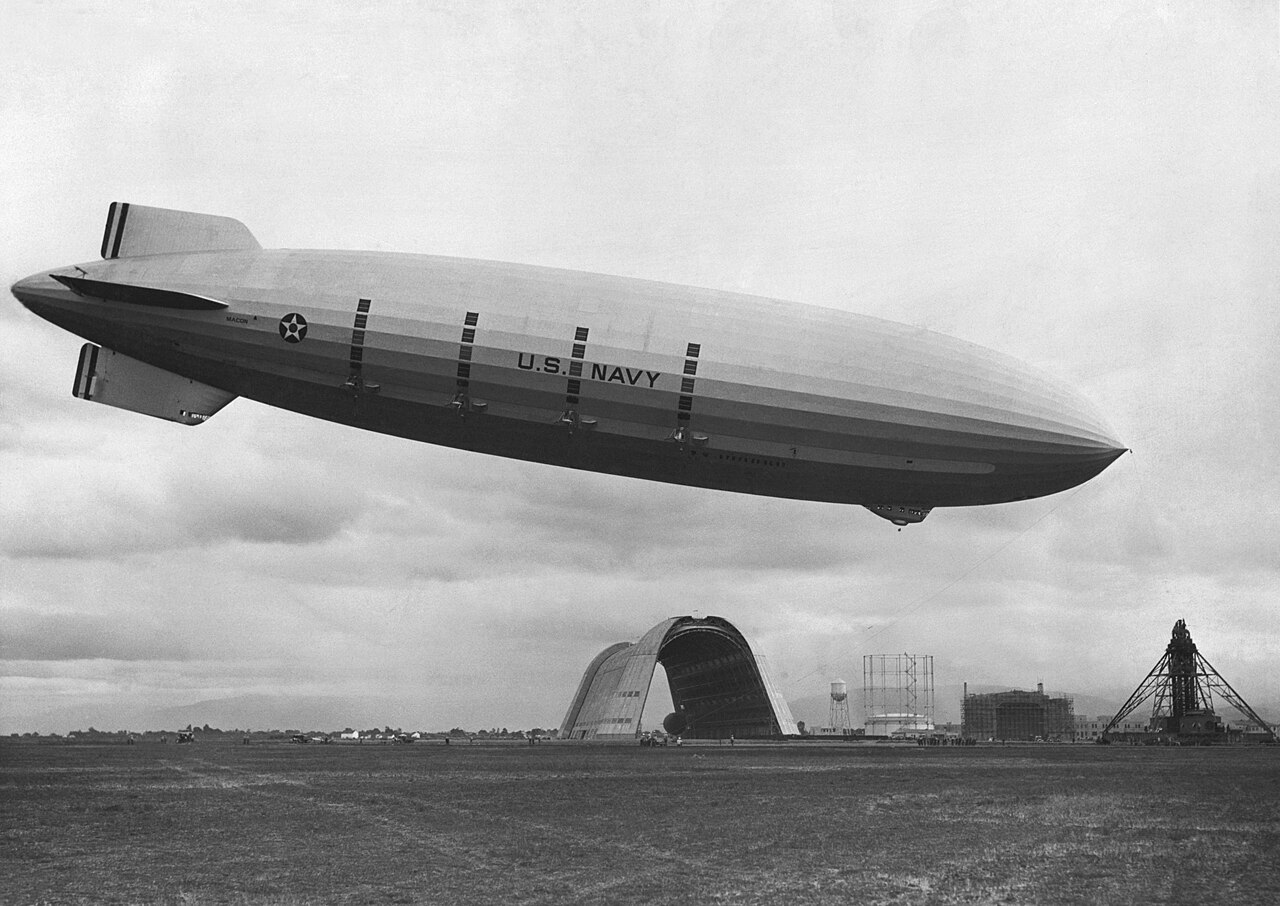
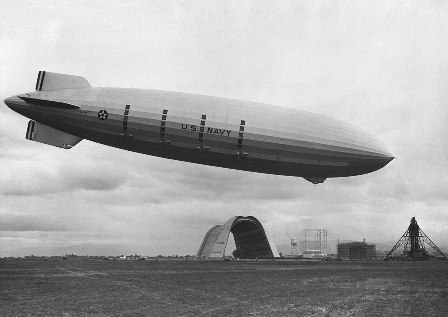
| Major Manly arranges for Indy to fly to Europe on U.S. navy
airship U.S.S. Macon. This was an actual airship in
service from 1933-1935. Indy catches the airship at the U.S.
Naval Air Station at Lakehurst, New Jersey. This is now
Lakehurst Maxfield Field at Joint Base
McGuire–Dix–Lakehurst. Indy previously visited
Lakehurst
in
The White Witch.
(Photo of the Macon from
Wikipedia.) |
 |
The cab Indy takes from Penn Station to Lakehurst is a
Plymouth. Plymouth was an American automobile brand
manufactured by Chrysler from 1928-2001.
On page 67, the Macon is said to have German-made
Maybach engines.
Maybach is
a German luxury car brand.
As Indy clings onto the loose
mooring line of the airship as it takes off on page 69, he
is reminded of a newspaper photo he had seen of two young
seamen falling to their deaths from a mooring line of a
dirigible in
San
Diego. This memory is from an actual incident involving
the USS Akron in May 1932.
The Macon's commander is said to be Alger Dresel.
Dresel was the actual commander of the Macon,
sister ship of the aforementioned Akron, which was
also under the command of Dresel during the San Diego
incident. Macon was commissioned on June 23, 1933,
so that may give us another point of chronology of this
novel, i.e. post-June 23. Further, crewman O'Toole tells
Indy he was on the Akron when it broke apart and
sank into the water "a couple of months ago," which occurred
on April 4, 1933.
Macon crewman
O'Toole is a baseball fan and keeps a Louisville Slugger
among his belongings on the ship.
The Louisville Slugger is a famous model of baseball bat
made by the Hillerich & Bradsby Company.
Page 74 reveals that Indy has a
new
Webley revolver.
Commander Dresel tells Indy that his drop off in
London
(where he will continue on by other means to
Rome)
will have to be by Sparrowhawk. The Curtiss F9C Sparrowhawk
is a light fighter aircraft carried by both the Akron and
Macon, mounted underneath.
The Curtiss Aeroplane and Motor Company existed from
1909-1929, until it merged with Wright Aeronautical to
become
Curtiss-Wright Corporation.
As hinted at on page 75, the United States supplies the vast
majority of the world's helium.
Commander Dresel tells Indy that the Macon's
improved design makes her "quite literally unsinkable," and
Indy retorts, "That's what they said about the Titanic."
And the Macon does later sink after being damaged in a
storm off the California coast in 1935. And, in case your
forgot, Indy was aboard the
Titanic when it struck an iceberg and sank in 1912,
as depicted in
The Titanic Adventure.
On page 75,
"Il Duce" is essentially Italian for "the Duke" and was a
nickname used by Mussolini.
On page 76, OVRA was the secret
police of Mussolini from 1927-1945. The organization's name
never appeared in any official Italian documents
for secrecy reasons, but it is believed that OVRA stood for
Organizzazione per la Vigilanza e la Repressione
dell'Antifascismo (Organization for Vigilance and
Repression of Anti-Fascism).
The dossier on Sarducci that Indy reads on page 76 says he
was born in Fascati, Italy. There does not seem to be a town
of that name, but I believe this is a misspelling of
Frascati, a city in the area of greater Rome.
The dossier reveals that Sarducci studied at the
Sarbonne and received a doctorate from the
University of Rome.
Pages 77-78 state that Balbo called his elite cadre of
airmen atlantici. Atlantici is Italian for
"Atlantic".
The SIAI airplanes mentioned on page 78 are actual models
that were manufactured by SIAI-Marchetti, an Italian
aircraft manufacturer from 1915-1983.
As stated on page 78, during his U.S. tour, Balbo visited
New York City, Coney Island, Broadway, and
Madison Square Garden, met President Franklin Roosevelt,
and had a street named after him (Balbo Drive in Chicago)!
On page 79, Ponta Delgada is an actual Atlantic island in
the Azores, part of Portugal.
Lisbon
is the capital city of Portugal.
Page 79 reveals that Indy's residence at this time is a
rented house at 1226 Chestnut in Princeton. Although there
is a Chestnut Street and Chestnut Court in Princeton, there
is no 1226 address on them.
On page 83, Mario Volatore says, "Eccomi, Dottore
Jones!" This is Italian for "Here I am, Doctor Jones!"
On page 85, Mario says, "Come si chiama...la bomba?"
This is Italian for "How is it called...a bomb?"
On page 87, Mario shouts out "Spazio!" before he
lets himself fall from the Macon into the sea. This
is Italian for "Space!" Indy explains on page 89 that it was
the Fascist war cry, as in space as "territory", elbow room.
My research suggests the full cry was "spazio vitale"..."vital
space".
On page 88, O'Toole mentions Babe Ruth.
George Herman "Babe" Ruth Jr. (1895–1948) was an American
Major League baseball player, playing for the Boston Red Sox
from 1914–1919.
Commander Dresel tells Indy he
can't wait to get him off his ship, as "trouble" seems to be
his middle name and Indy responds, "Actually, no." His
actual middle name is Walton, the same as his father. The
name was first seen in
"My First Adventure".
"Walton" is also the middle name of Indiana Jones creator
George Lucas.
Chapter 4: Soror Mystica
The title of this chapter is Latin for "Mystic Sister".
Arriving in London by Sparrowhawk, Indy sends a coded
message back to Major Manly to have Marcus ask the museum to
wire him travel money to the Bank of England to get to Rome,
designated as working capital for an expedition to the
Isle of
Wight as a cover story.
The Bank
of England has
been the chief issuer of paper currency for the UK since
1694.
On page 91, the Sparrowhawk pilot tells Indy that a few
months from now the plan is to remove the landing gear from
the Sparrowhawks and replace them with long-range fuel
tanks. This is true, the Sparrowhawks assigned to airships
had the landing gear replaced with fuel tanks for longer
flight range.
The landing gear was not needed because the small planes
docked with the airship by a trapeze mechanism underneath
the ship, not by "landing".
As the milk truck driver states on page 91, "Londinium" was
the name of the city established by the Romans that
eventually became London.
Indy and the milk truck driver discuss how history repeats
itself, such as Roman legionnaires fighting the English
natives for control of England and then British soldiers
fighting Zulus in Africa or the Irish in
Belfast.
On page 92, Indy gets off a double-decker bus on Tottenham
Court Road in Bloomsbury and sees the Greek facade of the
British
Museum a few blocks ahead. This is all accurate to a map
of London.
In the library of the British Museum, Indy finds the
librarian behind a desk described as looking like "it had
already been there when Napoleon was defeated at Waterloo."
Napoleon Bonaparte was
the high general, First Consul, and Emperor of France from
1799-1814. Napoleon met his defeat at the hands of the forces
of the Seventh Coalition in the 1815 Battle of
Waterloo.
Alecia points out that the Caliph of
Baghdad once threatened to have Indy boiled in oil (a
misunderstanding, Indy tells her).
The clerk at the Bank of England doesn't believe Indy's
story of having gotten into the country without a passport
due to arriving in the U.S. Navy dirigible Macon,
and retorts, "And were Tinker Bell and Peter Pan aboard?"
Tinker Bell and Peter Pan are characters in
the 1911
fantasy novel Peter
and Wendy by J.M. Barrie about a boy who
can fly.
Page 98 reveals that Indy has
carried a card of the Boy Scout oath with him since
childhood. Indy was seen to be a member of the Boy Scouts of
America
(now Scouts
BSA)
in a few of his youth adventures.
Alecia Dunstin lives in a flat on Southampton Row. This is a
thoroughfare through Bloomsbury.
Alecia confides in Indy that she visits cemeteries and
particularly likes to go to Mortlake and visit the grave of
Sir Richard. Mortlake is a suburb of London. The "Sir
Richard" she refers to is Richard Burton (the explorer
mentioned earlier in this study), whose tomb is at the
cemetery of St. Mary Magdalen Roman Catholic Church
Mortlake.
Among the souvenirs in the Dunstin siblings' flat are a
miniature
Eiffel
Tower and a toy cannon from
Gettysburg.
On page 101, Alecia tells Indy that Alistair breeds
passenger pigeons he keeps up on the roof of the building.
Indy responds, "Homing pigeons," and Alecia says, "I
suppose." Indy is presumably correcting her, since passenger
pigeons, once native to North America, went extinct due to
human hunting of them by 1914.
The history of Hermes Trismegistus' Emerald Tablet and its
rediscovery by Alexander the Great and loss after his death
which Alecia tells of on pages 102-103 is accurate to the myth.
The story of The Book of Abraham (more commonly
referred to as The Book of Abramelin) and The
Gospel of St. Dunstable and the hands they/it passed
through as told by Alecia is essentially true to history,
with embellishment.
Alecia claims that the Voynich Manuscript (and The Book
of Abramelin and The Gospel of St. Dunstable,
which she claims are all one and the same) is a kind of
Rorschach test for the soul: that you look at it and it
mirrors whatever you believe in.
A Rorschach test is a psychological test in which the
patient's perceptions of a series of ink blot cards is used
to interpret their psychological status.
On page 105, Alecia claims that Nicolas Flamel (1330-1418)
successfully made a lot of gold through alchemical
transmutation and that he and his wife, Perenelle, were made
essentially immortal by the philosopher's stone, saying the
couple gave lots of money to hospitals and churches, etc.
and were seen attending opera in Paris centuries later in 1761. But,
historically, while the couple was known for their philanthropy
later in life, Perenelle brought wealth into the marriage
from money she'd gained from two previous marriages. The
reported sighting of the pair in 1761 seems to be taken by
the author from the 1957 E.J. Holmyard book Alchemy,
which provides no source for the sighting.
On page 109, the couple who are neighbors to Alecia are
listening to the
BBC on radio.
When Alecia retrieves a carved piece of obsidian from her
flat, Indy realizes it is a shew stone. This is a term for
what is essentially a crystal ball.
On page 112, Indy and Alecia eat at a pub called Dark Horse.
This appears to be a fictitious pub for London. Possibly the
pub's name is nod to the publisher of Indiana Jones
comic books at the time, Dark Horse Comics.
On page 114, Alecia speaks Shelta Thari to a pub patron in
order to make him understand that she does not want Indy
beaten up. Shelta Thari is an actual secret language or
travellers language that is part Celtic and part Germanic.
On page 116, Indy asks Alecia if her body tattoo is a kell.
Her response is, "Not exactly. It is the mark of the Thari,
the ancient Druid caste of metalworkers..." I've not been
able to uncover what Indy means by "kell". Possibly, it is a
shortened term for "Celtic" ornamentation.
On pages 119-122, Indy and Alecia find themselves dodging
the bullets of the atlantici in a scrap yard called,
ironically, Jones Wrecking. This is likely a fictitious
business in London.
On page 123, Alecia turns towards the Thames as she makes
the decision not to return to her usual haunts where the
atlantici will likely know to look for her. The Thames is
the longest river in England, running through London.
Chapter 5: Flotsam and Jetsam
When Alecia volunteers to scrye the pages of the Voynich
Manuscript for Indy as she did for her brother, Indy tells
her he doesn't believe in such things and that it all begins
to remind him of that business with Arthur Conan Doyle and
the fairies.
Arthur Conan Doyle (1859-1930) was a British writer and the
creator of Sherlock Holmes. He also had a strong interest in
spiritualism, mysticism, and paranormal subjects, including
the photos of the so-called Cottingley Fairies taken by two
teen cousins (Frances Griffiths and Elsie Wright) that later
were shown to be faked by the girls.
As Alecia, in trance, begins to translate the Voynich
Manuscript on page 130, the first paragraph of the manuscript
("Praise be to God...") is actually from Jabir ibn Hayyan's
9th Century Kitab al-Ahjar ‘ala Ra'y Balinas (The
Book of Stones), an alchemical text that reputedly told
how to create living tissue from other matter. The third
paragraph ("Speak not fictitious things...") is from the
previously-mentioned Emerald Tablet. Other passages seen
here are small phrases from other esoteric sources or are
original to the author of the novel.
On page 130, Tabula Smaragdina is Latin for
"Emerald Tablet".
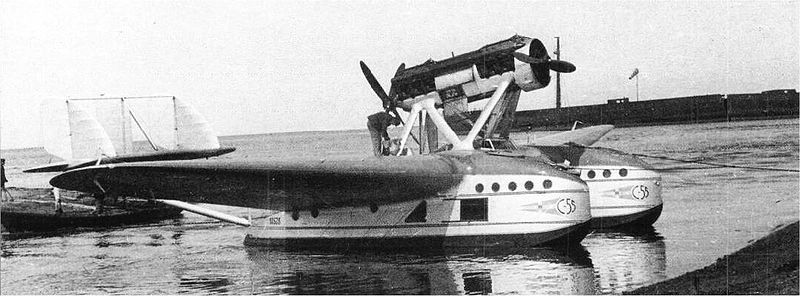
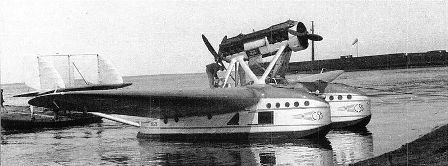
Forced to abandon the garbage scow, Indy and Alecia stow
away aboard their pursuers' Savoia-Marchetti 55 seaplane.
On page 141, Indy admits to Alecia that he can't read
Italian. Yet, he is known to be able to speak it in
"Love's Sweet Song" and
"To Have and Have Not".
When the pair arrive in Rome, it seems that he is unable to
speak it either, as far as this novel is concerned.
On page 144, the seaplane begins
its landing approach to the Ostia seaplane base near Rome.
This is an actual water airport on the coast of the Ostia
neighborhood of Rome.
Chapter 6: Tower of the Winds
On page 145, a soldier says, "Uno momento." This is
Italian for "One moment."
On page 146, the soldier says, "Che ha detto?" This
is Italian for "What did you say?"
When Indy and Alecia are stopped at the Ostia port by an
Italian soldier, Indy mumbles "Mozzarella" and "Ravioli",
possibly in an attempt to identify themselves, seemingly not
understanding or able to speak Italian. After knocking out
the soldier, Alecia complains that he could have used such
names as Botticelli, Raphael, Polo, or Columbo. These are
names of famed Italian (or Italian-adjacent) artists and
explorers.
On page 147, Indy and Alecia's
Fiat cab
pulls up to the Inghilterra on the Via Bocca di Leone,
though the pair decide not to stay there. The
Inghilterra (Hotel England) is an actual 5-star hotel on
the Via Bocca di Leone in Rome.
Rome is referred to as the Eternal City on page 47. This is
one of the nicknames of the city.
On page 147, Balbo and the atlantici, greeted by
Mussolini, march under the Arch of Constantine. This is a
triumphal arch in Rome dedicated to Constantine the Great,
Roman emperor from 306-337 AD.
Indy and Alecia end up staying at the Royal des Etrangers
hotel near the Piazza Colonna. The Royal des Etrangers
("Royal Foreigners" in French) appears to be a fictitious
hotel for the time. The Piazza Colonna is a public square in
the Colonna district of Rome.
The clerk at the Royal des Etrangers is named Giuseppe
Rinaldi. Possibly he was named by the author for the Italian
actor of the same name who lived from 1919-2007.
Rinaldi tells Indy the hotel is discreet, bragging that
Mussolini and his mistress had once stayed there and he told
no one. The mistress mentioned may be Clara Petacci
(1912-1945), though her relationship with the married
Mussolini is said to have begun in 1936, while this novel
takes place in 1933. Petacci remained his mistress until
near the end of WWII, when both were captured by Italian
partisans and executed together.
On page 149, Rinaldi tells Indy the hotel's restaurant is
buono. This is Italian for "good".
Indy reads the New York Herald Tribune in the
restaurant while he waits for Alecia to finish her bath.
This was an actual newspaper from 1924-1966.
When Indy tells Alecia that Italy's airplane armada had
traditionally lost one of every six planes in the crossing
of large distances such as the Atlantic Ocean, she calls it
Russian roulette. Russian roulette is a game of chance in
which a revolver is loaded with a single round, the cylinder
is spun, and the player places the muzzle against their head
and pulls the trigger, hoping they haven't landed on the
loaded chamber.
On page 150, Alecia remarks that Rinaldi probably thinks
Indy is John Dillinger and she his gun moll.
John Dillinger was an infamous U.S.gangster and bank robber
during the Depression who was killed by FBI agents during a
shootout in Chicago on July 22, 1934.
On page 152, Indy and Alecia
enter the Museum of Antiquities in Rome. This may be a
generic name used for a museum that existed at the time.
On the museum floor plan in the guidebook, Alecia finds a
room marked Maestro di archeologia. This is Italian
for "Master of archeology".
Sarducci's secretary, Caramia, greets Indy and Alecia as
Dottore and Signorina. These are Italian for
"Doctor" and "Miss", respectively.
On page 155, Caramia is said to smile "a Mona Lisa smile".
The Mona
Lisa is
a famous painting by Leonardo Da Vinci, painted in the 16th
Century. The smile on the woman in the painting is
considered enigmatic by many.
Sarducci's office is furnished
and decorated with items from the Renaissance. The
Renaissance is the period of European history covering the
15th and 16th centuries, a time of renewed interest in ideas
in art and science.
Indy picks up a sword in Sarducci's office and the man tells
him it was made in Toledo 600 years ago.
Toledo is a
city in Spain that is traditionally known for metalworking,
swords in particular, historically.
On page 159, Sarducci compares himself to Faust, suggesting
he's made a deal with the devil. Faust is the main character in
a German legend (based on the historical 16th Century
figure, Johann Georg Faust) of a man who makes a pact with
the devil for knowledge and worldly pleasures.
On page 160, Sarducci warns Indy, "As your poet said, you
are as one whose name is written upon the water." He is
referring to John Keats (1795-1821), an English poet who had
carved on his tombstone the words, "Here lies One whose Name
was writ in Water."
On page 161, Indy grabs a sword from the
hands of a wax statue of a Roman legionnaire in the museum
and Alecia asks him if he knows how to use it and can he
dance, referring to what she says is an old Celtic proverb,
"Never give a sword to a man who can't dance." This is an
aphorism that has been heard around the world for some time,
but its provenance is unknown. Some say it is a Celtic
proverb, others one from Confucius or other sources.
On page 162, a security guard at the museum shouts,
"Fermata!" at the fleeing Indy and Alecia. This is
Italian for "Stop!"
Also on page 162, Indy and Alecia run past glass cases of
Aztec, Mayan, and Incan artifacts and past a reconstructed
stone arch from Tulum. Tulum is the site of an ancient Mayan
walled city in the Mexican state of Quintana Roo.
On page 167, Nicholas quotes from the Bible, "what
does it profit a man to gain the whole world only to lose
his own soul?" This is from the Bible's Book of
Mark.
On page 168, Indy and Alecia pass through the Gate of St.
Anne into Vatican City and down the road to the Court of
Belvedere to the stairway leading to the
Vatican Library, next to the statue of the antipope
Hippolytus. The Gate of St. Anne is the border crossing
between Italy and the Vatican City State. The Court of
Belvedere is a 16th Century architectural work leading up to
the Vatican Palace, including the library. Hippolytus (c.
170–235 AD) was an important Christian theologian who became
the first antipope (a person who claims to be the pope as
the leader of a Christian faction at odds with the Catholic
Church).
Indy and Alecia are approached by a Swiss
guard who asks them their business at the Vatican.
The Pontifical
Swiss Guards
are honor guards for the pope and his palace within Vatican
City.
The pair explain to the
guard that they are looking for Dr. Morey and the guard says
he is in the Secret Archives in the Tower of the Winds. The
Secret Archives are now known as the
Vatican Apostolic Archive and it is located in the Tower
of the Winds (or the Gregorian Tower, for Pope Gregory
XIII). They find Morey in the Meridian Room of the archives,
an actual room in the tower. The anemoscope Morey describes
on page 171 is also there.
On page 168, Alecia essentially uses the Jedi mind trick on
the Swiss guard! Call it a Celtic mind trick, I guess.
(Another woman, Anita, a Mayan, performed a similar trick in
The Feathered Serpent!)
The Council of Trent mentioned by
Morey was held in
Trent, Italy from 1545-1563 as an ecumenical council to
discuss questions and issue changes of church doctrine.
Chapter 7: Sand
Marlow's crew delivers crates of Thompson submachine guns to
the Arab prince in Libya.
This is a real gun, famously known
as a Tommy gun during the gangster era of the 1920s-1930s.
On page 175, "Allah" is the
Arabic word for "God".
Prince Farqhuar is enchanted by the writings of Jules Verne
and Mark Twain. Jules Verne (1828-1905) was a
French writer known for his fantastical science-fantasy
novels. The story described by Farqhuar of the cannon shell
fired to the Moon is from Verne's 1865 novel From the Earth
to the Moon.
Mark Twain was an extremely popular American writer and humorist
of the 19th Century.
On page 177, Indy tries
half-heartedly to convince Alecia to go with Captain Marlow to
Cairo and
wait for him there with Sallah. Sallah is Indy's friend there,
whom he first met in
Tomb of Terror.
On page 184, upon finding a couple of light bulbs are not
working in the latrine,
Alistair remarks, "You'd think if Mussolini can make the trains
run on time, they could change a few lamps around here." There
was a popular saying during Mussolini's reign in Italy, "Say
what you like about Mussolini, he made the trains run on time."
On page 186, an Italian soldier says, "Grazie." This is
Italian for "Thank you."
When Sarducci asks where Alecia is, Indy responds on page 191,
"...she took off long before sunrise. You'll never find her.
She's got enough supplies to last a week and a Bedouin guide who
knows every inch of this country like the back of his hand."
This is similar to his response to Donovan about Marcus Brody in
The Last Crusade when he says, "He's got a two day head
start on you, which is more than he needs. Brody's got friends
in every town and village from here to the Sudan, he speaks a
dozen languages, knows every local custom, he'll blend in,
disappear, you'll never see him again." In both cases, Indy's
lying through his teeth. The Bedouin mentioned here were a nomadic Arab ethnic
group of the deserts, now mostly settled in the modern cities of
the Middle East.
On page 195, tenente is Italian for "lieutenant".
Sarducci claims that the tattoo on Alecia's back points the way
to various spots on Earth, including
Alexandria,
Moscow, and the Tomb of Hermes.
Sarducci says that Alexander discovered the Tomb of Hermes
roughly on the border of Libya and Egypt during his
pilgrimage in Siwa. Alexander the Great made this pilgrimage to
consult the oracle at the oasis of Siwa, who proclaimed that
Alexander was the son of Amun (one of the major Egyptian
gods) and therefore the legitimate Pharaoh of Egypt.
Sallah claims that Prince Farqhuar is one of his
brothers-in-law.
Tomb of Terror
established that Sallah has a number of extended family
members who do him favors.
On page 201, Farqhuar accompanies Indy and the others on
their quest for the Tomb of Hermes, announcing they have not
yet discussed the wonderful autobiography of Huckleberry
Finn. The Adventures of Huckleberry Finn is an 1884
novel by the aforementioned Mark Twain, told in the first
person of the words of Finn.
Chapter 8: The Stone
On page 210, Indy mentions the Valley of the Kings.
The Valley of the Kings is a real world archaeological site
where the Pharaohs of the Egyptian New Kingdom (16-11th
Centuries BC) were entombed.
On page 212, Sallah reveals that
he does not know how to swim.
On page 214, Farqhuar is said to speak to his men in tarog.
I've been unable to find this term as a language or dialect.
On page 215, the statue found of Hermes Trismegistus in the
underground cave depicts him wearing a robe covered with
alchemical symbols, including the winged Mercury. Mercury is
the Roman god of commerce and communication and wears winged
shoes and hat. Mercury is essentially the same as the Greek
god Hermes.
On page 216, Indy reads the Coptic inscriptions on the arch
found in the cave. Coptic is a group of Egyptian dialects
starting around the 3rd century AD.
The Latin phrase Visita Interiora Terrae Rectificando
Invenies Occultum Lapidem Indy and Alistair find
abbreviated as VITRIOL in the cave inscriptions is a
well-used phrase in the annals of alchemy. Alistair's
English translation of the phrase here is accurate ("Visit
the interior parts of the earth, and by rectifying you will
discover the hidden stone."). As soon seen on page 222,
"vitriol" is also an old name for sulfuric acid.
Indy and Alistair find foot stones in the chamber floor with
zodiacal symbols on them. Alistair deduces they may need to
step on them in alchemical sequence to proceed without
triggering a trap, and he proceeds to
guide Indy along the sequence through Calcination=Aries,
Congelation=Taurus, Fixation=Gemini, Dissolution=Cancer, and
so on. But there are a number of so-called "alchemical
sequences" historically, in different order. How did
Alistair know which one to apply here?
Epilogue
Indy informs Marcus that he plans to tell the FBI that the
Voynich Manuscript is gibberish, the Tomb of Hermes does not
exist, and the philosopher's stone is just a dream.
On page 234, ruba is Italian for "steal". On the
next page, Indy translates it as "stolen", but that word
would be rubato.
Unanswered Questions
Who stole the crystal skull from the American Museum?
Readers learn more about that and the skull itself in three
of the following novels by the same author, The Dinosaur
Eggs, The Hollow Earth, and The Secret of
the Sphinx.
The stolen Voynich Manuscript still has not been returned to
the museum. Who has it now? Will it ever be returned to the
public eye?
Back to Indiana Jones Episode
Studies