 |
Indiana Jones
The Mystery of Mount Sinai
Novel
Written by J.W. Rinzler
Cover art by Greg Knight
May 2009
|
Indy receives his next assignment from U.S.
Army intelligence.
Notes from the Indiana Jones chronology
This novel opens in late July 1941, immediately after the
events of The
Pyramid of the Sorcerer and proceeds into August.
Didja Know?
Indiana Jones and
the Mystery of Mount Sinai is a
juvenile novel published by Scholastic Books in 2009.
The book is dedicated by the author to seven men. The first
three are George Lucas, Steven Spielberg, and Harrison Ford "for
having created and molded the main character in this book."
Lucas, of course, was the creator and story driver behind the
first four Indiana Jones films. Spielberg was the
director of the first four films and Ford is the actor who
portrayed Indiana in all five films. Then the author continues
the dedication to Edgar Rice Burroughs, Robert E. Howard, Sir
Arthur Conan Doyle, and Ian Fleming.
These were all writers of men's adventure stories. Burroughs was
the creator of Tarzan, Howard of Conan the Barbarian, Doyle of
Sherlock Holmes and the Lost World, and Fleming of James
Bond (among other creations and writings, of course).
Notes from
The Lost Journal of Indiana Jones
The Lost Journal of Indiana Jones is a 2008 publication
that
purports to be Indy's journal as seen throughout The
Young Indiana Chronicles
and the big screen Indiana
Jones movies. The publication is also annotated with notes
from a functionary of the
Federal Security
Service (FSB) of the Russian Federation, the successor
agency of the Soviet Union's KGB. The FSB relieved Indy of his
journal in 1957 during the events of Indiana
Jones and the Kingdom of the Crystal Skull.
The notations imply the journal was released to other
governments by the FSB in the early 21st Century. However, some
bookend segments of The
Young Indiana Chronicles
depict Old Indy still in
possession of the journal in 1992. The discrepancy has never
been resolved.
The journal as published does not mention the events of this
novel,
going from entries about the events of
The Fate of Atlantis in
May 1939 to Indy's time working with Colonel George "Mac" McHale
during 1944. A five year gap seemingly left un-journaled.
Story Summary
In the summer of 1941, shortly after the events of The Pyramid
of the Sorcerer, Indiana Jones is once again working with
Colonel Musgrove and the U.S. government, pursuing clues
connected to the writings of Solon. At the same time, Nazi
Germany has become interested in the same mystery. Leading the
German search is the sinister General Helmut von Mephisto, an
occult-minded Nazi officer convinced that the lost knowledge
hidden near Mount Sinai could provide the Third Reich with an
overwhelming advantage in the war.
The trail begins with clues recovered from the previous
adventure and quickly carries Indy and his pilot friend Bert
Brodowski from the Americas to Europe. As they follow fragments
of ancient inscriptions and historical records, they discover
indications that the mystery is far older and broader than
anyone imagined. The evidence points toward Egypt and the Sinai
Peninsula, but important pieces of the puzzle lie hidden in
Italy. Their journey to Rome places them in the middle of
wartime intrigue, forcing them to evade Fascist authorities and
Nazi agents while navigating dangerous chases and narrow
escapes. Along the way, they become responsible for two orphaned
children who are drawn into the adventure and remain under their
protection for much of the story.
In Rome, Indy pursues leads through ancient archives and church
records, eventually gaining access to information preserved
within the Vatican. These documents reveal that Mount Sinai may
have been significant not merely as the traditional site where
Moses received the Ten Commandments, but as the location of
something far older and more mysterious. Religious traditions,
historical legends, and archaeological evidence all seem to
point toward a hidden source of power concealed beneath the
mountain. Political tensions in the Vatican involving Benito
Mussolini and Nazi Germany complicate the search.
Seeking further insight, Indy consults his father, Henry Jones,
Sr. Their discussions help connect the scattered clues. Together
they conclude that the legends surrounding Sinai may describe
not a supernatural miracle but evidence of an advanced ancient
technology misunderstood by later generations. This realization
shifts the focus of the quest. Rather than searching for a
purely religious relic, Indy is now investigating traces of a
lost civilization whose knowledge may have exceeded that of the
modern world.
The search eventually carries the heroes into Egypt and the
Sinai Peninsula. Traveling through the desert, they follow clues
leading toward the ancient Temple of Hathor. There they
encounter local traditions, ancient inscriptions, and hints
preserved by generations of guides and religious figures. Within
the ruins, Indy discovers references to a strange substance
unlike anything known to modern science. This mysterious powder
appears capable of reducing weight and overcoming gravity. As
the evidence accumulates, it becomes increasingly clear that the
builders of the site possessed technological knowledge far
beyond what historians would normally attribute to the ancient
world.
The Nazis soon catch up with the expedition and seize control of
the excavation. Mephisto captures several members of the group
and forces Indy to continue deciphering the ancient clues. The
German officers become convinced that the strange powdery
substance could allow for unprecedented advances in
transportation and military power, transforming warfare. As they
probe deeper into the hidden chambers beneath Sinai, they
encounter increasingly bizarre mechanisms and evidence that the
site was designed for purposes far beyond religious worship.
The search uncovers a hidden complex guarded by enormous stone
colossi. Guided by information gathered earlier, Indy uses the
mysterious powder in a ritual-like activation process. The
substance reacts dramatically, causing the gigantic stone
figures to rise into the air and reveal a concealed entrance
beneath them. What lies beyond is the true secret of Mount
Sinai: a vast underground chamber containing a colossal
obelisk-shaped structure unlike any known monument. Closer
examination reveals that it is actually a machine.
As tensions reach their peak, Mephisto turns on Indy and
attempts to seize complete control of the discovery. During the
ensuing struggle, a weapon discharge strikes the ancient
structure and inadvertently activates it. The machine begins to
glow, hum with energy, and awaken after lying dormant for
thousands of years. Ancient star maps found within the chamber
suggest that the builders maintained a connection with a distant
world associated with the constellation Orion. The strange
powder proves to be part of the machine's propulsion system, and
the enormous structure reveals itself to be some form of
spacecraft or interstellar vehicle rather than a religious
monument.
The novel concludes with the astonishing launch of the ancient
vessel. The discovery confirms that Mount Sinai concealed not
merely lost knowledge but evidence of a civilization possessing
technology far beyond modern understanding. Whether this
civilization was terrestrial, extraterrestrial, extradimensional
or some combination of the above is left ambiguous. The Nazi
plan collapses, the heroes survive, and the children are brought
to safety. General Mephisto is revealed to have survived the
catastrophe, ensuring that he remains a potential threat in the
future.
At the end of the novel, Indy returns to government service
expecting a period of rest, only to receive another classified
assignment from Colonel Musgrove. The new mission concerns
mysterious Japanese research connected to Orion and a project
known as "Tsuzumi Boshi". A submarine awaits to carry him toward
his next adventure.
Characters appearing or mentioned in this story
Indiana Jones
Bert Brodowski
Sir Reginald Brooksbank
(mentioned only, deceased)
Major Nichols
(mentioned only, deceased)
Colonel Musgrove
Obergruppenführer Helmut von Mephisto
T.E. Lawrence
(mentioned only, deceased)
Agent Z-733/scar neck (dies in this novel)
Mayan merchant
Dr. Harold Oxley (mentioned only)
Peku
Contessa (mentioned only)
Henry Jones, Sr.
Hilda (mentioned only)
Marion Ravenwood
(mentioned only)
Italian politicos
Isabella
Giovanni
Isabella and Giovanni's parents
(mentioned only)
Italian police
(mentioned only)
Baroness de Schlembraign
Vatican bureaucrat
Rudolfo Grazieni
Pontifical Commission official
Benito Mussolini
woman on tour
Italian soldiers
Pope Pius XII
Swiss Guard
Mrs. Blumenthal
(mentioned only)
Marcus Brody
(mentioned only)
Rafaelo Mercati
Blackshirts
telephone repairman
fruit stand owner
marketgoers
Schutzstaffel
Italian farmer
cookware merchant
spy
Captain Toma Dzhmiliv
Huey McDonald
Abdulmutalib bin Ghalib-Roca (dies in this novel)
Sallah
(mentioned only)
Isabella's tutor
(mentioned only)
Miss Seymour
(mentioned only, deceased)
SS guards
German sergeant
German sergeant major
Hochschullehrer Erik Jan Eckart
(dies in this novel)
Bedouin
military attaché
Didja Notice?
CHAPTER ONE
Pages 1-5 are a modified and
expanded
version of the epilogue of
The Pyramid of the
Sorcerer.
The book opens with Indy and Bert exiting the Hall of Records.
In
The Pyramid of the
Sorcerer, the Hall of Records was shown to be the Akashic records
of the religion of theosophy, being a
compendium of everything that has ever happened, is happening,
or will happen, to everything in the universe, living or dead.
In the preceding novel, the Hall of Records was shown to be
temporarily located in the Pyramid of the Sorcerer (the real
world Pyramid of the Magician in Yucatán).
As Indy muses on the fading of the Hall of Records into
another dimension, he feels that was something new that even Albert
Einstein would appreciate.
Dr. Albert Einstein is the renowned German theoretical physicist
who refused, during a visit to America, to return to Germany
after Hitler came into power, and became an American citizen.
The deceased Professor Brooksbank and
Major Nichols inside the vanished Hall of Records are characters
whose fate was seen in
The Pyramid of the
Sorcerer.
On page 2, Indy meets with Colonel Musgrove in a temporary
office in
Mérida,
Yucatan, not far from the pyramid's location in Uxmal, one
day after the events at the pyramid. Uxmal is an ancient Mayan
city considered one of the most important archeological sites of
that culture and is a UNESCO World Heritage Site, lying about 45
miles south of Mérida. In
The Pyramid of the
Sorcerer, a meeting very much like this one between the
archeologist and the army intelligence officer takes place
two days later, in a hotel bar in the city.
Musgrove mentions Hitler's previous obsession with finding the
Ark of the Covenant for its lethal power. This is a reference to
Raiders of the Lost Ark. Adolf
Hitler, of course, was the evil Chancellor of Germany from
1933-1945. The Ark of the Covenant is a wooden, gold-covered
chest that carries the Ten Commandants, as stated in the
Bible.
Page 3 has Indy thinking of the first time he met Musgrove, at
Marshall College five years before. This is another reference to
Raiders of the Lost Ark. Indy was teaching
at the fictitious Marshall College at the time (he is at Barnett
College at the current point of his career).
On page 3, Musgrove refers to Indy's history of "grave robbing",
but Indy corrects him with "artifact preservation".
On page 5, Indy walks along the streets of
Mérida near the Plaza Mayor. More commonly called the Plaza
Grande, it is the historic and cultural heart of the city.
As he walks, Indy thinks of Lawrence of Arabia with whom he had
some childhood adventures in Egypt. We saw these adventures in
"My First Adventure" and
"Daredevils of the
Desert".
Lawrence of Arabia (T.E. Lawrence)
was a British army officer, diplomat, and writer known for split
loyalty to the British empire and the Middle Eastern Islamic
world. He died in 1935 as stated here.
On page 6, gringo
is a
term referring to any English-speaking foreigner in a Spanish
language country and calle is the Spanish word for
"street".
Feeling like he's being followed,
Indy notices a man
with two parallel scars on his neck
casually reading a newspaper. Indy muses whether the man is a
Mexican vampire. Indy had a run-in with a supposed vampire,
General Mattias Targo, who believed he was reincarnation of Vlad
the Impaler in "Mask of Evil".
Near the end of the chapter, a Mayan street merchant offers to
sell Indy a Panama hat, but Indy says, "No, gracias.
Prefiero quedarme con mi propio..." This is Spanish for
"No, thank you. I prefer to keep my own..."
At the end of the chapter, Indy recalls a name he'd not thought
of for a while, Oxley. This turns out to be a reference to Dr.
Harold Oxley, a cohort of Indy's with whom he's currently on the
outs. Oxley does not appear in this novel, but will be seen in
1957 in Kingdom of the Crystal Skull.
CHAPTER TWO
As the chapter opens, Indy is in a
hotel suite he has rented along with Bert. He pays her what he
owes for airplane rides of the last few days. It's not clear
here whether they slept together the night before.
The hotel room overlooks the Parque Hidalgo. This is an actual
park in
Mérida.
On page 8, Bert tells Indy, "I'm a mercenary. Just like you," to
which Indy responds, "I'm not a mercenary. I just act like one."
Indy and Bert head out on horseback for
Itzamal.
Indy tells Bert that he and Oxley went to the same college
together. He is referring to the
University of
Chicago, where they both studied archeology under Dr. Abner
Ravenwood.
On page 11, Indy tells Bert the road they're travelling on is a
sacbe, a Mayan road at least a thousand years old. Indy
asks her if she thinks the
Pennsylvania
Turnpike will still be around that long. A sacbe
is a network of paved roadways constructed by the Maya that
spread across the Mayan civilization, joining all the major
ceremonial centers of the Mayan empire.
On Agent Z-733's dead body, Indy finds a note from his superior,
Obergruppenführer
Helmut von
Mephisto.
Obergruppenführer means
"Senior Group Leader", similar to lieutenant general in the
regular army. "Mephisto" (or "Mephistopheles") is a chief demon
in German literary tradition.
At the end of the chapter, Indy
mentions Uncle Sam and Ahnenerbe.
"Uncle Sam" is a common personification of the United States
government often depicted on propaganda and pop culture
materials as a man in a star-spangled suit and top hat with
white hair and goatee. The Ahnenerbe was a branch
of the Nazi SS dealing with research on the history of the Aryan
race (Forschungs- und Lehrgemeinschaft Das Ahnenerbe,
which translates to Research and Teaching Community of German Ancestral
Heritage).
CHAPTER THREE
Indy finds his old friend Peku,
driver of a horse carriage taxi, in front of the Convent of
Saint Anthony de Padua. This is an actual convent in Itzamal.
St. Anthony is one of the most beloved of saints in Christianity
as the patron saint of lost things, known for helping the poor
and protecting the downtrodden and interceding on behalf of
others.
On page 17, Indy scrutinizes the small yellow buildings that
make up
the small town.
Itzamal is now known as the Yellow City
for its yellow structures...but this was not until 1959, when
the mayor ordered the commercial signs that overwhelmed the
walls and roofs of the buildings to be removed and the buildings
painted yellow and white.
On page 18, Indy and Peku exchange a few lines of Mayan
language:
"Ba'ax ka wa'alik." "What do you say?"
"Yohel maya le ts'ulo."
"The foreigner knows Maya."
"Dyos bo'otik!" "Thank you!"
Reflecting on some incident from their past, Peku says to Indy,
"When the Contessa found out you were broke, I thought she would
kill you," to which Indy responds, "She would have. But Backlum
Chaam protected me."
Backlum Chaam is the Maya god of male sexuality and fertility.
Peku tells Indy and Bert that "Itzamal"
as the name of the city means "Place of the Hills" (the "hills"
are the remains of ancient pyramids). While that is one of the
nicknames of the city, from what I've found Itzamal
actually translates as "dew that falls from the sky".
Peku shows Indy and Bert some of the pyramids in the city and
Indy comments they are as big as the ones in Giza. He is
referring to the Great Pyramids on the
Giza Plateau at Cairo, Egypt.
When Peku offers to climb up one
of the pyramids, Indy says he'd rather go underneath and Bert is
incredulous. Peku remarks, "You forget, Señorita Bert. Most
pyramids have big underground structures." While many ancient
pyramids do have underground chambers associated with them, it's
an exaggeration to say that most do. In fact, since Mesoamerican
pyramids were usually temple platforms, they tend to be less
likely to have underground portions than their Egyptian and
Nubian counterparts.
CHAPTER FOUR
Underneath the pyramid, Indy and Peku walk along a tunnel that
Peku tells him goes all the way to Chichén Itza, which Indy
remarks is more than two hundred kilometers away.
Chichén Itza was a pre-Columbian city of the Maya. As far as
I can tell, there is no such lengthy tunnel leading to and from
the city. Also, the ancient city site is only about 75
kilometers away from Itzamal.
On page 23, a startled Peku hits his head on the ceiling of the
tunnel, saying "In pol!" This is Mayan for "My head!"
On page 27, Peku says, "De nada," when Indy thanks him
for saving his life. This is Spanish for, "It was nothing."
Also on page 27, a cenote is a sinkhole that has exposed
groundwater within after the collapse of limestone bedrock under
the ground.
On the island stela found in the cenote, Indy sees the figure of
a bearded man holding a key which he thinks is of the kind held
by kings in
Mesopotamian sculpture. Mesopotamia is an historical region
located between the Tigris and Euphrates rivers, largely
encompassed by modern Iraq. It began with the
proto-civilizations of around 10,000 BC to mid-7th Century AD.
On page 28 Indy finds a cigarette lighter on the
ground of the
island with the German inscription "Zu meinen fuzzy bär". His
translation of the German as "To my fuzzy bear" is accurate.
On page 30, Peku says, "Sí, señor." This is Spanish for
"Yes, sir."
Page 31 mentions that Indy had tangled with the
Ahnenerbe
before. This occurred in
"The Tomb of the Gods" storyline.
CHAPTER FIVE
Bert tags along with Indy back to the U.S. on a
Mexicana
Airlines Douglas DC-2. On page 32 she says, "Thanks to the
Benjamins you gave me [...] I can go home in style and lord it
over my folks." "Benjamins" refers to $100-dollar bills,
so-called because they have a portrait of Benjamin Franklin
(1705-1790), one of the founding fathers of the United States
and a polymath. The DC-2 was a twin-engined propeller-driven
aircraft produced by the Douglas Aircraft Company from
1934-1939.
On page 32, adios is Spanish for "goodbye".
Also on page 32, Bert pops some
Beemans chewing gum into her mouth. This gum has been
popular with aviators, supposedly bringing good luck, since the
1910s.
Page 32 reveals that Indy had written a paper on Egyptian
hieroglyphics when he was a student.
On page 33, Indy shows Bert his paper copy of the Mayan
inscriptions he found on the cenote stela, telling her that no
one has ever decoded Mayan glyphs. This was mostly true at the
time, but in the 1950s a breakthrough was made when Russian
linguist Yuri Knorozov demonstrated that the script largely
represented sounds or syllables, not just ideas, and
decipherment grew from that point on.
Also on page 33, a stewardess offers Indy and Bert
Coca-Cola.
Indy consults with his father in Ferndale on
the Mayan glyphs.
Ferndale is a small town in Sullivan County, New York. It was
established that Henry, Sr. lived there in
The Last Crusade.
The novel reveals that while
father and son had repaired their estrangement and grown closer
after their adventures involving the search for the Holy Grail
(in
The Last Crusade),
they still had disagreements about politics and family life, and
Senior wanted Indy to settle down and give him some grandchildren.
Indy, on the other hand, is described as not ready to give up
his gun belt.
Bert claims that her parents live in Ferndale as well, but are
out of town until the next day, so she accompanies Indy to his
father's house.
On page 34,
Newark Airport is an actual airport in
Newark, New
Jersey.
Henry, Sr. is said to have a housemaid named Hilda.
The doorway to Henry's kitchen is said to be framed by medieval
paintings of dragons and Grail knights. The Grail knights were
the knights in medieval Arthurian legend who sought the Holy
Grail, the mysterious sacred vessel most often identified with
the cup used by Jesus at the Last Supper.
Page 35 reveals that Indy had canceled his plans to teach summer
school and lecture on The Importance of Egyptian Mystery Schools
in Hellenistic Culture when he took on his current work for the
government. Mystery schools (or mystery religions) are ancient
or esoteric traditions of hidden spiritual teachings, usually
kept secret from the general public, with structured systems of
initiation often involving rituals, symbolic teachings, and
personal transformation.
Henry is rather disgusted that his son is working for the
government, calling it "that gang of New Deal has-beens, those
illiterate boobs..." "New Deal"
refers to President Franklin D. Roosevelt's 1933-1938 New Deal
program of financial reforms, regulations, and public works
projects to rescue the U.S. from the Great Depression.
Henry points out that one of the
Egyptian hieroglyphs in Indy's notes is that of the phoenix.
In most mythological accounts of the phoenix it as a type of bird,
who could arise anew from it's own ashes (or that it gave rise
to its offspring in this manner), originating in Greek
mythology, but with analogs in Egyptian and Persian myth.
On page 37, Henry mentions Wolfram
von Eschenbach's Parzival.
Wolfram von Eschenbach (c. 1160 - c. 1220) was a German knight,
composer, and poet. Parzival is
his epic chivalric romance about the Arthurian knight Parzival
and his quest for the Holy Grail.
Indy and his father have a discussion about the Grail on page 37
which builds upon the Grail legend as seen in
The Last Crusade
and expands on it to include other versions of the Grail
mythology.
Henry walked over to a bookshelf.
"You know, junior, this may touch upon the Grail legend
after all." he pulled out a large tome. "Wolfram
von Eschenbach mentions in
Parzival that the phoenix burns to ashes and is
reborn." He rifled the pages back and forth.
"Please, Dad, not the Grail again. I found this on a Mayan
stela."
"Junior, the Grail legend is as old as time," Henry insisted,
looking up. "The Grail was a cup, but it was also many other
things--a blood line and a holy elixir."
"But Dad, we found the Grail."
"Correction, Junior. We found a cup that was a Grail,"
Henry explained. "But many of the oldest Grail texts,
written by the most ancient seers, refer to the Grail as an
elixir, as a bread, a powder, gold, or a stone." |
As far as I can tell, Karl Richard
Katz, an author mentioned on page 38 is fictitious.
Jean-François Champollion, also mentioned on this page, was a
real world French philologist and orientalist who deciphered
Egyptian hieroglyphics through his study of the Rosetta Stone,
an Ancient Egyptian stele transcribed in 196 BC, featuring a
text in ancient Egyptian hieroglyphs, Demotic script, and
ancient Greek.
The Sumerians and Babylonians mentioned on page 38 were ancient
civilizations of 3000 and 1894-539 BC, respectively.
On page 39, the Kabbalists are an ancient esoteric school of
mysticism in Judaism.
CHAPTER SIX
On page 41, Henry asks his son whatever happened to Marion. Indy
only says he doesn't know where she is. Marion Ravenwood, of
course, is the woman with whom Indy has had a tumultuous
on-again, off-again relationship for most of his adult life, up
to and including age 70 in the The Dial of Destiny,
since she was a teenager.
Henry tells Indy that, based on Plato's writings, he'll have to
try to find whether any of Solon's lost writings actually did
survive in the secret library of the Vatican. Solon (c. 630-560
BC) was an ancestor of Plato and one of the Seven Sages of
Greece. The
Vatican does not have a "secret" library (as far as is known
publicly), but Henry may be referring to the Vatican Secret
Archive, now known as the
Vatican Apostolic Archive; the word "secret" in this sense
is not like the modern meaning of "covert", but rather simply
"private".
On page 44, Benito Mussolini was the fascist dictator of Italy
from 1925-1945.
CHAPTER SEVEN
As the chapter opens, Indy and Bert are walking in
Rome
along the Tiber River on the way to Vatican City. The Tiber
is the longest river in Central Italy, flowing from the Apennine
Mountains to Ostia and into the Tyrrhenian Sea.
On page 46, Indy and Bert pass through the Via del Corso and
Indy spots the famous Roman Pantheon between two Renaissance
palaces. The Via del Corso is a main street in Rome's historical
center. The
Pantheon in Rome is a 2nd Century Roman temple that was
converted into a Catholic church (Basilica of St. Mary and the
Martyrs) in 609 AD. The two Renaissance palaces Indy sees are
probably the Palazzo Madama and
Palazzo Montecitorio, though
they are not right next to the Pantheon.
The Italian spoken on page 46, "Buongiorno, signore!",
"Ciao!", and "Mi scusi, devo andare," mean
"Good morning, sir!", "Hello!", and "Excuse me, I have to go."
On pages 47-48, "Dove hai trovato questo?", "La
Polizia," "Sei affamato?", "Si, bella donna!",
"Si, signorina," "Andiamo, Isabella e Giovanni,"
and "Fantastico" are Italian for "Where did you find
this?", "The Police," "Are you hungry?", "Yes, beautiful
woman!", "Yes, young lady," "Come on, Isabella and Giovanni,"
and "Fantastic."
On page 47, "Il Duce" is essentially Italian for "the
Duke" and was a nickname used by Mussolini.
As Bert decides to buy a meal for a pair of siblings whose
parents have been abducted by the Fascist police, Indy continues
on the way to the Vatican, crossing the Ponte Cavour bridge over
the Tiber, and spotting the
Castel Sant'Angelo and
St. Peter's Basilica. The
Ponte Cavour is an actual bridge in Rome.
On page 48, Indy wonders how he's going to get into the secret
library, let alone how to find the writings of Solon he's
looking for, with scrolls and books back to the time of Noah's
flood and maybe even before, lining the library's miles of
shelves.
Noah's flood, of course, to the Biblical account of the flood
and Noah's Ark. Indy found what was believed to be Noah's Ark on
two different occasions, in 1927 in
The Genesis Deluge and
in 1937 in The Great Circle.
Indy also muses on Solon's notes on Atlantis. He had previously
recollected Solon's notes on the subject in his own Atlantis
adventure in
"The Fate of Atlantis"
(Part 2).
On page 49, OVRA (Opera Vigilanza
Repressione Antifascismo, or Organization for Vigilance and
Repression of Anti-Fascism) was the secret police of Mussolini
from 1927-1945.
Indy enters the Vatican through the
Porta di Santa Anna in the Via di Porta Angelica. This is also
the main entrance to the Vatican Secret Archive.
Indy has entered Italy (and the Vatican)
under the guise of a Fascist-friendly American reporter for
Social Justice. This was a real world American weekly
newspaper founded and edited by controversial Catholic
"radio priest"
Charles Coughlin and his
National Union for Social Justice from 1935-1942. While the
paper was
somewhat mainstream in the beginning, it became increasingly
anti-Semitic, anti-communist, isolationist, and sympathetic to
some fascist movements in Europe, hence allowing Indy some
reason to be in Fascist Italy under this guise at this time in
history.
On the politicos' Vatican tour, Indy meets the Baroness de
Schlembraign. This appears to be a fictitious noblewoman. In
fact, "Schlembraign" does not appear to be
an actual name of any person or place in the world. It's
possible it's a joke by the author; "schlem", in Luxembourgish,
means "poor" and "braign" could simply be an alternative
spelling of "brain".
On page 50, a gentleman in the tourist group tells Indy, "Siamo
in attesa di" Il Duce. This is Italian for "We are waiting for"
Il Duce (Mussolini).
When Mussolini enters the room, Indy notes that one of the two
officers accompanying him is wearing the red enameled
scudetto identifying him as a captain in the well-known Sirte
Division of North Africa. A scudetto
is a small shield pin in the tri-colors of the Italian
flag, known today for being worn by the annual champion teams of
Italian sports; there does not seem to be any particular
exceptional use of the scudetto
for captains of the Sirte military division. Sirte was a
settlement established by the Italians on the coast of Libya
during WWII which has since grown into a city. I'm also not certain
that Italy's Sirte division of its military forces was all that
"well-known" other than that the forces there were led by German
Field Marshal Erwin Rommel (the Desert Fox) for a time.
Indy also had a close brush with Mussolini in
The Great Circle.
On page 51, Indy notes that the Lateran treaties in which the
Italian state had formally recognized Vatican City as fully
sovereign and independent had improved relations between the
two. This is more formally referred to as the Lateran Pacts,
consisting of three treaties signed in 1929.
Also mentioned on page 51, Pius XII was the pope of the Catholic
Church from 1939-1958.
Indy recognizes one of Mussolini's officers as Rudolfo "The
Butcher" Grazieni.
Grazieni (1882-1955) was an Italian military officer and
prominent member of the National Fascist Party. He was known for
his brutal and repressive measures against the countries and
regions his forces invaded on behalf of the Kingdom of Italy
from 1936-1941.
The Vatican tour commences, accompanied by two members of the
Pontifical Commission. A pontifical commission is a committee of
Catholic experts gathered by the Pope for various specific
purposes. Probably the commission represented on this tour would
be the
Pontifical Commission for Vatican City State.
The tour includes a visit to the Pauline
Chapel with viewings of the last two frescoes of Michelangelo,
the Crucifixion of St. Peter and the Conversion of
St. Paul. Michelangelo (1475-1564) was an Italian artist
and engineer. These two frescoes are actual frescoes in the
Pauline Chapel, a chapel inside the Apostolic Palace. The chapel
is not included on any normal public tours. As the tour guide
informs the group, the chapel was commissioned by Pope Paul III
in 1538.
On page 52, Indy wonders if his two childhood friends,
Pablo Picasso and Norman Rockwell, whom he met in Paris, had
ever made it to this room to study the two masterpieces. He met
the two painters when he was 9 years old in
"Passion for Life".
Picasso (1881-1973) was a Spanish painter and sculptor who lived
most of his life in France. Rockwell (1894-1978) was an American
painter and illustrator.
On pages 52-54,
"Scusatemi. Devo respondere al telefono dal
Führer,"
"Cosa?", "gli inglesi", and "Aspettare..." are
Italian for "Excuse me. I have to answer the phone from the
Führer,"
"What?", "the English", and "Wait..." And "Guten morgen mein
freund! Kein grund zur aufregung," "Ja! Ja! Ja! Ja! Ich weiB
es--die Englander...", "Dummkopf...sie haben den Code
gebrochen!" and "Nein!" are German for "Good
morning, my friend! No need to get worked up," "Yes! Yes! Yes!
Yes! I know—the English...", "Idiot...they've broken the code!"
and "No!"
The
title Führer is
German for "Leader".
On page 53, a woman on the tour examines a small Byzantine icon
in the chapel. The Byzantine Empire was another name for the
Eastern Roman Empire, which existed from the 6th-15th centuries
AD.
Over the phone, Mussolini tells Hitler he knows the English are
reinforcing Malta.
Malta is an island
nation in the Mediterranean Sea.
CHAPTER EIGHT
As the chapter opens, Indy slips into the Vatican Secret Library
and finds the librarian, a giant man in a black beret with a heavy Swiss-German accent.
Indy pegs him as a member of the Vatican's Swiss Guards and thinks this librarian is a far cry from Mrs. Blumenthal at
Marshall College. The
Pontifical
Swiss Guards are honor guards for the pope and his palace
within Vatican City. This is the first and only mention of
Mrs. Blumenthal. It seems a bit odd that Indy would be thinking
of a Marshall College librarian considering he teaches at
Barnett College at this point in his career. Perhaps he was just
particularly fond of Mrs. B.
On page 56, Indy says, "Hold on, bitte," to the Swiss
Guard.
Bitte is German for "please".
On page 57, Indy, in the secret library, spies a couple of
volumes on a bookshelf with the names Francis Bacon and Bernard
de Clairvaux. Francis Bacon (1561-1626) was a renowned
philosopher and author. Bernard de Clairvaux (Saint Bernard),
was an abbot, mystic, and a co-founder of the Knights Templar.
On page 58, Indy sees the name of Aristotle's Protrepticus
on an aged parchment. Aristotle was a brilliant student and then
teacher of science, philosophy, and the arts in ancient Greece.
Protrepticus is a lost work by
Aristotle on encouraging his followers to study philosophy.
Indy meets the Archivist of the Vatican libraries,
Rafaelo Mercati, whom he refers to as monsignor. This
is a senior title of a Roman Catholic position.
On page 60, Mercati opens a drawer labeled 0010A1308 to show
Indy some ancient documents. Notice that if you omit the 0s and
the letters from the drawer label, you get 1138, an in-joke to
George Lucas' first film, 1971's THX 1138.
On page 61, "Benben", in the ancient Egyptian religion of the
city of Heliopolis, is the mound of earth which rose from the
primordial waters and on which the creator god Atum landed. So,
the "land of the Benben" mentioned by Mercati is the holy
land...the land of Mount Sinai, where the Abrahamic religions
say that God gave Moses the Ten Commandments.
On page 61, shem-an-na is a term from ancient
Mesopotamian and Egyptian mythology associated with a legendary,
cone-shaped bread or powder. In esoteric traditions and
alternative history, it is equated with the biblical "manna" and
described as an alchemical "white gold" powder used by gods and
kings.
CHAPTER NINE
On page 63, "Fermare!" and "Questo uomo e una
spia!" are Italian for "Stop!" and "This man is a spy!"
Grazieni approaches Indy with a
Beretta
pistol in hand on page 63.
On page 65, aprirlo is Italian for "open it".
On page 66, Mussolini argues with Hitler over the phone, saying
that the Germans did not conquer Greece, it was his Italian
troops that did it, with only a tiny bit of help from Hitler's
forces. In truth, both armies fought in unison against the
Greeks, but Germany started the invasion (on April 6 of 1941)
and it was to Germany that Greece first surrendered later that
month. The formal surrender agreement was signed on April 23,
including both Germany and Italy. Mussolini was said to have
been touchy about it.
On pages 66-67, the following German and Italian words and
sentences are spoken in broken dialog:
"Nein, I conquered Greece with just a tiny--ein ganz
klienes bisschen--of your help." ("No, I conquered Greece
with just a tiny bit of your help.")
"Nein, The Germans did not conquer Greece--nein...NO!"
("No, The Germans did not conquer Greece--no...NO!")
"Mi perdono, pardon me." ("Forgive me, forgive me.")
"Nein--I do not need reinforcements, no U-boats--wir
sind gut!" ("No--I do not need reinforcements, no
U-boats--we are good!")
"Spia!" ("Spy!")
"Questo e un dead-end, stupido!" ("This is dead-end,
stupid!")
On page 66, Indy finds his way blocked by Blackshirts.
"Blackshirts" in Italy at the time were
the MVSN (Milizia
Volontaria per la Sicurezza Nazionale; Voluntary Militia for
National Security), the paramilitary wing of Mussolini's
National Fascist Party, distinguished by their black uniforms.
On page 67, Indy ascends the Tower of
Winds. This is a square tower (also known as the Gregoria Tower)
and early observatory on the Apostolic Palace, connecting to the
Villa Belvedere.
Sliding down from the top of the tower on some telephone cables
to a pole, Indy collides with a telephone repairman working on the
pole and the pair of them plummet onto a fruit stand on the
street below. The repairman moans, "Diavolo! My ribs."
Diavolo is Italian for "devil".
On page 70, "Et tu, Brute?" is Latin for "And you,
Brutus?" This is a famous line from Shakespeare's Julius
Caesar.
|
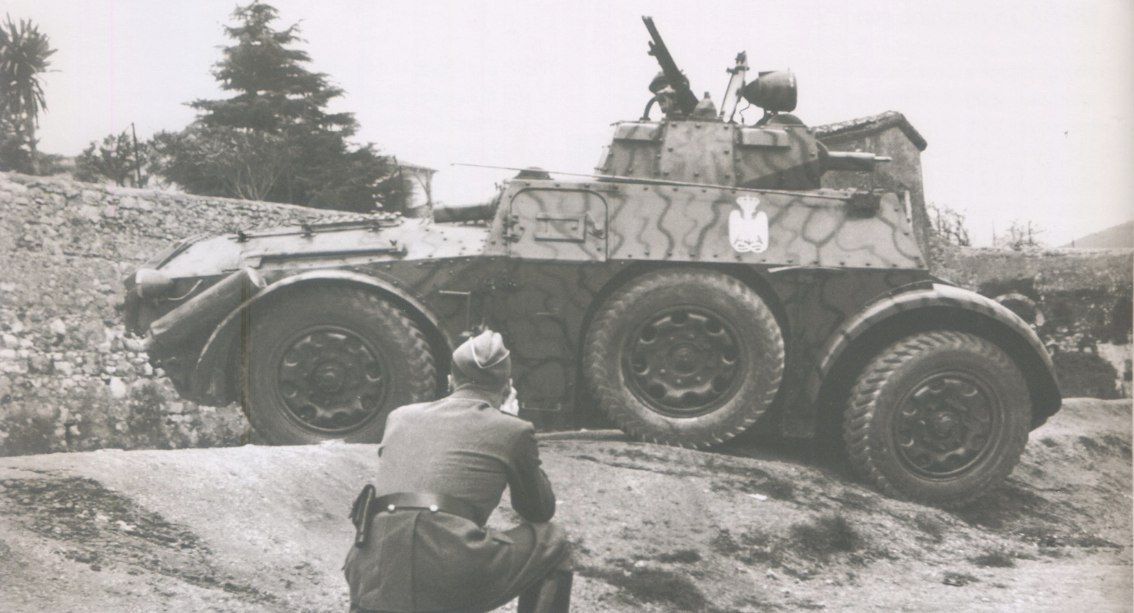
Indy is faced with an AB40 armored vehicle as he tries to
leave the street market. The AB40 (Autoblindo 40) is an Italian
armoured car manufactured by Fiat-Ansaldo during WWII.
(Photo from
Tanks Encyclopedia). |
 |
On page 70, Schutzstaffel is German for "Protection
Squadron" and was the secret police of Nazi Germany from
1925-1945.
Von Mephisto tells Indy he is a "knight of the Black Order,
representative of his eminence Heinrich Himmler." "Black
Order" is another term of the Schutzstaffel, though it
was not used in its time, but applied by some later writers of
the history of the organization. Reichsführer-SS Heinrich
Himmler (1900-1945) was leader of the Nazi secret police.
On page 71, "Third Reich" refers to the German state under the
Nazi Party of dictator Adolf Hitler.
On page 71, Mephisto says, "Danke!" when Indy
returns the lighter that had been a gift from his dear mother.
He then says, "Ich bin ein bad boy!" These are German
for "Thank you!" and "I am a bad boy!"
CHAPTER TEN
On page 72, "Jawohl!" is German for "Yes."
On pages 73-74, the following German and Italian words and
sentences are spoken in broken dialog:
"Bravo! Bravo! L'americano e molto intelligente! Molto
coraggioso!" ("Bravo! Bravo! The American is very
intelligent! Very brave!")
"Mach schnell! Machen sie einen U-turn!"
("Hurry up! Make a U-turn!")
"Come on--fai presto!" ("Come on—hurry up!")
"Buongiorno, fratello!" ("Good morning, brother!")
On page 77, the Ponte St. Angelo is an actual bridge over the
Tiber River in Rome, originally built in 134 AD by the Roman
Emperor Hadrian.
 |
Von Mephisto says he was at Wewelsburg Castle and knows the
secrets of the Schwarze Sonne. Wewelsburg Castle is
a Renaissance era castle in the village of
Wewelsburg,
Germany. During the war it was the central SS training site.
The Schwarze Sonne (Black Sun) is a symbol that was
built into the marble floor of Wewelsburg Castle's north
tower and the symbol (original meaning unknown) was adopted
by Himmler as one of the symbols of the Schutzstaffel. |
On pages 78-79, untermensch and "Tried ihn jetzt!"
are German for "subhuman" and "Try him now!"
On page 79, Indy shouts at Mephisto, referring to him
sarcastically as "Superman". Indy is likely relating the Nazi's
use of the word
untermensch
(subhuman) for that of
German philosopher Nietzsche's use of ubermensch
(superman) in his work of philosophical fiction, Thus
Spake Zarathustra, published in parts from 1883-1892.
CHAPTER ELEVEN
On pages 82-83, "Attenzione!", "Aqua minerale, per
favore!", "Grazie," "boconotto", and
"Grazie, signore," are Italian for "Attention!", "Mineral
water, please!", "Thank you," "bocconotto" (an Italian pastry) and "Thank you,
sir."
On page 84, Indy, Bert, and the two children drive out of Rome
in an NSU Fiat 500 two-seater, taking Via Aurelia to
Civitavecchia. "NSU" (NSU Motorenwerke) was a German
automobile manufacturer, but it seems to be misused here, as the
Fiat 500 two-seater, nicknamed "Topolino" ("little mouse"), was
manufactured from 1936 to 1955 by Fiat alone. The author seems
to have confused it with the later 1959–1963 NSU/Fiat Weinsberg
500. The Via Aurelia is an actual road in Rome (originally
constructed in 241 BC).
The next leg of the quartet's journey is to
Port Said on the Sinai Peninsula of Egypt.
CHAPTER TWELVE
Indy employs the services of Captain Toma Dzhmiliv (recommended
by Musgrove, having earned his department's trust over previous
missions) and his ship, the Jenny, to take him and his
threesome across the Mediterranean to Port Said.
On pages 88-89, "Si," and "Arrevederci" are
Italian for "Yes," and "Goodbye."
On page 89, in Port Said, McDonald asks Indy if he's there to
see the Imam. Imam is the title of someone who is a prayer
leader of Islam. Later in the book, it turns the Imam in
question is the same one Indy went to see to translate the
markings on the headpiece to the Staff of Ra in
Raiders of the Lost Ark.
Page 90 reveals that Indy is wearing an A-2 bomber jacket. A-2
jackets are leather flight jackets made in the 1930s-40s and
known especially as being a favorite among U.S. Army Air Forces
pilots, bombardiers, and navigators. While the leather jackets
worn by Indy in the movies were inspired by the A-2, they all
had various modifications made to them for styling, stunt, and
performance reasons.
At the docks of Port Said, Indy admires the beauty of the HMS
Napier, an N-class destroyer ship of Australia. The
Napier was an actual destroyer of the British
Navy built for Britain's sister country of Australia during
WWII. While the text here in the novel uses the ship prefix
"HMS" (His or Her Majesty's Ship), the actual destroyer used the
prefix HMAS (His or Her Majesty's Australian Ship).
On page 91, Port Said is struck by a flight of Stuka dive-bombers.
"Stuka" is
a German contraction of Sturzkampfflugzeug (dive
bomber), usually referring more specifically to the German
Junkers Ju 87 dive bomber of World War II.
|
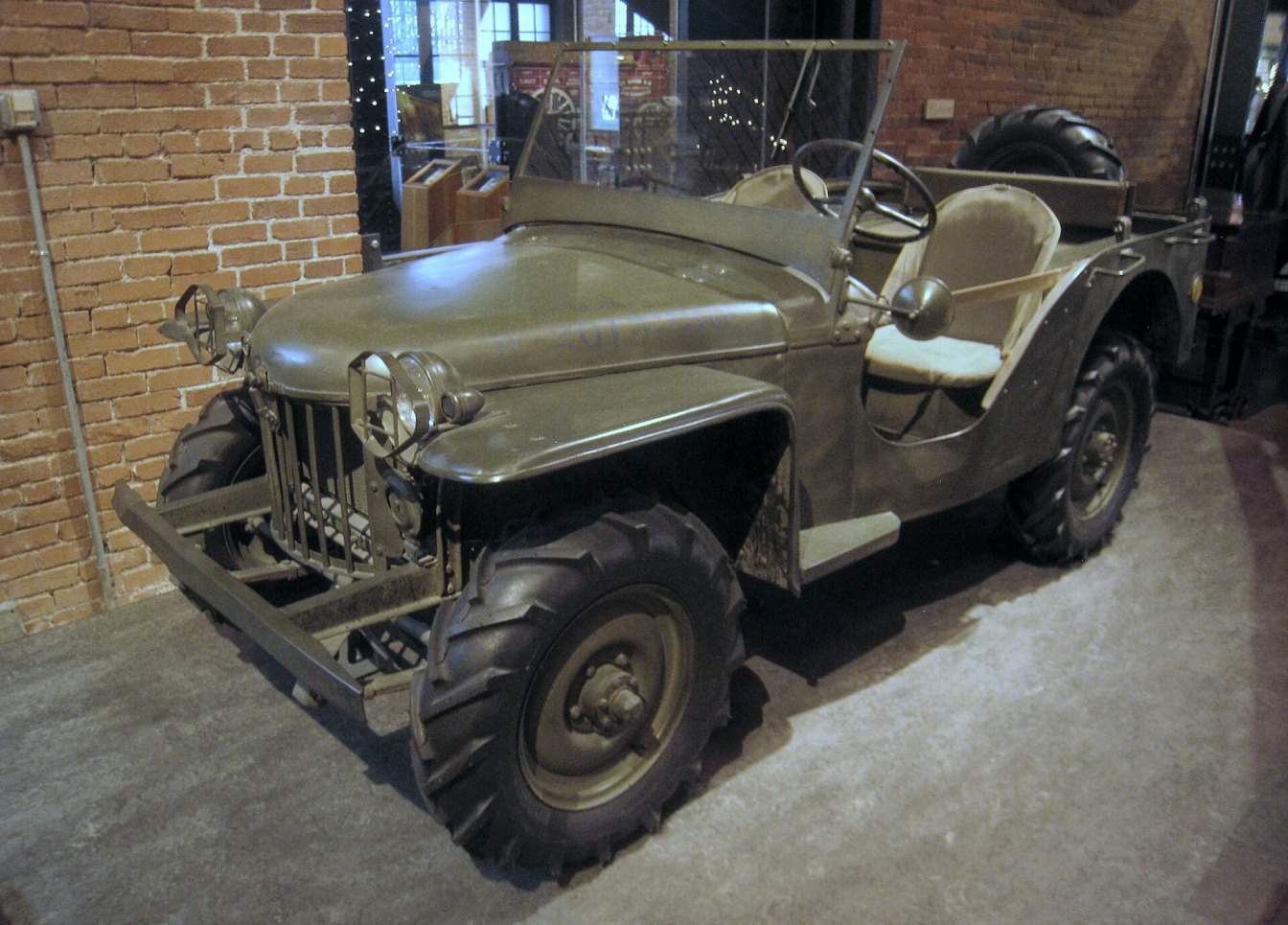
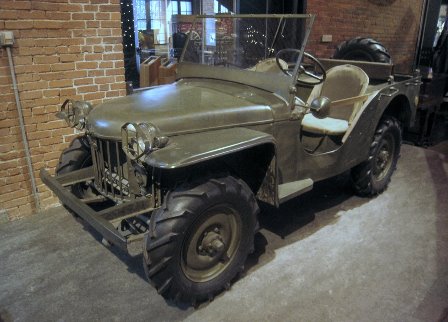
McDonald drives Indy and his crew
away from the battle of Port Said in a Bantam. The Bantam is
an American Bantam off-road vehicle constructed in 1940 in a
small number of a couple thousand and was the precursor to
the Jeep. |
 |
CHAPTER THIRTEEN
On page 94, Bedouins were a nomadic Arab ethnic group of the
deserts, now mostly settled in the modern cities of the Middle
East.
On page 95, Indy sees a membership card for the Bund in the
glove compartment of McDonald's Bantam. The German American Bund
was a pro-Nazi pre–World War II organization whose members were
all Americans of German descent who wished to promote a
favorable view of Nazi Germany.
Indy asks McDonald if they are headed for An Nakhi, which the
driver confirms. Possibly, they are referring to the town of
Nakhl, the administrative center of Egypt’s Sinai Peninsula and
not too far from what is traditionally accepted to be the modern day
Jebel Musa ("Mountain of Moses").
McDonald drives his charges in the Bantam through the mountains
of the Mitla Pass. This is an actual mountain pass in the Sinai
Peninsula.
Indy asks McDonald what he thinks of FDR. FDR are the initials of
Franklin Delano Roosevelt, 32nd president of the United States
from 1933-1945.
On page 96, McDonald tries to tell Indy that the Germans are
just protecting themselves from the Ruski Bolsheviks. "Ruski" is
a term used for a Russian. The Bolsheviks were a radical Marxist
faction of the Russian Social Democratic Labour Party, founded
by Vladimir Lenin and Alexander Bogdanov.
On page 98, Indy and the Bedouin man exchange greetings, "Es
salaam aleikom," and "Wa aleikom es salaam." These
are Arabic for "Peace be upon you," and "And upon you be peace."
On page 99, the Bedouin refers to their destination as the Veil
of Death. I am not aware of any real reference to a location by
that name or
as a reference to Mount Sinai. Indy, on the other hand refers to the Land of
Fayrouz. This is an Egyptian name for the Sinai Peninsula and it
means "Turquoise Land" in honor of the historical turquoise mines
there.
At the end of the chapter, the three camels bearing our heroes
and the Bedouin into the desert are referred to as the three
"ships of the desert". Camels have been referred to by that term
for centuries because they are like ocean-going ships in that
they travel an ocean of sand, carrying both passengers and
cargo.
CHAPTER FOURTEEN
On page 100, Indy sees a symbol on the Bedouin guide's
ammunition pouch that denotes him as a member of the Muzziena
tribe. This is an actual tribe of Bedouin in the southern Sinai
Peninsula.
On page 101, the Bedouin refers to Bert as seydah. This
is an Arabic term for "lady".
On page 102, Indy is brought into the presence of the Imam, who
says to him, "You seek my help," and Indy responds, "Ya
Mu'aleem." This is Arabic for "Yes, teacher."
Indy asks the Imam about how Sallah is doing and is informed
that he fights the barbarians (Nazis) in his own way.
The Imam refers to Ormuzd, or Ahura Mazda, as the Persian God of
Light and Life. This is correct, from Zoroastrianism.
When the Imam asks Indy if he's familiar with
inter-dimensionality, the concept of another world, another
dimension, Indy responds that is he is, a little, thinking to
his experience in the Hall of Records. Again, this was in
The Pyramid of the
Sorcerer.
The Imam's description of ormus, the so-called Bread of the
Gods, made from several metals that when heated takes on
mystical qualities, is one that has been promulgated in some 20th
Century esoteric literature. In this realm of knowledge, it is
referred to as Ormus (ORME, Orbitally Rearranged Monoatomic
Elements). Believed related to the manna mentioned in
Chapter Eight.
The Imam tells Indy that the Order of the Knights Templar were
familiar with the bread, having found the ancient scrolls hidden
under King Solomon's temple. This is also part of modern
esoteric/mystical canon. The Knights Templar were a Catholic
military order from 1139-1312, often associated with secret
societies and Catholic mysticism in modern mythology. King
Solomon is a Biblical monarch of ancient Israel, the son of King
David, and was famed for his wealth and wisdom and his temple
was a central place of worship in ancient Israel, traditionally
believed to have been built by King Solomon in the 10th century
BC in Jerusalem.
On page 106, Indy asks the Imam if manna is the power the
alchemists searched for, such as Magnus and Newton.
Magnus refers to Albertus Magnus (c. 1193-1280), a medieval
scholar, Dominican friar, philosopher, scientist, and theologian
of whom medieval legends claim he was also an alchemist who had
discovered the Philosopher's Stone. Sir Isaac Newton (1642-1727)
is often considered the father of modern science, though he was
also very interested in alchemy.
At the end of the chapter, Indy tells Bert that the thinks what
they find on Mount Sinai may make TNT look like a cap gun. TNT
is Trinitrotoluene, a chemical compound best known for its use
as a powerful explosive. A cap gun is a toy gun that makes a
sound and smoke like a gunshot when the gun's hammer hits a very
small paper or plastic cap of gunpowder loaded into the toy.
CHAPTER FIFTEEN
When Isabella tells Indy that she doesn't like the camels and
remarks that they smell like her tutor, Indy comments in
agreement, "I know what you mean. My tutor when I was a boy,
Miss Seymour, if she forgot to put on her perfume, she smelled
like a baseball mitt." Miss Seymour was seen in a number of
episodes of The Young Indiana Jones Chronicles as
Indy's aged tutor.
Page 108 describes the children as finally falling asleep around
the witching hour. The "witching hour" time can vary by
tradition, but is generally considered to be midnight to 1:00, a
time when supernatural forces are supposedly at their height.
On page 110, the Bedouin tells Indy and Bert they are nearly at
the location of Mount Sinai, halfway between the Gulf of Aquaba
and the Gulf of Suez. These are both bodies of ocean at the
northern tip of the Red Sea.
CHAPTER SIXTEEN
On page 113, Roca checks his Krag–Jørgensen rifle to make sure
its loaded when the group sees the Nazis have beat them to the
base of Mount Sinai. The Krag–Jørgensen is a repeating
bolt-action rifle designed by Norwegians Ole Krag and Erik
Jørgensen in the late 1880s.
On page 115, two German sentries spot Indy trying to climb the
cliff above them and exchange, "Was fur ein idiot!" and
"Ja!" These are German for "What an idiot!" and "Yes!"
On page 117, "Guten morgen, fraulein," "mein
frauchen", and "herr" are German for "Good
morning, missy," "my mistress," and "sir".
Von Mephisto relates more of his medals to Bert and the kids,
mentioning the Iron Cross, the Blue Max, and the JagerSchaft.
The first two medals are for military distinction in Germany in
the early 20th Century. The JagerSchaft was a hunting society in
Nazi Germany, meant not only to improve German hunting culture,
but also to promulgate Nazi ideology.
Bert refers to von Mephisto as "herr mac", much as
Marion Ravenwood had referred to the Nazi agent Toht in
Raiders of the Lost Ark.
"Mac" is a slang term for "fellow", but it may be that she is
referring to the fact that von Mephisto is wearing a trench
coat, also known as a "mac".
CHAPTER SEVENTEEN
Climbing Mount Sinai on page 118,
Indy arrives at the Egyptian Temple of Hathor, called the
Mistress of Turquoise. While the
Temple of Hathor is real, it is not located on the slopes of
Mount Sinai, but on a mountain plateau near the famed mountain
called Sinai. Hathor is the ancient Egyptian goddess of the sky;
she was called the Mistress of Turquoise.
On page 119, Indy sees evidence that the Temple of Hathor has
architectural traits and glyphs that date it to the Middle
Kingdom, about 2025 BC, and some from the New Kingdom, about
1550 BC. He makes a mental note to write an article about his
observations for
National Geographic Magazine. Generally, the Middle
Kingdom is considered to have begun at about 2040 BC, so Indy's
2025 date is a bit earlier and seems odd for him to reach that
year unless he had spent weeks or more studying the site to find
that earlier date.
On page 120, Anubis is the jackal-headed god of the afterlife
and mummification in ancient Egypt.
On pages 120-121, Indy reads an inscriptions on an altar in the
temple which invokes Ra and the Elohim and which reminds him of
prayers in the Egyptian Book of the Dead. "Ra" is the name of
the ancient Egyptian sun god. "Elohim" is a Hebrew word that
means "gods" or "those of godhood".
The real world Book
of the Dead is
actually a selection of varying scrolls of funerary rites which
the ancient Egyptians referred to as the Book
of Coming Forth by Day;
these books are meant to tell the soul of the deceased the
proper procedures and incantations for proceeding to the
afterlife.
CHAPTER EIGHTEEN
On page 124, an SS guard fires an
MP40 Maschinenpistole at Indy, shouting "Er ist
hier!" The
MP40 is a submachine gun designed by the German Heinrich
Vollmer in 1938. The guard's vocalized burst is German for "He
is here!"
Page 126 describes giant monsters
sculpted out of marble, stone, and bronze behind each of two
immense slabs of stone in the interior temple. Indy compares
them to the Colossus of Rhodes. The Colossus of Rhodes was a
statue of the Greek sun god Helios in the city of Rhodes, and
was one of the Seven Wonders of the Ancient World. It said to
have stood 70 cubits (or about 108 feet) high.
On page 126, "Nein! Nein! Ich werde nicht geben!",
sturmscharfuhrer, "Mach schnell!", "Erbarme
dich," and obershutze are German for "No! No! I
will not give!", stormtrooper leader, "Hurry up!", "Have
mercy!", and sergeant major.
On page 128, "Ah, mein dear kinder," is German for "Ah,
my dear children."
CHAPTER NINETEEN
On page 129,
sturmscharfuhrer, schutze, mein liepschen, and
kinder are German
for "stormtrooper leader", "rifleman", "my darling", and
"children".
On pages 130-131, Totenkopfring and Hochschullehrer
are German for "skull ring" and "university professor". The
skull ring (death's head ring) of the SS of Nazi Germany was an
award that was personally bestowed by Himmler on SS members of
distinction. Von Mephisto claims he earned his as a descendant of
Frederick the Second of Prussia. Frederick II was Holy Roman
Emperor from 1220-1250.
On page 133, schadenfreude is a German term, now used
in English as well, for the experience of pleasure or joy at the
misfortune of others.
On page 133, Mephisto observes that heat seems to have
activated anti-gravitational forces on the colossal statues and
Giovanni exclaims to Isabella that it's fairy dust just like in
Peter Pan. Peter Pan is a 1911 fantasy novel
by J.M. Barrie about a boy who can fly. In the novel the
character of Tinker Bell uses fairy dust to enable other
children to fly and follow her to Neverland.
CHAPTER TWENTY
Proceeding past the Colossuses, Indy finds a huge chamber in the
center of which is a towering obelisk. He observes that it is
covered with hieroglyphics like the other obelisks he'd seen in
Egypt, Paris,
Rome, and London.
There are indeed Egyptian obelisks now located in these
locations.
On page 136, Mephisto says "N'est-ce pas?" This is
French for "Isn't that right?"
On pages 137-142, "Jawohl!", "Schnell!",
"Schnell, sie schmutzige hund!", "Achtung!",
"Fertig!", Steilhandgranate, "Nien, sie
idiot!", and "Keine panik!" are German for "Yes!",
"Quick!", "Quick, you dirty dog!", "Attention!", "Ready!", stick
grenade, "No, you idiot!", and "Don't panic!"
CHAPTER TWENTY-ONE
No notes.
CHAPTER TWENTY-TWO
The proverb on page 148 ("An army of sheep led by a lion would
defeat an army of lions led by a sheep") is based on a quote
attributed to the ancient Greek conqueror, Alexander the Great
(353-323 BC), a Macedonian king who ruled one of the largest
empires of the ancient world and who was never defeated in battle.
On page 152, Indy hands over the vial of white powder and the
alleged recipe for it to Musgrove, who says "We'll get our top
men right on it," and Indy remarks, "Yeah. I've heard that
before." This is a reference to the end of
Raiders of the Lost Ark, where the
government tells Indy they have "top men" studying the recovered
Ark of the Covenant.
Musgrove hands Indy his next assignment, having to do with
supernatural experiments in Japan (Land of the Rising Sun), code
name: Tsuzumi Boshi. "Tsuzumi boshi" is a
Japanese term used to help children visualize the Orion
constellation, a tsuzumi being an hourglass shaped
drum, similar to the shape of the constellation.
The story ends on this thread, likely intended to lead
to another book in the series. Because the series was
discontinued, the Japan story has never been told.
Back to Indiana Jones Episode
Studies