 |
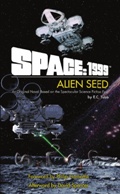
Space: 1999
Alien Seed
Novel
Written by E.C. Tubb
Original version published 1976
Powys timeline revised-version
published 2020 |
A large object collides with the Moon,
releasing a pair of horrors.
NOTES FROM THE
SPACE: 1999
CHRONOLOGY
According to Powys Media on Facebook: The
Powys revised version
of this novel, edited for continuity with the larger canon which
includes all of
Space: 1999
Season One, Season Two, and the original novels, takes place after
the events of "The Last Sunset".
STORY SUMMARY
The novel begins with Moonbase Alpha trying to make its
existence a little more sustainable. A large underground cavern
is being converted into a garden where plants can be cultivated,
providing food and giving the Alphans a more natural
environment. A young botanist, Constance Boswell, has been
involved in designing the garden, including its central
fountain.
As the garden project proceeds, Alpha detects a huge object
approaching the Moon. At first it appears to be an asteroid,
with a projected impact zone on the Moon close enough to Alpha
that the resulting impact could destroy the base. Commander
Koenig launches Eagles to investigate and determine whether
anything can be done.
Professor Bergman notices that the object isn't behaving quite
like an ordinary asteroid. Its appearance suggests something
artificial or biological. Rather than simply destroying it,
Bergman proposes using a controlled nuclear explosion to alter
its trajectory. Koenig agrees.
The plan works, but only partially. The object is deflected
enough to miss Alpha itself, but it crashes into the lunar
surface roughly thirty kilometers away. The collision breaks the
object apart.
The Alphans investigate the wreckage. Inside they discover
dozens of strange spherical objects, roughly melon-sized. The
exterior of the enormous object is extraordinarily tough and
difficult even to penetrate with Alpha's equipment. Bergman
eventually concludes that the spheres are biological seeds. The
gigantic object therefore appears to have been some sort of
interstellar seed pod, launched into space from an alien world.
There are 87 of the spheres. But there is an additional mystery:
the mass of the original object doesn't correspond properly to
the mass of the wreckage and the 87 spheres. Something else must
have been aboard.
Bergman, fascinated by the potential scientific value of the
seeds, persuades Koenig to allow them to be cultivated rather
than immediately destroyed.
While Alpha's people are investigating the crash site, a search
party disappears. The survivors of another expedition report
encountering something enormous and extremely dangerous. The
creature is not simply a physical monster. It appears capable of
affecting the minds of humans.
Meanwhile, back at Alpha, Dr. Russell has been conducting
experiments involving ESP and brain activity. One of the women
involved in the experiment,
Lynne Saffery, suddenly becomes violently disturbed.
Her brain-wave pattern contains a peculiar signature associated
with an extreme physiological state: hunger. The timing is
significant: Koenig eventually realizes that the woman appears
to be somehow mentally connected with the alien creature. The
creature itself has begun moving through the Moon's underground
caverns toward Alpha.
Koenig realizes that the woman's mental connection to the
creature can be exploited.
If she experiences an overwhelming sensation of hunger, the
creature apparently experiences the same thing, so Koenig devises a trap.
Food is placed in an underground cavern, together with
explosives.
The woman is positioned where she can sense the food and
experience the anticipation of eating it.
The alien, responding to that hunger, follows.
As it enters the prepared cavern, Koenig triggers the
explosives.
The creature is destroyed.
The woman immediately begins to recover her normal mental state.
It seems as though the crisis is over.
But in fact, the real crisis is only beginning.
The seeds begin to grow.
The alien spheres that Bergman had preserved are now
germinating.
Alpha scientists attempt to reproduce the environmental
conditions of the creatures' home world. They create different
growing environments in the underground garden, hoping that at
least one will provide the conditions the plants require.
Most of the alien organisms die.
One doesn't.
A single plant begins growing extraordinarily rapidly.
It becomes enormous, resembling a gigantic alien flowering
plant.
Constance Boswell discovers it.
Something about the plant seems to affect her mind. She becomes
entranced and approaches it almost as if under hypnosis.
The plant's petals close around her.
When the other Alphans eventually find her, she is confused and
strangely protective of the organism.
More disturbingly, she is suffering from severe anemia.
The scientists examine the enormous plant.
It doesn't behave entirely like a plant.
It contains structures and characteristics that resemble both
plant and animal biology. Most disturbingly, the scientists
detect what sounds like a heartbeat coming from inside its
central trunk or bulb.
Koenig begins to suspect that something is developing inside it.
Then the plant opens.
From inside emerges a human-looking woman.
She is extraordinarily beautiful and bears a striking
resemblance to Constance Boswell.
Her name is Enalus. She initially appears harmless, gentle, and apparently innocent.
But she has an extraordinary psychological effect on the men
around her, who become fascinated with her almost immediately. They want to
protect her, spend time with her, and defend her against anyone
who suggests that she might be dangerous.
Women aren't affected in the same way.
This produces considerable tension throughout Alpha. Men become
jealous and possessive, while their female partners become
suspicious of Enalus.
Koenig himself is affected and Dr. Russell
realizes that he isn't behaving entirely rationally around
Enalus.
The situation becomes much more serious when Constance Boswell's
boyfriend, who has been assigned to guard Enalus, suddenly dies.
The cause is apparently catastrophic anemia.
There is no obvious explanation.
The guard who replaces him insists that Enalus never left her
room and therefore couldn't have been responsible. Dr. Russell begins to suspect that Enalus is somehow obtaining something
from the men around her.
Russell and Bergman secretly arrange an experiment.
Paul, one of the Alphans, spends time with Enalus while playing
his guitar for her. His physical condition is secretly
monitored. When Enalus touches him, his blood measurements
change dramatically; he is becoming anemic.
The Alphans finally understand what is happening.
Enalus isn't exactly drinking blood like a conventional vampire.
She is taking iron from the blood, specifically the iron
associated with hemoglobin.
The men who spend time with her therefore become progressively
anemic.
Most recover.
Constance's boyfriend died because Enalus had taken too much
from him.
The frightening implication is that Enalus apparently isn't
consciously malicious. She is simply doing what her biology
requires.
She needs the iron to continue developing.
Because Commander Koenig himself has been affected by Enalus, he is inclined to defend her and resist the idea that she should
be treated as a threat. Dr. Russell therefore has to act almost independently of him.
Eventually the women take responsibility for guarding Enalus.
The scientists realize that Enalus doesn't actually require
human blood.
What she requires is iron.
So they begin supplying her with iron directly, but this leads
to an unexpected consequence.
Enalus begins to change. She grows larger and increasingly less
human, swollen and strange, almost like a transitional
biological form.
It becomes apparent that her humanoid appearance was never her
final state.
Eventually Enalus stops feeding and becomes inactive, apparently entering a kind of hibernation
or metamorphic stage.
Then her body begins to split open. What emerges isn't another
physical creature, but an energy being.
It communicates with the Alphans and expresses gratitude for
their assistance.
Then it simply passes through the structure of the base and
leaves Alpha, disappearing into space.
And that is essentially the end of the crisis.
With Enalus gone, the situation on Alpha gradually returns to
normal and the Alphans are left with the realization that they have
witnessed only a small portion of an utterly alien life cycle.
DIDJA KNOW?
Alien Seed was an original
Space: 1999
novel by
E.C. Tubb first published in 1976. When Powys Media began its
continuation of the TV series as a series of new novels in the
21st Century, they obtained the rights to republish the original
1970s novels, revised for continuity with the Powys canon. The
revised version of the novel will be the main focus of this
PopApostle study with additional notes when significant
differences between the two versions are recognized.
The gigantic, tentacled alien creature featured in this novel is
reminiscent of creatures from the Cthulu Mythos of American
horror writer H. P. Lovecraft, not only in its physical
description, but in its capacity to drive a human being insane
(or nearly so) simply from the sight and experience of it due to
the extreme cognitive dissonance of the existence of such a
horrifying and powerful type of life in the universe.
CHARACTERS APPEARING OR MENTIONED IN THIS NOVEL
Commander Koenig
Professor Bergman
Nancy Coleman
Constance "Connie" Boswell
Connie's boyfriend (unnamed)
Paul Morrow
Dr. Russell
Lynne Saffery
Sandra Benes
David Kano
security men
Alan Carter
Chad Amonovich
Frank Baker (in Kano's memories only, deceased)
Main Mission operative
Dr. Mathias
Peter Garforth
Dr. Warren
Harmond (dies in this novel)
Chagny
(dies in this novel)
Dorothy Bergman (mentioned only, deceased)
Jamson
Peter Lodge
(dies in this novel)
Peter Lodge's girlfriend (mentioned only)
Edward Markham
(dies in this novel)
Ivan Beresov
(dies in this novel)
Osgood
Sonya
(mentioned only)
Tony Allan
Dennis
(mentioned only)
Enalus
George Tomlinson
Winters
DIDJA NOTICE?
The builder of the new fountain in the botanical cavern is
Nancy Coleman. Is she any relation to Cindy Coleman, who
later appears in "Dead End", also written by this novel's author,
E.C. Tubb?
Presumably the botanical cavern is the same cavern that was
just beginning to be dug in
"Breaking Ground". On page
97, the cavern is officially called Rural Area One,
nicknamed Eden.
On page 2, Commander Koenig reflects on the tremendous
explosion of nuclear waste that tore the Moon from Earth's
orbit and sent it on its incredible journey in
"Breakaway".
Page 3 reveals that the botanical cavern has a mass of
lights mounted into the high ceiling to mimic an Earth-type
sun, complete with sunset, nighttime with stars, and dawn.
Page 4 explains that the inhabitants of Moonbase Alpha had
recently been disappointed in hopes of being able to escape
the confines of Alpha through the actions of the people of
the planet Ariel who had tried to help them. This refers to
events in "The Last Sunset".
On page 4, Connie Boswell talks about also adding some
artificial birds in artificial trees in the cavern, to sing
during the day.
Nancy tells Koenig that some of the men want to decorate the
walls of the cavern to look like the interior of a
cathedral, suggesting Chartres.
Chartres Cathedral is
a real world Catholic cathedral in Chartres,
France built
in the late 12th and early 13th centuries. It is famed for
housing the Sancta Camisa (the alleged tunic of Virgin Mary
worn during Christ's birth) and its Black Madonna statue.
| On
pages 6-7, Dr. Russell tests
Lynne Saffery for extrasensory perception using cards whose
faces are marked with star, circle, square, cross, or wavy
line, which Dr. Russell later tells Koenig were invented by
a Dr. Rhine years ago.
These cards are actually called Zener cards, designed
by perceptual psychologist Karl Zener (1903–1964), who
worked with parapsychologist J. B. Rhine (1895–1980) testing
subjects for extrasensory perception in the 1930s. |
 |
The asteroid belt between the
planets Mars and Jupiter mentioned on page 9 is real. It is
believed by most astronomers to have been formed from the
primordial solar nebula, though a smaller number of
researchers suggest it is the remains of an exploded planet
that may have once existed between Mars and Jupiter.
On page 11, Kano reports that the approaching asteroid is on
an intercept path with Crater Plato. Moonbase Alpha is
located in this crater.
Paul Morrow still has his arm in a cast and sling due to the
broken arm he suffered in "The Last Sunset".
This element was added to the Powys revision, not
seen in the original version of the novel.
On page 13, Bergman is described as a genius.
On page 18, Koenig orders three Eagles armed with a full
complement of nuclear missiles to intercept the object
approaching the Moon. This is the first indication that
Alpha is armed with nuclear missiles. What was the original
reason that missiles were stocked at the moonbase when the
Moon was still orbiting Earth? An additional NATO-type
deterrence of nuclear response to a nuclear attack against
nations of Earth by rogue nations?
Carter's co-pilot for the Eagle approach to the object is
Chad
Amonovich. He will appear again in "Dead End" by the same
author. In the original novelization of Alien Seed,
he is called Chad Bailey instead. I don't see any reason the
name was changed unless it was just to increase the
international flavor of Moonbase Alpha with a
Russian-sounding last name.
It seems that David Kano attended Dawakin Tofa Science
College, as he was acquainted with Frank Baker, gardener
there, a man he greatly respected for his uneducated wisdom.
Dawakin Tofa Science College is a real world college in the
state of
Kano, Nigeria. Is David Kano named for his home state?
After Alpha successfully nudges the object off its collision
course with the moonbase, Computer predicts it will strike
the Moon about 30 miles away in the region of Gaghiel, a
shallow satellite crater of Plato. As far as I can find,
Gaghiel is a fictitious name as far as Moon craters go. In
the original novel, the crater is called Schemiel, which
also seems to be fictitious.
On page 37, Dr. Mathias tells Koenig and Russell of an
experiment he and fellow students performed at the Kenyatta
Institute in Nairobi. This presumably refers to
Kenyatta
University in
Nairobi,
Kenya.
The Peter Garforth who appears in this novel also appears in
"The Lambda Factor", Survival, and Born for
Adversity. In the original novel, the character is
simply someone called "Frank" instead.
On page 47, Dr. Russell looks at a sketch of a house that
Bergman had once planned to build. This must be the same
house of which she had seen the plans for in Bergman's
quarters in "Black Sun".
On page 49, Koenig, Bergman, and Dr. Russell discuss where
the gigantic seed pod originated and how it could have wound
up in space, speculating a scenario similar to the 1883
explosion of Krakatoa. Krakatoa is a caldera in a volcanic
island group in the Sunda Strait between the islands of Java
and Sumatra. In that year, the caldera exploded in one of
the most destructive events in recorded history, with some
researchers speculating it blew debris into space.
The panspermia theory that life travelling through space on
meteors and other types of debris can arrive at a hospitable
world and populate that planet is a real one
hypothesized by Swedish scientist Svante August Arrhenius in
1903 (though first proposed in the 5th Century CE by Greek
philosopher Anaxagoras).
Dr. Warren, the head of Hydroponics at Alpha, appears here
for the first time. Apparently no relation to astronaut
Frank Warren who died in
"Breakaway", Dr. Warren will be
seen again in "The Troubled Spirit". Warren does not appear
in the original version of the novel.
Dr. Russell tells Koenig that there is always the danger
that the pressure and stress the moonbase inhabitants face
on their bizarre, haphazard journey through the cosmos could
cause General Adaptation Syndrome, resulting in violence
against one another and their situation, similar to the
combat fatigue of World War One. General Adaptation Syndrome
is a profile of how organisms respond to stress, developed by
Hans Selye, an endocrinologist who conducted research in the
1930s into the responses of organisms to stress.
On page 56, Koenig, seeing Lynne in her hospital bed, thinks
she looks like a painting of an angel by a pre-Raphaelite
school artist. The pre-Raphaelite school of art strived for
realism in its artistic depictions.
A humorous line on page 56, as Koenig thinks that Lynne
looks like an angel: An angel, Koenig thought, but, at
times, all men thought women were angels. Most later changed
their minds.
On page 64, Bergman paraphrases a quote from Sherlock
Holmes, "When faced with the incredible, first eliminate the
impossible and then what is left, no matter how improbable,
must be the answer," and Koenig compares it to Occam's
Razor. Sherlock Holmes is the legendary fictional detective
character created by Sir Arthur Conan Doyle (1859-1930). In
the novel The Sign of Four, Holmes says "When you
have eliminated the impossible, whatever remains, however
improbable, must be the truth."
Occam's razor is a principle which suggests that the
simplest possible answer that fits the facts of a puzzle is
probably the correct one. It was devised by William of
Ockham (1287–1347), an English Franciscan friar and
philosopher.
Page 66 reveals that Bergman's
wife (named as Dorothy in the novelization of
"Black Sun"), died in a crash at
some point in his past.
Another amusing line, on page 68: David Kano wasn’t
married to the computer, but even so, he took it to bed with
him.
When Kano tries to call Koenig's commlink on page 70, he
receives a message telling him that the commander's commlock
was already engaged, with an option to hold or try again
later. In the original version of the novel, he calls the
"operator", who gives him that message! An instance of an
operator is seen again on page 151 of the original version.
This novel suggests that Professor Bergman would take
temporary command of Moonbase Alpha if Commander Koenig were
to die, until such time as a new commander could be decided
upon.
Page 97 states that Nancy Coleman developed a new strain of
wheat and page 99 informs us it was called W-725 and it took
her 15 years to develop. She had also bred a hybrid Luna
Orchid in the low gravity Moon environment and it had taken
the botanical world by storm. It goes on to state, if the Moon had not been blown
out of Earth's solar system, she would have been able to
retire with wealth to her small estate in the Lesser
Antilles. The Lesser Antilles are a group of islands in the
Caribbean, including the Virgin Islands, St. Lucia, and
Trinidad and Tobago, among others.
Worrying that the giant "seeds" could actually be eggs of
the tentacled creature that killed five men on the Moon's
surface, Koenig tells Bergman that he may have planted a
nest of serpents in Eden. Eden, as mentioned earlier in the
study, is the
Rural Area One hydroponics cavern beneath Alpha, but in
Koenig's statement it is also a reference to the Biblical
Garden of Eden, where the serpent (Satan) tempted Eve.
On page 111, Bergman is said to have a depiction of the
Evening Star, one of the first interplanetary transports, on
his desk.
The man called
Osgood in charge of cavern examinations on page 115, is
probably Patrick Osgood who appears in a similar role in
"Catacombs of the Moon". In the original version of the
novel, the character is called Roper.
On page 123, Koenig compares Dr. Russell to Galen. Galen
(129-216 CE) was a Greek physician, surgeon, and medical
researcher who influenced the fields of anatomy, neurology,
pathology, pharmacology, and physiology, as well as the
disciplines of logic and philosophy.
In the original version of the novel, no mention of Galen is
made, Koenig simply thinks of Russell as a tiger when she is
determined to get her way in a medical situation.
In the original version of the novel, security chief Tony
Allan is replaced with a standard security man named Brody.
On page 129, Connie and Edward discuss the myth of Jason and
the Argonauts and of Cadmus. Jason and the crew of the
Argo, as well as Cadmus are characters from Greek
mythology. Edward corrects Connie's assertion that Jason
planted the teeth of the dragon that Cadmus slew, which grew
into warriors, saying it was Cadmus who planted the teeth.
But, actually, they are two separate legends, with both
Jason and Cadmus planting dragon's teeth in the ground. I
suppose this mix-up was intentional on the part of the
author, to show that neither Connie nor Edward were
particularly up on their Greek mythology.
On pages 131-132, Koenig sits in his office listening to
music from Gustav Holst's The Planets suite,
specifically "Saturn, the Bringer of Old Age". This is a
real world music suite by Holst, written between 1914 and
1917.
Page 133 implies that Koenig enjoys skiing.
On page 135, Coleman explains that garden peas have 8
chromosomes and humans have 46, while the alien seeds
growing in the cavern have more than 500. Her statement of
the number of human chromosomes is correct, but the original
version of the novel has her saying 48. Older textbooks
(into the 1960s) used to say that humans had 48 chromosomes.
Geneticists Joe Hin Tjio and Albert Levan showed in 1955
that humans had 46 instead. I guess author Tubb was reading
an old textbook!
On page 139, Coleman remarks that chrysanthemums will only
flower when the days and nights are of equal length. I have
not found any knowledge that says this is so. Chrysanthemums
are known to bloom in response to short days and long
nights.
In the original version of the novel, when Koenig is told
that Connie Boswell suddenly has anemia, he remarks, "It's
almost like saying the girl has a fit of the vapours."
"Vapours" is an outdated, somewhat derogatory, term ascribed
to women who seemed to suffer from depressive or
hysterical conditions, believed to be caused by internal
emanations from the womb. It was essentially a way of
dismissing women's constitutions. Koenig's line was probably
removed for the new edition due to its outdatedness, and
possibly, so it would not sound dismissive of those who
suffer from anemia.
Dr. Russell explains that normal anemia is simple to treat
with injections of liver extract and vitamin B-12. This is
roughly accurate for common anemia (a lowered ability to
carry oxygen due low red blood cells count).
The Alphans name the woman who emerges from the sole
surviving alien plant Enalus. In Greek mythology, Enalus was
a man from the island of Lesbos whose virgin lover was to be
offered as a sacrifice into the sea in honor of the goddess
Amphitrite (Queen of the Sea and wife of Poseidon) and the
Nereides and he leaped into the sea with her.
On page 175, Enalus is compared to Aphrodite. Aphrodite is
the Ancient Greek goddess of love and beauty (Venus to the
later Romans).
When Koenig becomes fearful that a plague may have struck
Alpha on page 179, he thinks of it has one of the Four
Horsemen that have always threatened humanity. This refers
to the Bible's Book of Revelation, the vision of
the Four Horsemen of the Apocalypse (Pestilence, War,
Famine, and Death).
While Morrow assists with running a socialized test on
Enalus, his spot in Main Mission is taken by Winters.
Winters also replaces Morrow in "The Infernal Machine". In
the original version of the novel, the replacement is
referred to only as a relief man.
On page 188, Dr. Russell calls Sandra "Sahn". In Season Two
of the TV series, Sandra is always called Sahn, for short, for
some reason. In the Season One televised episodes, she is
always "Sandra".
In the original version of the novel, Dr. Russell calls
Sandra "girl" here instead!
UNANSWERED QUESTIONS
It seems rather coincidental that the gigantic pod carrying
the seeds is on a collision course not only with the
wandering Moon itself, but will collide at a point
practically on top of Moonbase Alpha. Considering that the
sole surviving progeny of the pod metamorphisized into an
ethereal, higher order of life, could it have been connected
to the Mysterious Unknown Force and therefore was
deliberately targeted for Alpha as a test of humans there?
Back to Space: 1999 Episode
Studies
