 |
Space: 1999
"The Last Sunset"
TV episode
Screenplay by Christopher
Penfold
Directed by Charles Crichton
Original air date: January 1,
1976 |
An alien civilization grants the Alphans'
Moon with its own atmosphere to sustain life.
Read the episode summary at the Moonbase Alpha wiki
NOTES FROM THE
SPACE: 1999
CHRONOLOGY
The Powys Books timeline suggests that this episode takes just
2-3 days after "Alpha Child".
CHARACTERS APPEARING OR MENTIONED IN THIS EPISODE
Professor Bergman
Commander Koenig
Tanya Aleksandr
Sandra Benes
Alan Carter
Ken Johnson
Paul Morrow
Dr. Russell
David Kano
Pierce Quinton
Operative Kate
Anna Wong
Lee Oswald
Dr. Mathias
DIDJA NOTICE?
Eagles 2 and 7 are in use at the beginning of this episode.
At 0:29 on the Blu-ray, Eagle 2 is seen flying through space
with the cockpit windows visible. Alan can be seen in the
pilot's seat with a spacesuit collar visible on his neck and
no one in the co-pilot seat. Yet, when the scene changes to
the cockpit interior, Ken Johnson is in the co-pilot's seat
and both men are wearing standard uniforms, not spacesuits.
In the episode, the planet the Alphans cross paths with is
called Ariel. The Zack comic book adaptation reveals that
the planet's sun is called Daius.
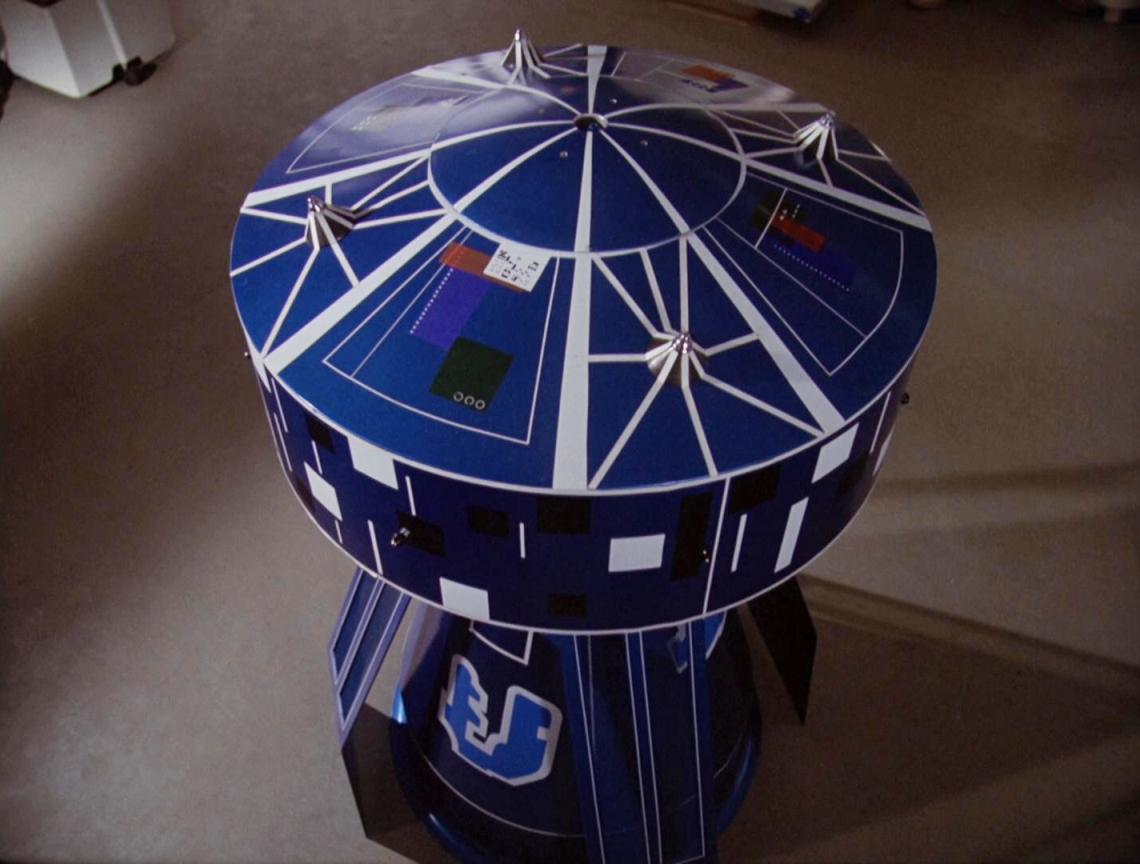
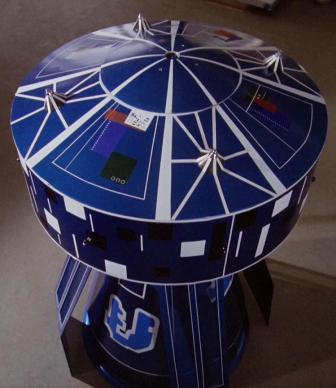
The alien probe miniature changes a bit from shot-to-shot
and its attachment bsit to the Eagle cockpit changes
position.
The alien probe appears to have alien writing on
it. This large prop version of the probe is much more
detailed than either of the two miniature models seen
previously.
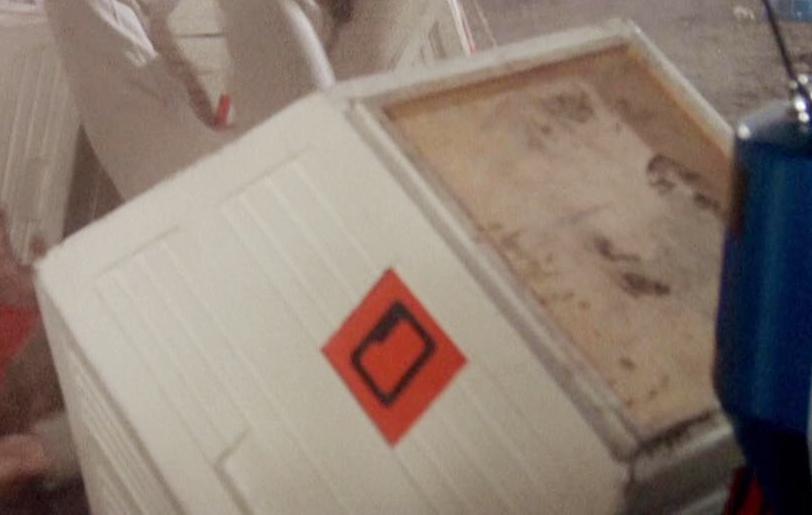
When the alien device unexpectedly begins emitting gas,
Koenig quickly rushes Dr. Russell and Bergman out of the
Technical Section room and seals the door, telling them,
"Helena, prepare to receive casualties. Victor, analyze that
gas sooner than possible!" It's hard to say whether the
"sooner than possible" line was a flub made by actor Martin
Landau or written that way intentionally to convey an ironic
sense of urgency.
The alien objects pour an Earth-level atmosphere over the
Moon and Sandra reports that the gravity is also increasing
to Earth equivalent. In the Powys novelization, she also
reports that the Moon's rate of rotation has increased to a
near twenty-four hour cycle.
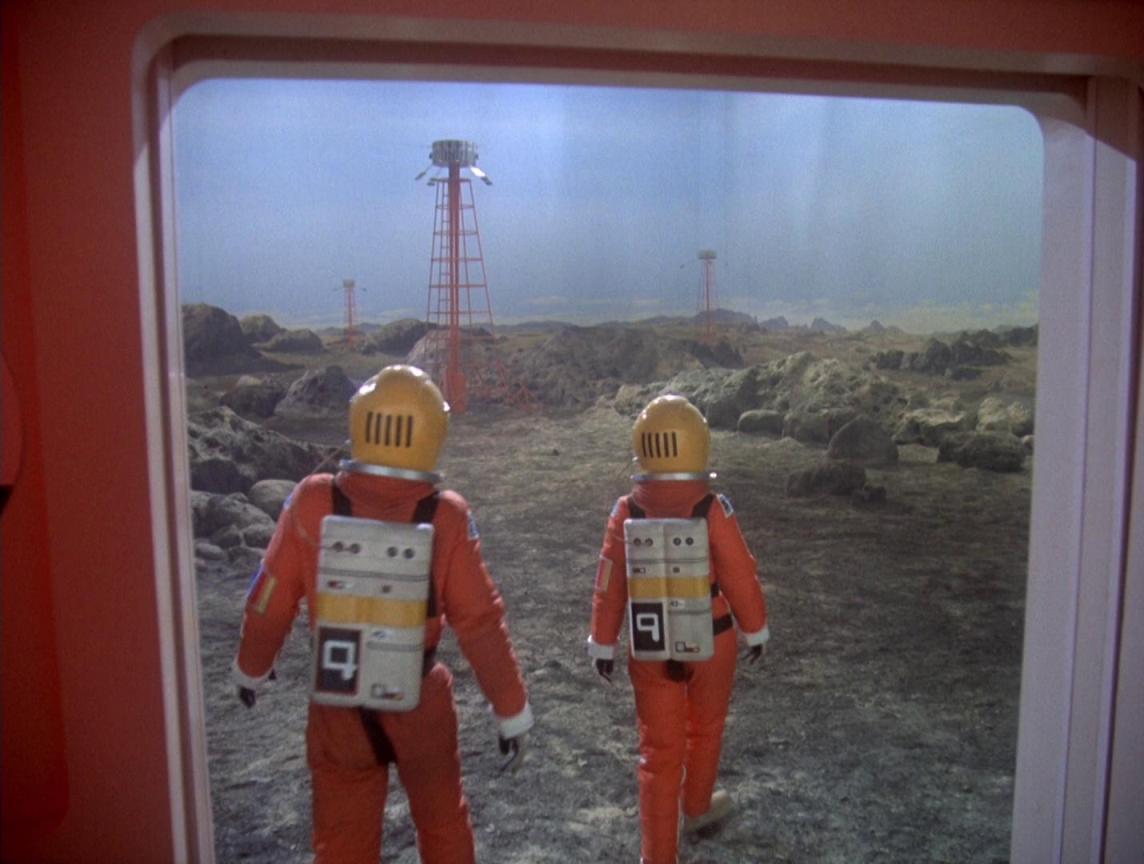
| At 11:41 on the Blu-ray, the
towers seen on the Moon's surface as Morrow and Sandra walk
out of the base airlock to test the atmosphere are
presumably some of the gravity towers, but they look
different than those that appeared in previous episodes. |
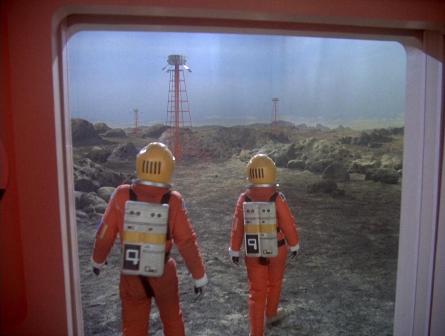 |
At 11:41 on the Blu-ray, seam lines of
the background "sky" can be seen on the wall of the set.
After breathing the new air of the Moon,
Morrow and Sandra rush to hug each other and, as they do,
Morrow's open helmet visor falls back down to cover his face
and they both laugh about it and Morrow raises the visor up
again. It seems as if this may have been a blooper that
occurred while shooting and the production decided to leave
it in.
Notice also that the pair try to kiss, but their
bulky helmets get in the way, another glimpse of their
romantic relationship as glimpsed in previous episodes.
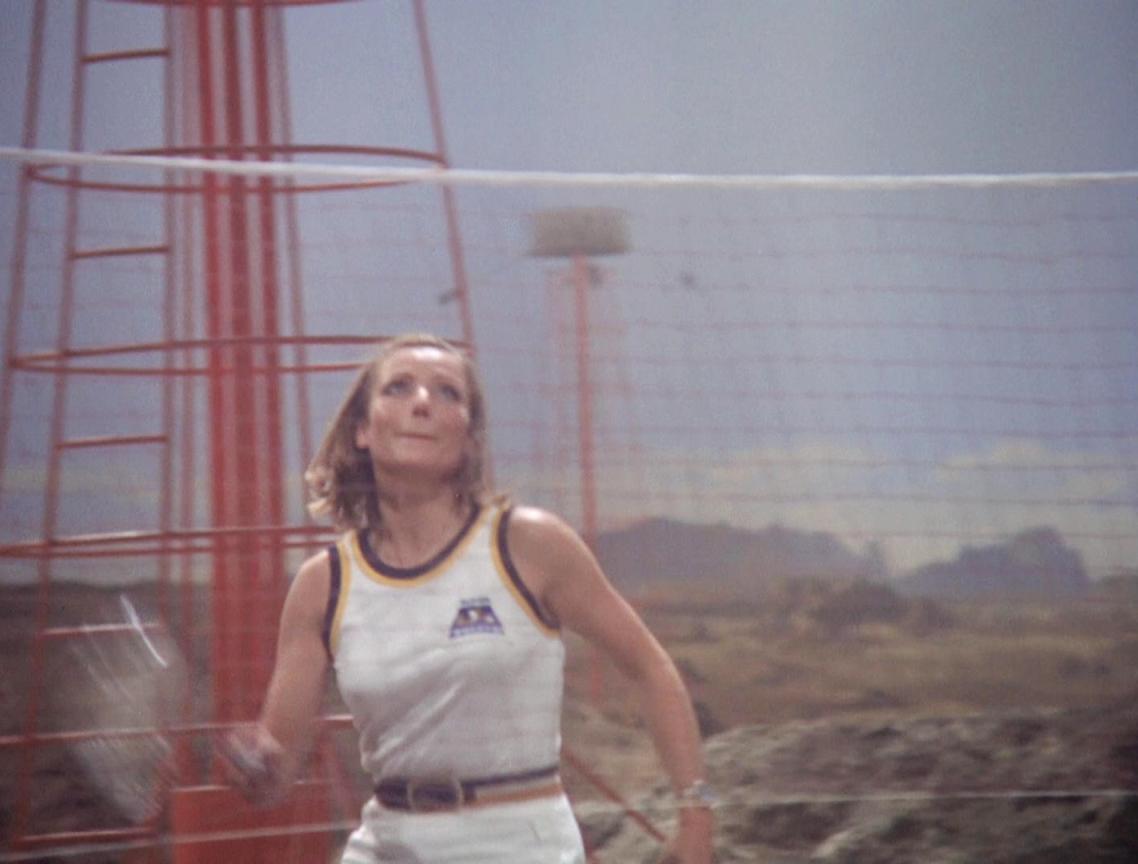
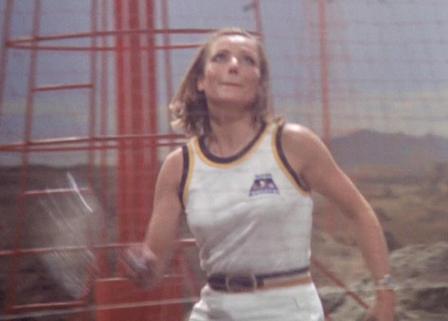
Playing badminton on the surface of the Moon, Tanya and Alan
are wearing Alpha Moonbase tank tops!
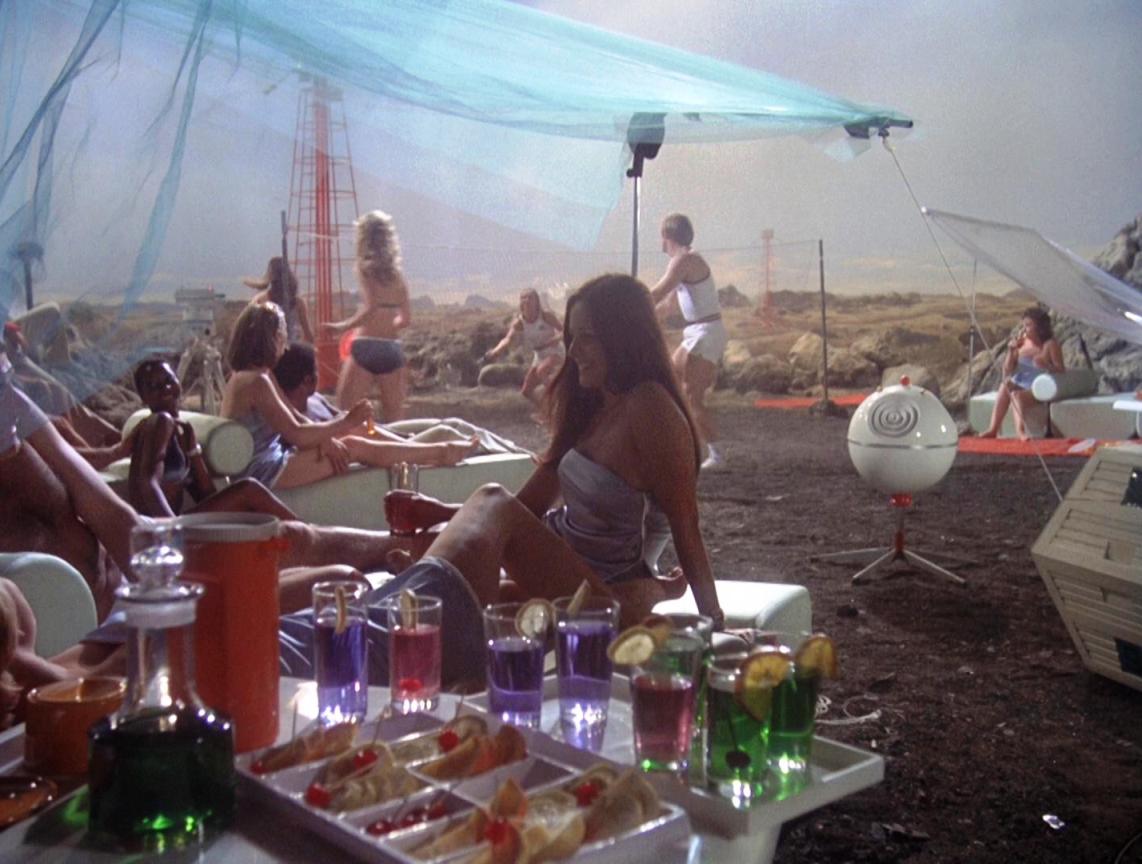
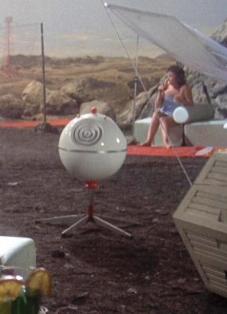
At 13:05 on the Blu-ray, a globe of the Death Star is seen
among the outdoor revelers.
At 13:16 on the Blu-ray, a handle that was never seen before
is suddenly in place to allow the window in Koenig's office
to be opened! Why would open windows ever be an option on
the Moon when the base was built?? However, the Powys
novelization (and the original 1975 novelization, for that
matter) explains that the window was just installed to take
advantage of the Moon's new climate and that the room it is
in is actually in the Technical Section, not Koenig's office
(though it looks much like Koenig's office!).
Part of a ceiling structure of the "outdoor" set can be seen
to the left of the gravity tower at 13:44 on the Blu-ray.
During her stroll on the Moon's surface with Paul, Sandra
remarks that the personnel of the base have done the longest
tour of duty ever.
Bergman is excited about the prospect of starting rain
cycles on the Moon and growing crops in the lunar dirt.
Koenig reminds him that it took 25 years to reclaim the
Sahara desert. In reality, the Sahara has not been reclaimed
and, in fact, the desert continues to grow larger. In the more
technologically advanced Space: 1999 universe, it
seems this was not the case.
When it starts raining on the Moon, Bergman rejoices that
soon the Sea of Tranquility will be an actual sea and the
craters will become lakes. Koenig rains on his parade by
pointing out that Alpha is built inside a crater, so it
could soon be underwater. According to most Space: 1999
sources, Alpha is located in Plato crater.
At 17:25 on the Blu-ray, a stray hair can be seen stuck on
the camera lens at the left of screen.
At 17:31 on the Blu-ray, Alpha personnel are seen bringing
supplies into the survey Eagle from the exterior doors on
both sides. But the previous establishing shot showed the
Eagle on the landing pad with just the starboard door
docked. It seems that the interior scene was meant to be of
an Eagle still in the underground hangar.
Carter flies Eagle 28 as the Alphans survey the
newly-habitable Moon for the best places to live.
In the Eagle, Morrow points out that there is a heavy rain
cloud forming over the Taurus mountains. This is an actual
mountain range (usually referred to in Latin as Montes
Taurus) on the Moon, named for the Taurus Mountains in
Turkey.
After Eagle 28 crashes, a number of Eagles are ordered into
the air in a search pattern: Eagles 9, 12, 24, 19, and 14.
After the crash, Carter remarks that there are 27
serviceable Eagles available at Alpha to search for them.
When the rescue Eagle flies nearby searching for the crash
survivors, why don't Carter and Morrow attempt to contact
with it their commlocks?
Dr. Russell discovers that briassic acid has leaked after
the crash and contaminated the food, medical supplies, and
water. "Briassic acid" appears to be a fictitious acid.
At 33:21 on the Blu-ray, the last water jug on Eagle 28 is
sitting without it's cap on when Morrow grabs it to pour a cup
for Sandra. He doesn't put the cap back on when done. Yet,
the jug suddenly has the cap on just half-a-minute later.
And then seconds after that, the jug is seen with the cap
off again! Also the water level in the jug changes between
shots.
Morrow calls the camp he sets up outside
the crash site for him and Sandra a new Garden of Eden.
The Garden of Eden, of course, is the land of paradise
created by God for Adam and Eve at the beginning of mankind
as described in the holy texts of the Abrahamic religions.
Morrow also refers to the new
mushrooms now growing on the surface as manna.
Manna is the name given to the divine food which
miraculously appeared to the Israelites for 40 years during
their exile in the desert as described in the Biblical Book
of Exodus.
Morrow remarks that the improvement in Sandra's condition is
born of hope, "But man should not live by hope alone." He is
changing up the idiom "man does not live by bread alone"
from Deuteronomy in the Bible.
Later, his mushroom-induced delusion has him using other
Biblical phrases like "milk and honey" and "sacred bread".
At 44:16 on the Blu-ray, Dr.
Russell's medical supply kit is seen to hold
Gillette
Sabre scalpels, an Avon Surgical blood administration set,
and a Twinlite diagnostic set. Something that looks like an
unlabeled container of
Tic
Tacs is also seen to appear as pills!
Eagle 28 is destroyed as Dr. Russell blows it up as a signal
to the rescue Eagle flying on the horizon.
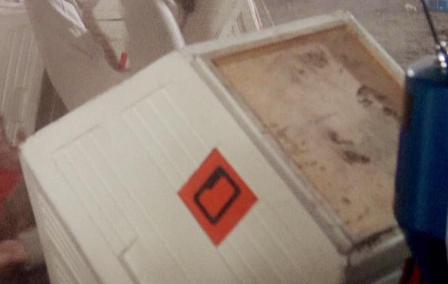
At 47:50 on the Blu-ray, Koenig and Morrow topple a stack
of futuristic plastic crates in their tussle and we can see
that the bottoms of the crates are just plywood!
At the end of the episode, it seems that Alpha plans to grow
more of the extremely nutritious mushrooms and remove the
hallucinogenic compounds so the mushrooms can be used as a
steady source of food.
The original alien probe that finally leaves the Moon and
beams a short message to Alpha is not the same more squat
probe that was seen arriving, but one of the thinner models
that arrived later.
This episode seems to hint of a relationship between Alan
Carter and Tanya Aleksandr.
 |
Notes from the novelization of
"The Last Sunset" by
John Rankine
as it appears in the Space: 1999 Year One
omnibus published by Powys Media.
The page numbers presented here come from the full
Space: 1999 Year One
omnibus. "The Last Sunset" begins on page 313 of
the book.
There will also be
notes (as appropriate) from the original adaptation of
"The Last Sunset" by
Rankine as it
appeared in Space: 1999 - Moon Odyssey, a merged
novelization of the episodes "Alpha Child", "The Last
Sunset", "Voyager's Return", and
"Another Time, Another
Place",
first published by Pocket Books in 1975. (Chapters
2-4 cover the events of
"The Last Sunset"). |
CHARACTERS APPEARING OR MENTIONED IN THIS
NOVELIZATION, NOT IN THE EPISODE
Sue Crawford
Jackie Crawford
Dr. Linden (mentioned only)
DIDJA NOTICE?
Sue Crawford and her baby son, Jackie, previously appeared
in
"Alpha Child".
The Dr. Linden who is mentioned by Sue Crawford on page 313
appeared previously in "Cargo" and
will have an important role in "Voyager's Return".
On page 318, as Morrow and Sandra are chosen to be the two
officers to first experience the Moon's new atmosphere, the
two come to be affectionately viewed by the rest of the base
personnel as the first pair for a new Garden of Eden.
After the Moon gains a climate of
its own, page 319 states that the Alphans were turning the
base into a Lido, working around the clock. "Lido" is a
British term for an outdoor swimming pool and its
facilities.
In the episode, Sandra says to Paul, "Do you know what
Earthly sounds I have come to miss the most in the silence
of space?" and Paul guesses, "Birdsong?" It stays at that in
the episode, but in the novelization she corrects him that
it's the sound of children playing, which seems to hint at
the thought of the two of them having children now that the
Moon is a living sphere.
After Morrow builds his campsite, it is described as a Heath
Robinson structure at best, but he saw it as if it was a Winter
Palace. Heath Robinson (1872-1944) was a British cartoonist
known for drawings of goofy contraptions built from whatever
assorted parts a character had lying around. "Winter Palace"
probably refers to the famed and opulent Winter Palace in
St. Petersburg, Russia that was the home of Russian Emperors from 1732-1917.
The end of the tussle between Morrow and Koenig here is
somewhat different than the one seen in the episode and the
original novelization, with Morrow suffering a broken arm.
Due to this, his arm is still in a cast and sling in
Alien
Seed.
 |
Notes from the "The
Last Sunset"
comic strip adaptation
German comic strip
Zack
#15
Koralle-Verlag GmbH
Text: Farinas
Art: Cardona
1978 |
Zack
was a German comic magazine, 17 issues of which featured a
Space:
1999
strip. Many of the strips were original stories, others
adaptations of the televised episodes. All were written by
Farinas and drawn by
Cardona (Spanish artist José Maria
Cardona Blasi).
DIDJA NOTICE?
When the alien objects begin landing on the Moon and
releasing gas on page 5, Commander Koenig orders the
magnetic protective screen to be raised around the base. In the TV
series, Moonbase Alpha is never specifically said to have a
magnetic screen or force field to protect it, though in
"Black Sun" Professor Bergman
develops a way to push extra power to the base's gravity
towers to deflect the massive gravity of the black hole the
Moon falls into. Possibly, Alpha is still able to use this
as a defense mechanism.
The ending message from Planet 16 (Ariel) is quite different
here than in the televised episode and novelization. The
alien speaker gives the name of the planet as Antar and tells the
Alphans that Antar will explode in a few years and they
had hoped to make the Moon habitable and live among the
Alphans. But their calculations were wrong and the
experiment did not work and now the Moon is continuing its
own trajectory away from the star system.
MEMORABLE DIALOG
sooner than possible.mp3
we've got an atmosphere.mp3
the longest tour of duty ever.mp3
we'll build a new Alpha.mp3
if it rains as hard as you hope it will.mp3
it wasn't a bad trip.mp3
human nature.mp3
Back to Space: 1999 Episode
Studies