 |
Space: 1999
"Spores"
Comic book story
Space: 1999 #3
B&W comic magazine published by Charlton Publications
Story: Mike Pellowski
Art: Adolf Buyalla
March 1976 |
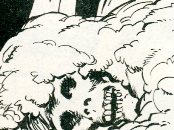
The spores of a space-borne fungus drift
onto the Moon.
Read the
brief story summary of "Spores" at Dark Worlds Quarterly
DIDJA KNOW?
"Spores" is a 15-page comic book story in issue #3 of
Charlton Publications' black-and-white
Space: 1999 magazine.
This is yet another story that begins with an object on a
collision course with the Moon. Others are
"Live Warhead",
"Black Sun", and, of course,
"Collision Course".
CHARACTERS APPEARING OR MENTIONED IN THIS STORY
Commander Koenig
Professor Bergman
Dr. Russell
Alan Carter
Paul Morrow
Hawk pilot #1
(unnamed, dies in this story)
Hawk pilot #2
assistant controller
botanical engineer (unnamed, dies in this story)
DIDJA NOTICE?
On page 1 of the story, the narrative mentions "John Koenig
and his 311 comrades" at Moonbase Alpha. The 311 number
comes from the number of personnel believed to be on the
base when the Moon was blown out of Earth orbit, as stated
in a newscast at the end of
"Breakaway". Of course, that 311 included
Koenig at the time! And, as perusers of PopApostle's
Space: 1999
chronology know, the base gained about 50 more refugees from
the top secret Moonbase Beta in
"Operation Deliverance".
Koenig and Bergman enjoy playing chess together.
On page 1 of the story, Alan Carter is engaged in the old
Earth custom of "standing on a corner watching all the girls
go by." This line is a lyric from the 1956 song "Standing on
a Corner" by the Four Lads.
In this story, Main Mission is for some reason referred to
as Emergency Base.
As in
"Live Warhead", on page 2 of the story Alpha sends up Hawks
to intercept the meteor. However, Alpha itself is not
known to have any Hawks (though a number of them are stored
at the as-yet-undiscovered secret cache on the far side of
the moon, as revealed by Admiral Walker in
"Aftershock"). It might be best
to here imagine that only Eagles are sent up to target the
meteor.
To pilot the "Hawks", page 3 describes Carter and two other
pilots proceeding from the "Emergency Base" to the adjoining
launch bay. What is it with "Emergency Base"??? The writer
continues using the term throughout the story and also the
term "Moon City" as if the two were separate compounds on
the Moon. Possibly, he was using some old promotional
material for a new series concept that eventually became
Space: 1999 (see
Publicity Booklet for Menace in Space).
In the lead Hawk, Carter refers to the other two Hawks
approaching the meteor as "brood".
The space spores that drift onto the Moon are seen to be
about the size of a baseball.
On page 9, Bergman, at a loss on how to control the space
fungus infecting the base, suggests, "Maybe COMCOM can give
a course of action to follow!" In the aforementioned
Publicity Booklet for Menace in Space, the
Commander's Computer in his office is called COMCOM.
On page 11 of the story, Bergman relates his idea of
producing heavy water through electrolysis and getting the
fungi to absorb it. Heavy
water is water in which the hydrogen component is mostly
deuterium (heavy hydrogen, containing both a proton and
neutron at its nucleus, as opposed to just a proton) instead
of standard hydrogen. It can be produced through
electrolysis, just as Bergman states. However, Bergman's
concept of using heat to then turn the "heavy fungi" into
miniature H-bombs to destroy them is pure fantasy.
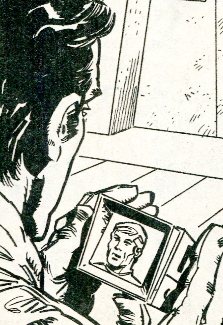
On page 12 of the story, the commlock in Koenig's hands is
about twice the size it should be!
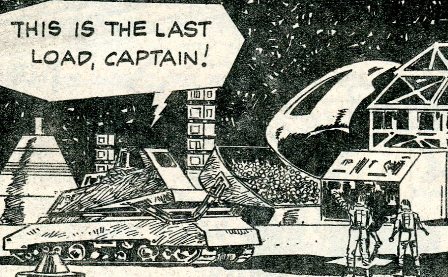
On page 15 of the story, a couple of bulldozer-like track
vehicles are seen to be part of the base's vehicle
contingent.
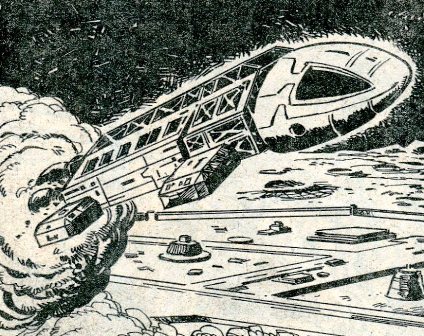
The Eagle seen on page 15 of the story is missing its
landing struts!
After destroying the fungi that has
invaded the base, personnel are sent to gather up the
remaining dormant spores and load them into an Eagle which
is then sent into space and set adrift. This seems like an
awful waste of the base's limited supply of Eagles! It's
better to think of it as the deadly spores were placed into
an hermetically-sealed containment pod and the pod then
ejected from the Eagle to drift into space.
It would also be essentially impossible
to gather up all the spores that had originally drifted onto
the Moon. They fell widely across the surface of the Moon
after all, not just on the base. Any expeditions onto the
Moon's surface should be continuously warned not to pick up
anything that looks like the large spores.
As the story ends, the Alphans are relieved to be rid of the
spores, now drifting in space aboard the sacrificial Eagle.
Carter then remarks, "Whoever finds those seeds and plants
them will reap a bitter harvest!" and Dr. Russell responds,
"Amen to that!" Are you frakking kidding me?! So, the
Alphans are celebrating the idea that some other poor
suckers will be killed by the spores! Hey, at least it's not
us, right?? (Not to mention that throughout the story, the
invading parasite is referred to as spores and fungi, not
sprouting from seeds.)
To provide a good laugh at the end of the story, Carter ends
up with an ironic case of athlete's foot.
Back to Space: 1999 Episode
Studies
