 |
Indiana Jones
The Hollow Earth
Novel
Written by Max McCoy
Cover by Drew Struzan
1997
(Page numbers come from the mass
market paperback edition, 1st
printing, March 1997)
|
Indy sets out to stop the Nazis from
recovering the Crystal Skull of Cozán from a watery resting
place in the Arctic.
Read the summary of this novel at the
Indiana Jones Wiki
Notes from the Indiana Jones chronology
This novel takes place from early to mid-February 1934.
Didja Know?
In this novel Indy has a position at
Princeton University.
Notes from
The Lost Journal of Indiana Jones
The Lost Journal of Indiana Jones is a 2008 publication
that
purports to be Indy's journal as seen throughout The
Young Indiana Chronicles
TV series
and the big screen Indiana
Jones movies. The publication is also annotated with notes
from a functionary of the
Federal Security
Service (FSB) of the Russian Federation, the successor
agency of the Soviet Union's KGB security agency. The KGB relieved Indy of his
journal in 1957 during the events of Indiana
Jones and the Kingdom of the Crystal Skull.
The notations imply the journal was released to other
governments by the FSB in the early 21st Century. However, some
bookend segments of The
Young Indiana Chronicles
depict Old Indy still in
possession of the journal in 1992. The discrepancy has never
been resolved.
The journal as published does not mention the events of this
novel, containing some notes from May 1933 relating to the
Crystal Skull of Cozán from
The Philosopher's Stone,
followed by the edges of four pages torn from the journal, with the next existing entries being from 1935 and
Indy's adventures as depicted in The Temple of Doom.
Characters appearing or mentioned in this novel
Indiana Jones
Ulla Tornaes
Nazi SS troops
Captain
Gunnar Erickson
Nicholas Swan/Sparks
Marcus Brody
Evelyn Briggs Baldwin (dies in this novel)
Abner Ravenwood (mentioned only)
station agent
Kapitan Rudolf Reingold (also uses the alias Rudolph "Rudy"
Hyde-Smith)
Jaekal
Dortmuller
(dies in this novel)
Leibel
(dies in this novel)
train conductor
track workers
track foreman
railway detective
Zoe Baldwin
gravedigger
arc light operator
Professor Rand
Toby
audience woman
Sheriff Roy Dickerson
Burgess Hotel desk clerk
Lincoln Ellsworth
Roald Amundsen
Burgess Hotel maid
cafe waitress
Reynolds (mentioned only, deceased)
bank robber
police officer
Wilbur Underhill
(mentioned only)
Wally Underhill
bus driver
Bertha Glover
Deputy Sheriff Buster
John Seven Oaks
Buster's brother
(mentioned only)
Juan Seven Oaks
(mentioned only, deceased)
Maria Seven Oaks
(mentioned only, deceased)
Jake Cruz
(mentioned only)
Jesse Cruz
(mentioned only)
bunk partner
(mentioned only)
Rene Belloq
Alecia Dunstin (dies in this novel)
irate farmer
cowboy
Clarence Robert "Bob" Ward
Donny Ward
(mentioned only)
saxophonist
kidnappers
Edwards
St. Charles Hotel manager
(mentioned only)
DuBois
(mentioned only)
Mr. James
(mentioned only)
wine steward
Ulla's father
(mentioned only)
waiter
float driver
Colonel William Markham
Creole cabbie
Lt. Goodwin
Captain Buck Blessant
Sergeant Dan Bruce
Sparks' father
(mentioned only, deceased)
Sparks' mother
(mentioned only)
Anna Jones
(mentioned only, deceased)
German men on raft
Dieter (dies in this novel)
Lord Dwyden (corpse only)
Lord Dwyden expedition members (corpses only)
monks
Henry Jones, Sr.
(mentioned only)
husky
Didja Notice?
The book is dedicated to Don Coldsmith and the Tallgrass
Writing Workshop. Coldsmith (1926-2009) was an American
writer of Western fiction. The Tallgrass Writing Workshop is
a workshop for writers hosted by
Emporia State
University in Emporia, Kansas with which Coldsmith was
associated.
The book opens with a quote from Edgar Allen Poe's 1833
short story "MS. Found in a Bottle".
Prologue: The Chimera of Memory
Indy continues to carry a trusty
Webley
revolver.
On page 1, "Schnell!" is German for "Quickly!"
On page 3, in their desperate situation, Ulla claims the
Valkyries have arrived. A Valkyrie is a Norse mythology
female being who guides the spirits of deceased warriors to
their reward in Valhalla, a hall of honored warriors in the
world of Asgard, home of the Norse gods.
Chapter 1: The Late Visitor
The chapter opens in
Princeton, New Jersey in the winter of early 1934.
On page 4, Indy is reading Coronado's Children.
This is a 1930 book by J. Frank Dobie about lost mines and
treasures in the southwest United States.
Page 5 reveals that Indy occasionally has a recurring
nightmare of being buried alive that may go as far back as
"that summer in Utah, when he was thirteen." This likely
refers to
"The Cross of Coronado",
where Indy gained his current fear of snakes when he was
thirteen in August of 1912.
On page 7, Indy tells Baldwin
that he is heading for New Mexico in the morning to do some
limited archaeological work in the Guadalupe Mountains. This
is an actual mountain range in southeast New Mexico and west
Texas.
Indy's visitor,
Evelyn Briggs Baldwin was a real world American polar explorer known
for the 1901-1902 Baldwin-Ziegler Polar Expedition, a failed
attempt to reach the North Pole from the Franz Josef Land
archipelago in the Arctic Ocean. In reality, he died in
1933, but here in the Indiana Jones universe, he lasted a
bit longer. Author Max McCoy acknowledges this in the book's
afterword.
Baldwin reminds Indy that they met briefly when Indy was a
graduate student at the
University of Chicago at a lecture
there. Indy recalls the lecture, which was about Baldwin's
adventures with Peary in the Arctic and the North Pole
misadventure. Indy goes on to gush that the man built Fort
McKinley and discovered Graham Bell Land and believed the
aurora borealis could be harnessed as a source of perpetual
power. "Peary" is Robert E. Peary (1856-1920), an American
explorer and naval officer who made a number of expeditions
to the Arctic. The Fort McKinley referred to here is the one
Baldwin established in 1898 in Franz Josef Land. Graham Bell
Land (usually called Graham Bell Island) is an island of the
Franz Josef archipelago. Baldwin believed the electricity of
the aurora borealis could be harnessed to light the world.
The wooden box Baldwin carries as he meets with Indy is
manufactured by Burroughs Wellcome & Co. This was a
pharmaceutical company founded in 1880 and now known as
GSK plc
(formerly GlaxoSmithKline plc).
On page 9, Schutzstaffel is German for "Protection
Squadron" and was the secret police of Nazi Germany from
1925-1945.
Also on page 9, the Luminous Lodge of the Vril and the
Thule Society mentioned by Baldwin were other names for the
Vril Society, a secret society postulated to exist by some
occult theorists. Many Nazis (the German National Socialists
party) of the time believed in the powers of an energy form
called vril allegedly accessible by humans of the "master race".
In this novel, Indy is said to own a
Ford coupe.
On page 11, Indy tells Baldwin that he's heard arguments
before that the Earth was hollow and they failed to
convince him. He may be partially referring to the events of
The Interior World,
where he experienced an adventure involving an underground
civilization, but at the end of the book was convinced (or
nearly so) by Marcus Brody that he was fooled by the use
of drugs and tricks by
Guajira Indians he encountered in South America.
On page 12, Baldwin asks Indy if
he's familiar with the legend of the Kingdom of Agartha and
Indy nods, saying it's an ancient Buddhist myth about a race
of supermen at the center of the Earth. This is correct,
though the Buddhist myths usually refer to the kingdom as
Shambhala. The name Agartha comes from French author Louis
Jacolliot's 1873 book Le Fils de Dieu, in which he speaks of
some Hindu Brahmins of Central Asia who told him stories of
Agartha, a city many millennia old that was the home of the
Aryan civilization.
Chapter 2: The Thule Stone
On page 14, "Penn Railway" refers to the Pennsylvania
Railroad, which existed as such from 1846-1968.
Marcus finds Indy at
Princeton Station.
On page 16, a man trailing Indy and his package pretends to
read a copy of
The Saturday Evening Post.
Marcus finds an article about the passing of Baldwin in the
New York
Times in between an article about two thousand
Italian marriages performed simultaneously to commemorate
the twelfth year of fascism and an item from La Paz about
new fighting over the Chaco region. I have been unable to
find reference to the two thousand simultaneous marriages in
Italy, though the Fascist Party of Italy did turn twelve
years old in 1934.
La Paz is
the capital of Bolivia. The reference to fighting over the
Chaco region is to the Chaco War of 1932-1935 fought between
Bolivia and Paraguay over the Gran Chaco region in which
Bolivia lost a large portion of the Chaco to Paraguay.
The Times article mentions Walter Wellman. Wellman
(1858-1934) was an American journalist and explorer. Baldwin
was his second-in-command on the 1898 North Pole expedition
mentioned here.
Indy asks Marcus to ask some of his Washington pals what
they know about the Thule Society.
Washington, D.C.
is the capital of the United States.
Marcus hands over to Indy a document from a collection in
Mexico
City as mentioned in
Coronado's Children that Indy had been looking for that was first discovered in the
basement of the palace in Santa Fe. The palace referred to
must be the
Palace of the Governors historic adobe in
Santa Fe,
New Mexico.
On page 19, Coronado's Children is mistakenly
called Coronada's Children and the city of Santa Fe
is mistakenly Sante Fe.
Captain de Gavilán and the pueblo uprising of 1680, mentioned
by Marcus on page 19, are true to history.
On page 20, Marcus suspects that Indy's search for something
in the Guadalupe Mountains has to do with the Crystal Skull.
Indy discovered a crystal skull in the lost city of
Cozán in Honduras in
The Philosopher's Stone,
but had it stolen from him by Leonardo Sarducci. Indy's been
looking to retrieve it ever since.
As noted in previous novels, and
on page 20 here, Marcus is the curator of special
collections at the
American Museum of Natural History in New
York.
On page 21, Reingold is said to be a member of the
Leibstandarte SS.
As stated in the book, the Leibstandarte was Hitler's
personal guard, part of the larger SS.
Reingold has his blood type tattooed under his right arm.
This was true of SS members, though it was usually the left
arm rather than the right.
As stated here, the Leibstandarte had a height requirement
for its members, but my research suggests it was 5'10", not
6'1".
The Reichstag fire Reingold ruminates on
on page 22 was an
arson attack on the German government's Reichstag building
on February 27, 1933, a month after Hitler was sworn in as
chancellor.
On page 22, Reingold is said to have been an advisor for a
new type of konzentrationslager in Dachau.
Konzentrationslager is German for "concentration camp".
Dachau was one of the first Nazi concentration camps in
Germany, built in March 1933.
Reingold reflects that he has a new, important task that was
assigned to him at the Eagle's Nest. The Eagle's Nest (Adlerhorst)
was a military bunker complex that served as Hitler's main
military command complex, but it was not built until 1939!
Jaekal carries a 9mm Luger Parabellum. Luger is a pistol
design first patented by Austrian Georg Luger in 1900.
On page 23, Jaekal says "Javolt." This is German
for "Yes, certainly."
Reingold pretends to be English with Indy and uses the alias
Rudolph "Rudy" Hyde-Smith, formerly of
London,
now of
Boston.
Reingold tells Indy he works in sales for Hister Industries,
which makes kitchen appliances, adding, "Ovens, mainly. Gas,
not wood." Hister Industries is a fictitious company, likely
a play on the name of "Hitler" on the part of Reingold.
Author McCoy may have borrowed the name "Hister" from the
prophecies of Nostradamus, which some claim was the
prophet's close attempt at naming Hitler as the figure who
will "by his tongue…seduce a great troop". The oven
reference is another dark cleverness by Reingold to describe
the giant ovens soon to be used to burn human corpses in the
Nazi concentration camps.
Reingold reads a copy of
Sports Afield on the train.
On page 31, Reingold pulls a 7.65mm
Walther pistol.
On page 33, Reingold remarks to Indy and the railway
detective that they seem to be in a Mexican standoff. A
Mexican standoff is a pop-culture term describing two or
more opposing parties, usually armed with guns, standing
off, each with an equal chance of killing one or more of the
others at the same time.
On page 34, Reingold shouts "Auf
wiedersehen, Dr. Jones!" This is German for "Goodbye,
Dr. Jones!"
Indy arrives in
Oswego, Kansas on page 34.
Baldwin's niece, Zoe Baldwin, remarks to Indy that she once
tried to read her uncle's book, "Under the North Star
or something like that--but it bored me to tears." Indy
retorts that he found it rather fascinating. The book they
are referring to is actually titled The Search for the
North Pole. As stated in the author's afterword,
Baldwin did not actually have a niece name Zoe, though there
was a niece named Geraldine Pinsor.
The Hotel Burgess and its Burgess Cafe in Oswego appear to
be fictitious.
When Zoe says her uncle's box that was left with Indy looks
like a little treasure chest, Indy tells her it is actually
a medicine chest that her uncle probably carried with him on
expedition. This fits in with the chest having been
manufactured by Burroughs Wellcome & Co., the pharmaceutical
company, as mentioned earlier.
When they finally decide to open the medicine chest, Indy
and Zoe find a piece of spar and Baldwin's journal from his
1902 expedition to reach the North Pole, including sketches
of the flagship America. America was the
actual flagship of the Baldwin-Ziegler Polar Expedition.
Chapter 3: Buried Alive
On page 42, Indy sees that his room at the Burgess is across
from the Nu-Day Theater, with its neon marquee advertising
Stronnger's Return starring Lionel Barrymore and
House on 56th Street starring Kay Francis, along with a
performance by Professor Rand's Vaudeville Canine Review and
Dog Circus from Harlem. The Nu-Day Theater appears to be
fictitious. I presume "Stronnger's Return"
is meant to refer to The Stranger's Return, a 1933
film that starred Barrymore. House on 56th Street
is another 1933 film, indeed starring Kay Francis. The
Canine Review is a fictitious performing troop as far as I
can tell. Vaudeville is a type of travelling variety show
performed live. Harlem is a neighborhood of the Upper
Manhattan borough of New York City.
Page 44 states that Indy had had his satchel's strap repaired
at a shoe shop in
Chicago
when he switched trains.
The entries Indy reads in Baldwin's journal appear to be
fictitious. While the entries express the fate of the
Baldwin-Ziegler Expedition in the very broadest sense, i.e.
failure to reach the pole and supply issues, I've been
unable to confirm the more detailed portions, such as crew
deaths and alleged cannibalism. The ship name of the America
is correct (as already pointed out above), but the other two
ships were Frithjof and Belgica, not Pluto and Proserpina.
The Camp Ziegler in Baldwin's journal was an actual camp
established by the Baldwin-Ziegler Expedition on Alger
Island of Franz Josef Land.
On pages 44-45, "the Stars and Stripes" is a nickname for the
U.S. flag.
On page 47, lapis exilis is Latin for "thin stone".
On page 50, Toby, a dachshund with the Vaudeville Canine
Review and Dog Circus, howls "Yankee Doodle". "Yankee
Doodle" is a
well-known American folk song since around the 1780s.
Also on page 50, Jaekal throws a
Nazi salute to the audience in the theater and shouts,
"Heil
Hitler!"
This is "Hail Hitler!" in German and was often spoken as
part of the Nazi salute during Adolf Hitler's reign over
Germany from 1933-1944.
On page 53, Thule
Gesselschaft is German for "Thule Society", as Marcus
says here.
The history of the Thule Society given by Marcus on page 53
is largely borrowed from the modern mythology of Nazism,
which emphasizes occultism and paganism, probably to a much
higher degree than was historically true. The mention of
Dietrich Eckhart (1868-1923) as the founder of the Nazis is
loosely correct. Hitler's book Mein Kampf (My
Fight) is dedicated to Eckhart, as Marcus states.
The Coming Race, as mentioned by Brody on page 53,
is an 1871 novel by English writer Edward Bulwer-Lytton
about a subterranean master race that harnessed the power of
vril to achieve a great civilization. Some readers then and
now believe the things said in the novel are true.
On page 54, Indy refuses to help the feds keep track of the
Germans who are after the Baldwin journal, citing the last
time he tried to help them he nearly got thrown from a
dirigible, shot at across half of Europe, and almost left
behind in the desert. This refers to events in
The Sky Pirates.
On page 55, the
Burgess Hotel desk clerk is asleep behind the desk behind
the sports section of the
Kansas City
Star.
On page 56, Indy rejects Zoe's attempt at a fling and says,
"I'm not in the mood, even if I am turning my back on the
Rosetta stone of Romance." "Rosetta stone" is
a reference to the ancient Egyptian stele transcribed in 196
BC, featuring a text in ancient Egyptian hieroglyphs,
Demotic script, and the ancient Greek, becoming a
translation tool for Egyptian hieroglyphics.
On page 60, as Indy is being
buried alive in a coffin, he hears a preacher speaking the
words, "...ashes to ashes, dust to dust..." These are words
from the
classic Anglican burial liturgy.
Indy finds that he was being
buried in Baldwin's cemetery plot and one of the funeral
attendees is American millionaire and arctic explorer
Lincoln Ellsworth. Ellsworth (1880-1951) was just as claimed
here. He was also one of the chief funders of the American
Museum of Natural History (where Marcus works at this time).
Ellsworth tells Indy that the glyphs on the Thule Stone tell
the story of Ultima Thule, "the mythical land where the gods
live at the top of the world." Ultima Thule was thought by
the Ancient Greeks to be the northernmost land on Earth,
usually an island in the Arctic Circle. The details of its
mythological history given by Ellsworth on page 63 are
accurate.
The story of Roald Amundsen (born 1872, disappeared 1928)
told briefly on pages 63-64 is accurate.
The Ellesmere Island mentioned in Baldwin's journal on page
67 is the northernmost island of Canada, off the northwest
coast of Greenland.
Baldwin's July 4, 1902 journal entry mentions that it is
Independence Day. This is
the U.S. Independence Day holiday, when the original English
colonies in America pronounced the Declaration of
Independence from Great Britain.
On page 70, Indy sees a couple of
men pull up on the street outside of the Burgess cafe in a
Pontiac. Pontiac was an American automobile manufacturer
from 1926-2010.
On page 71, a Catherine wheel is a type of firework mounted
on a stick, allowing the firework(s) attached to it to spin
on a wheel.
On page 72, one of the bank robbers wields a Thompson
submachine gun, known as a Tommy gun during the gangster era
of the 1920s-1930s.
Bank robber
Wilbur Underhill (1901-1934) mentioned by the cafe waitress
was an American criminal known for bank heists and burglary.
He was known as the Tri-State Terror, just as the waitress
mentions here; also known as Mad Dog.
Wilbur's cousin, Wally Underhill, is the crook who
turns out to be one of the bank robbers. As far as I can
find, Wally is fictitious.
Chapter 4: Apache Gold
As the chapter opens, Indy is dropped off by bus at
Guadalupe Pass and the Pine Springs Cafe. Guadalupe Pass is
an actual mountain pass in Texas, on the border with New
Mexico. The Pine Springs Cafe was an actual business that
existed in the area from 1913-1992. The woman who serves
Indy there is Bertha Glover (1893-1982), who owned the
store/cafe with her husband, Walter.
The bus that drops off Indy is travelling a road that was
once the trail used by the Butterfield Stage before the
Civil War. The Butterfield Stage was a passenger and mail
stagecoach service from 1858-1861 covering two routes, from
Memphis, Tennessee, and St. Louis, Missouri, to San
Francisco, California. The American Civil War lasted from
1861–1865.
Bertha remarks that Geronimo had claimed that all the gold
the Apaches had had come from the Guadalupe Mountains.
Geronimo (1829-1909) was a leader and medicine man of the
Bedonkohe band of the Apache people and was involved in
numerous raids of European settlements in the American
southwest and northern Mexico and in battles against U.S. and
Mexican military forces.
Bertha tells the story of John
Seven Oaks and that his adoptive parents lived in Juniper
Springs. This is an actual spring at the eastern base of the
Guadalupe Mountains in Texas.
On page 83, Indy gazes up at El Capitan, a craggy peak that
he compares to a Gibraltar. El Capitan is an actual peak in
the Guadalupe Mountains of Texas.
Gibraltar is an overseas territory of the United Kingdom on
the Iberian Peninsula, at the entrance of the Mediterranean
Sea; the Rock of Gibraltar is a gigantic limestone
promontory on the tip of the Iberian Peninsula near the
entrance of the sea.
On page 84, Indy interprets a
coiled snake drawn on his treasure map as a southwestern
folklore symbol indicating "dig here for treasure". This is
an actual symbol that was used throughout the ancient world
in the idea that snakes guard treasure. Likewise, the turtle
images Indy finds on the walls of the cave he explores match
the penchant for treasure hiders to point the way to it with
turtles, either etched on rock or wood, or constructed out
of rocks.
On page 86, Indy, crawling through a cave, finds an old
human skeleton wearing rotted
Levi's and with a .45
Colt
lying next to it.
On page 88, Indy is under "attack" by a mountain lion and is
reluctant to kill it because he likes cats (he
manages to scare it off instead). Possibly the "likes cats"
reference is a nod by the author to The Young Indiana
Jones Chronicles TV series and Old Indy's pet cat,
Henry.
On page 93, Indy discovers a chamber in the cave filled with
gold nuggets, Spanish armor and swords, and three
Wells Fargo strongboxes.
On page 96, Indy emerges from the underground lake unable to
see anything since his helmet-mounted lantern has been swept
away and his matches are soaked. He says, "Fudge," and the
text indicates he would normally have used a stronger
expletive, but dire circumstances always made him a little
more cautious with his language, just in case it mattered.
The mild language and the explanation for it may be author
McCoy's way of acknowledging prior author Rob MacGregor's
rebuke from George Lucas, with the
directive that Indy doesn't swear!
Indy's definition of autokinesis
on page 98 is accurate.
Chapter 5: Ghost Stories
Tornaes leads Indy on an arduous 3-mile hike to a mesa above Bell
Canyon. Bell Canyon is an actual geologic formation in the
Guadalupe Mountains.
On page 104, Tornaes reveals she is from
Copenhagen.
On page 105, Tornaes uses the phrase, "When in Rome..." The
complete saying is "When in Rome, do as the Romans do." This
proverb is usually attributed to Saint Ambrose, the Bishop
of Milan from 374-397 AD. Its meaning is simply that one
should follow the customs of the place one is at.
Rome,
of course, is the capital of Italy and was long the capital
of the Roman Empire.
On page 108, Indy deciphers the markings imprinted in one of
the gold bars he took from the cave for Tornaes, informing
her the bar was cast in
Mexico
City and was entrusted for transport to Spain by a man
named Don Pedro Juan Garcia. Garcia appears to be a
fictitious person.
As Indy states on page 108, the Aesir are the old gods of Norse
religion and mythology.
The story of his relationship with Alecia Dunstin that Indy
tells to Tornaes relates to events in
The Philosopher's Stone.
The irate farmer tells Indy and
Tornaes that he bought a sorry excuse for a car in Tulsa
that quit on him in New Mexico three days later.
Tulsa
is a city in eastern Oklahoma.
Indy tells Tornaes he learned about (American) Indian sign
language in the
Boy Scouts.
On page 117, Tornaes refers to herself as a Viking girl.
Vikings were Scandinavian warriors and seafarers in the 8th
to 11th Centuries. Scandinavia is a region of northern Europe
made up of Norway, Sweden, and Tornaes' homeland of Denmark.
A young cowboy drops Indy and Tornaes off at a small
airfield outside
El
Paso, Texas, then he drives off with a rebel yell. The
rebel yell was a war cry made by Confederate troops during
the U.S. Civil War of 1861-1865; at that time it was
described as a cross between an Indian war whoop and a
cougar growl. Since then, it is often depicted in film and
television as a simple "yee-haw!"
Indy and Tornaes get passage to New Orleans through Ward
Bros. Air Cargo. This appears to be a fictitious company.
Indy tells Tornaes that the Ward brothers are from Erbie,
Arkansas. This was a living town at the time, now largely a
ghost town and a registered historic place.
On page 121, Clarence tells Indy that Donny went down to
Jaurez for a couple days. He is probably referring to the
city of
Ciudad Juarez in Mexico, on the Texas border.
Clarence hesitates to help Indy again, saying the last time
he helped Indy fly something out of Yucatan, it took him a
week to patch up all the bullet holes in the plane. We might
imagine this as a reference to Indy's visit to the Yucatan
in
"Indy vs. the Volcano".
On page 121, Tornaes uses the term "Okies". This is a slang
term referring to a person from the state of Oklahoma.
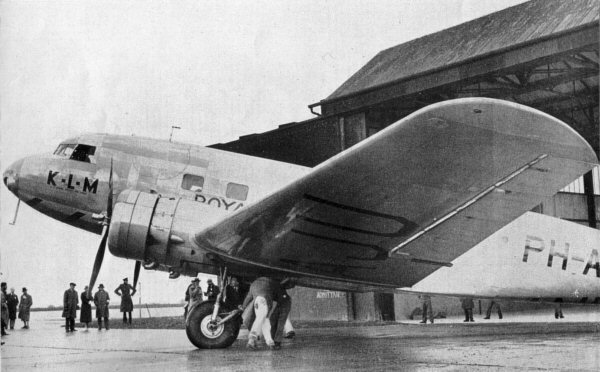
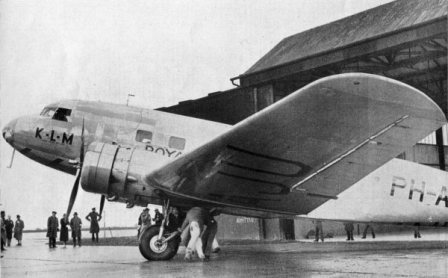
| The Ward brothers call their DC-2 transport plane Miss
Adventure, nickname Missy. "Miss Adventure" is
a play on the word "misadventure" (unforeseen or unplanned
events during an undertaking). The DC-2 was a twin-engined
propeller-driven aircraft produced by the Douglas Aircraft
Company from 1934-1939. |
 |
Clarence reminds Indy of two times he was arrested, in El
Cedral on Cozumel and in Costa Rica. El Cedral is a real
town on the Caribbean island of Cozumel (which is part of
the Mexican state of Quintana Roo). Costa Rica, of course,
is a country in Central America.
Clarence's estimate of about 1,000 miles from El Paso to New
Orleans on page 125 is accurate.
Chapter 6: Fat Tuesday
The name of this chapter comes from the translation of the
famous New Orleans annual festival called (in French)
Mardi Gras. It is a (very loose) Christian celebration
lasting for about 2 weeks from King's Day (the Twelfth Day
of Christmas) to the midnight before Ash Wednesday, the
first day of Lent (which itself is a six-week period of
penitence before Easter). Indy and Tornaes arrive in the
city on Shrove Tuesday, the day before Ash Wednesday. In
1934, Ash Wednesday was on February 14, so it is currently
the 13th for them.
As the chapter opens, Indy and Tornaes make their way down
Bourbon Street, heading for the St. Charles Hotel. Bourbon
Street is the most well-known historic street in the French
Quarter of New Orleans. The St. Charles Hotel was a real
hotel of the time, existing in three different buildings
built in the same location from 1837-1974. The history of
the hotel given by Indy on pages 131-132 is accurate.
The saxophone player at the street celebration is playing
"When the Saints Go Marching In". This is a Christian hymn
from the early 1900s that is also popular with jazz bands.
On page 132, Indy and Tornaes see a Mardi Gras
couple dressed as Marc Antony and Cleopatra. Marc Antony was
a Roman general and politician who became the lover of
Cleopatra of Egypt.
There were many queens of Egypt named Cleopatra. The most
famous one, and the one who is the focus of this story, was
Cleopatra VII, the last pharaoh of Egypt. After her death,
Egypt became a Roman province from 30 BC - 641 AD.
On page 133, the hotel clerk
tells Indy the manager is currently out with his krewe. A
krewe is a group of dancers in a carnival parade. They may
also build and decorate floats.
Indy mentions the owner of the St. Charles as being named
DuBois. I've been unable to confirm if this is accurate.
Indy and Tornaes are placed in the Pontalba Suite at the St.
Charles. I've been unable to confirm whether there was such
a suite by that name, but Gaston de Pontalba and his mother,
Baroness de Pontalba, were well-known in New Orleans from
1848-on and they built the iconic Pontalba Apartments just down
the road from the hotel.
Indy asks the hotel clerk to procure he and Ulla some
carnival costumes of the characters of Fortinbras and
Ophelia from Shakespeare's Hamlet. The character of
Danish queen Gertrude is also mentioned. William Shakespeare
(1564-1616), of course, is widely considered the greatest
writer in the English language. Hamlet is a 1601
tragedy play by Shakespeare set in Denmark and is about a
Danish royal family.
On page 135, Indy remarks that private ownership of gold is
now illegal. This was true in the U.S. at the time, due to
the passage of the Gold Reserve Act on January 30, 1934. The
act was intended to shore up the money supply in the nation
during the Great Depression. It largely achieved its
purpose, though, as with anything, it brought its downsides
as well. The act was repealed in 1974.
Indy and Ulla enjoy a bottle of Bordeaux at the hotel
restaurant. Bordeaux is wine produced in the Bordeaux region
of France near the
city of
the same name.
On page 136, Ulla remarks that New Orleans is really the
only place in the New World where one can get decent
training in the sport of fencing. This is at least somewhat
true, as the city has been known for several fencing schools
and clubs over the years.
On page 137, Indy tells Ulla he cashed in his gold ingots
for cash in an arrangement with Pelican Bank of New Orleans.
I've been unable to confirm if this was an actual bank in
the city at the time.
On page 140, Belloq says n'est pas and au
contraire. These are French for "does it not" and "on
the contrary".
Belloq is dressed as Jean Lafitte for the carnival, whom he
claims was a member of his family. Lafitte (c. 1780 – c.
1823) was a French pirate who operated in the Gulf of Mexico
and was particularly associated with New Orleans.
Indy introduces Belloq to Ulla as "Monsieur Belloq of
Marseilles." Monsieur is French for "mister".
On page 141, cuisses de grenouille is French for
"frog legs".
On page 142, bon appetit is French for "enjoy your
meal".
On page 144, Indy calls Belloq a "wormy little frog coward."
"Frog" is a pejorative term for a French person.
Belloq claims he is a baron.
When Indy and Belloq agree to a duel of pistols with each
other in the morning at
St. Louis Cemetery No. 2, Ulla chimes in that she will
be Indy's second. Belloq retorts that his second will have
to be Captain Dominique You. Indy explains to Ulla that You
was one of Lafitte's pirates and was at the Battle of New
Orleans. The You story is true. The Battle of New Orleans
was part of the War of 1812 between the U.S. and the U.K. on
December 24, 1814.
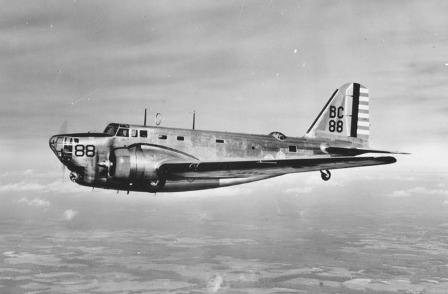 |
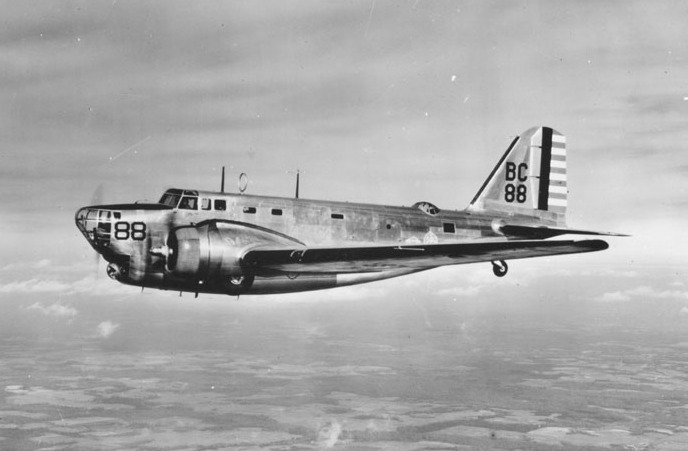
Colonel Markham offers Indy the use of a Douglas B-18 for a
proposed Arctic expedition to find out what the Nazis think
they have found there. The B-18 was a heavy bomber used by
the American and Canadian militaries in the late 1930s to
early '40s. It was not introduced until 1935, but Markham
does say here that the one he's offering is a prototype. |
Markham tells Indy his airplane will be on the tarmac and
ready to fly at 0900 at Shushan Airport (now called
Lakefront Airport).
Belloq takes Ulla to an antique store on Rampart Street
where she is able to acquire a pair of 1840 dueling pistols
for Indy's and Belloq's duel in the morning, as well as a
copy of the Code Duello book. Rampart Street is an
actual street of historical note in New Orleans. "Code
Duello" is Latin for "Duel Code".
Chapter 7: The Silver Ship
At the dueling site, Belloq says "Bonjour," to
Indy and Ulla. This is French for "Good morning."
Indy and Ulla find Belloq sitting atop the concrete of Marie
Laveau's grave at the cemetery. Marie Laveau (1801-1881) was
a famed American voodoo practitioner and herbalist healer in
New Orleans.
On page 156, Belloq says, "Merci," after Indy
chooses not to kill him. This is French for "Thank you." On
page 157, he says, "Au revoir," which is "Goodbye."
On page 157, Indy remarks they should get out of the
cemetery before they wind up in the Crescent City Jail.
"Crescent City" is one of the many nicknames of New Orleans
(in this case, referring to the crescent trail of the
Mississippi River through the city).
Page 159 states that the new terminal building of Shushan
Airport was built by the
Works Progress Administration. The Works Progress
Administration was created by the U.S. government during the
Great Depression and ran from 1935-1943. Since the current
novel takes place in 1934, the new terminal should not have
been built yet!
Lt. Goodwin tells Indy that he
located Clarence in the French Quarter with the help of a
military police detachment on Dauphine Street. This is an
actual street in the French Quarter of the city.
Indy tells Goodwin that Ulla is a specialist with the Danish
Speleological Survey. As far as I can tell, this is a
fictitious organization.
Goodwin tells Indy the B-18 has two Wright-Cyclone engines.
Wright-Cyclone was a series of air-cooled radial piston
engines produced by Wright Aeronautical (now
Curtiss-Wright) in the 1930s-40s.
On page 162, Goodwin tells Indy the B-18 has a Plexiglas
nose.
Plexiglas is a brand of transparent engineering plastic
often used in place of glass in construction where toughness
is important.
Indy is disappointed there are not more
firearms stocked for the expedition and Goodwin tells him he
can get Springfields with no problem. This refers to
Springfield Armory, a federal armory that served as the
main manufacturing center for U.S. military firearms from
1777-1968. The complex is now a protected national historic
site of the National Park System.
Goodwin also says he can probably scrounge up some
weapons at the naval air station on Long Island they'll be
stopping at. He is probably referring to Naval Air Station
Montauk on Montauk Point, built in 1917, which became
Montauk Air Force Station in 1953 until its shutdown in
1981.
On page 164, Clarence remarks that Donny is probably at Ma
Crosby's place in Juarez, eating steak tampico and drinking
beer. While there is a restaurant and bar called Ma Crosby's
in the Mexican city of Acuña, I'm unaware of there ever
having been one in Juarez. Acuña is hundreds of miles away
from Juarez.
Goodwin declares that the B-18 is nothing compared to the
B-17 still in development. The
Boeing
B-17 Flying Fortress is a four-engine bomber developed in
the 1930s and famous for its use during WWII.
Chapter 8: The Top of the World
Clarence dubs the B-18 the Penguin.
On page 166, the B-18 stops at Goose Bay, Newfoundland
(probably the same Royal
Canadian Air Force field at Goose Bay Indy visited briefly
in The Sky Pirates)
and then to Godthaab, Greenland (now
Nuuk).
Clarence remarks that he piloted a Jenny in "the big one."
The "big one" is a reference to the Great War (now known as
World War I). "Jenny" was a nickname for a Curtiss JN
biplane.
On page 167, Indy asks Sparks if he's heard anything from
Markham on the location of the Graf Zeppelin.
The Graf
Zeppelin was
a German transatlantic passenger airship offering service
from 1928-1937. Indy encountered the Graf Zeppelin
in The White Witch.
On page 168, Sparks asks what
they are listening for on the twenty meter frequency band, a
tone or a Morse signal? "Morse" refers to Morse Code,
a method of communicating via a series of on-off signals
such as flashes, tones, or clicks, invented by Samuel Morse
(1791-1872).
Sparks tells Indy he built all
the communications equipment on the Penguin,
starting with a standard super-heterodyne receiver invented
by Armstrong. Edwin Howard Armstrong improved the
super-heterodyne receiver in 1913 with an oscillating
principle similar to what Sparks describes here.
Sparks tells Indy he is from a little place in Iowa called
Payne Junction. Indy says he knows of it because he visited
some Indian mounds near there. There is a tiny farming area
in Iowa near the border with Nebraska that is sometimes
referred to as Payne Junction (or just Payne). I'm not aware
of any Indian mounds in that area though.
Reminiscing over a lost parent with Sparks, Indy remarks
that his mother died of scarlet fever.
Indiana Jones: The Ultimate Guide states
she died of scarlet fever on May 16, 1912.
Sparks says he read his father's
copies of
Amazing Stories, published by Hugo Gernsback.
Gernsback was the original publisher of the magazine
starting with its founding in 1926.
On page 171, Goodwin tells Indy they'll be landing in
Reykjavik to refuel in 20 minutes.
Reykjavik
is the capital of Iceland.
On page 172,
LZ 127 was the construction number of the
Graf Zeppelin when it was built by the Zeppelin
Transport Company (Deutsche
Zeppelin-Reederei) in 1928. Indy's comment that the LZ 127's
top speed is about 80 mph is correct.
The
Svalbard (or Spitzbergen) islands on page 172 are part
of Norway, just as mentioned here.
On page 173, Sparks comments they have to hope the
Graf Zeppelin radios back to Berlin so they can track
what direction it is heading.
Berlin
is the capital of Germany.
On page 176, Blessant jokes as he is about to take off along
the runway out of Reykjavik that he'd hate to run into "that
famous volcano they have here." Iceland is known for its
abundant volcanoes, many of which are still active. He is
probably referring to its most well-known and largest one,
Mount Hekla. Arguably, Hekla is far enough away from
Reykjavik that he doesn't need to worry about that one, but
he probably would not know that.
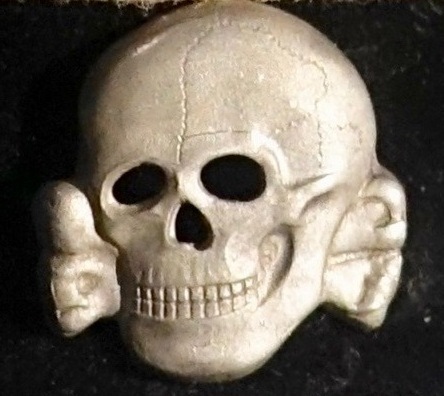
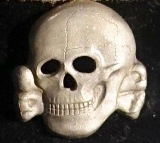
| On page 189, Reingold is said to
have the Totenkopf symbol of the SS on his cap.
Totenkopf is the German word for "skull". |
 |
Chapter 9: Lost!
The fighter plane carried by the
Graf Zeppelin is a Messerschmitt Bf.107a. As far
as I can tell, this is a fictitious experimental model.
Willy Messerschmitt was a German aircraft designer who would
go on to found the Messerschmitt aircraft manufacturing
company in 1938.
Page 191 mentions that Germany was forbidden to rearm by the
Treaty of Versailles. The Treaty of Versailles is the peace
treaty signed at the end of WWI in 1919. Part of its
provisions is that Germany was forbidden to rearm, but just
as in this novel, Germany secretly began rearming within a
few years for its own defense. (Indy was present for the
signing of the treaty in
"The Gentle Arts
of Diplomacy".)
On page 192, Ulla has to translate the German transmissions
between the
Graf Zeppelin and the Messerschmitt. But it was
shown that Indy himself speaks German in
"Demons of Deception".
On page 193, Indy refers to the
German pilot of the Messerschmitt as "Richthofen". This is a
sarcastic reference to
Baron Manfred von Richthofen, the Red Baron, who was
officially credited with at least 80 air combat victories
for the Germans in WWI. Indy met the baron in
"Attack of the Hawkmen"
and "The Fokker Agenda".
Translations of the German spoken
on pages 193-195:
"Was?" = "What?"
"Wie bitte? Ich spreche kein
Englisch." = "Excuse me? I don't speak English."
"Hallo! Guten Tag." =
"Hello! Good afternoon."
"Ja?" = "Yes?"
"Nein." = "No."
On page 198, Indy finds the
Messerschmitt pilot dead in his cockpit and when Ulla asks
him how the man is, Indy responds, "Kaputt." This
is German for "broken", but has taken on a wider meaning in
English as something that is utterly beaten.
On page 206, "midnight sun" is a phenomenon that occurs
during summer months north of the Arctic Circle and south of
the Antarctic Circle, where the sun is still visible at
midnight.
On page 207, the Union Jack is the flag of the United
Kingdom.

The Lord Dwyden expedition of 100 years previous which Indy,
Ulla, and Sparks discover the remains of appears to be
fictitious. The vitamin A poisoning that Indy speculates
killed the expedition members is an actual malady,
officially called Hypervitaminosis A, the result of the
ingestion of too much vitamin A. Just as Indy states, the
liver of huskies has unusually high levels of the vitamin.
On page 210, the Lord's Prayer mentioned by Sparks is a
Christian prayer taught by Jesus and found in the Gospels of
Matthew and Luke in the Bible.
Our Father, which art in heaven,
Hallowed be thy Name;
Thy kingdom come;
Thy will be done
in earth, as it is in heaven:
Give us this day our daily bread;
And forgive us our trespasses,
as we forgive them that trespass against us;
And lead us not into temptation,
But deliver us from evil;
For thine is the kingdom,
the power, and the glory,
For ever and ever.
Amen. |
Ulla's definition of the word "berserker" (from Old Norse)
on page 214 as one who wears a bear-shirt and has the fighting fury of a
bear is correct.
The story of Nansen and the Fram's attempt to reach
the North Pole in the 1890s on page 216 is accurate. Hjalmar
Johansen (1867–1913) was a Norwegian polar explorer who also
participated in the Amundsen expedition mentioned earlier in
this study.
Chapter 10: The Maelstrom
The mythology of Ragnarok told by Indy and Ulla on
page 219 is reasonably accurate to the Old Norse myths.
On page 223, St. Elmo's Fire is an electrical weather
phenomenon that is known to create a glowing plasma field
around a grounded object.
The crashed plane found by Indy and his crew on page 229,
called the Latham, was the actual plane, the Latham 47, used
on the Amundsen rescue mission that disappeared in the
arctic in June 1928.
Reingold says that Reichsfuhrer Himmler has an astrologer
who assured him the crystal skull was vitally important to
the future.
Reichsführer-SS Heinrich Himmler (1900-1945) was leader of
the Nazi secret police. He is known to have had an intense
interest in the occult.
On page 231, Alecia refers to
Reingold as hauptsturmführer. This was a Nazi
paramilitary rank meaning "head storm leader".
Alecia tells Indy of her recurring nightmare--actually
prophecies--that if the world fights the Nazis there will
come a moment when a single bomb destroys an entire city and
its inhabitants...and also that Indy would wind up sealed in
a tomb filled with thousands of snakes. Her visions are of
the atomic bomb used against Japan on the city of
Hiroshima,
Japan and, later,
Nagasaki in 1945 during WWII, and of Indy
getting sealed into the Well of Souls in Raiders of the
Lost Ark in 1936.
On page 234, Ulla takes an MP-40 submachine gun from a Nazi
soldier she has disabled. The MP-40 is a real world gun used
by the Axis powers during the war.
Chapter 11: Ultima Thule
On page 242, Ulla remarks that her and
Indy's team will be
the first on record to go into the hollow Earth and compares
them to Columbus. Christopher Columbus (~1450-1506) was an
Italian explorer who is credited with opening up, if not
exactly "discovering", the New World for Spain in 1492.
Ulla wants to call the shaft they're
travelling down in the Edda Shaft, referring to the Medieval
Icelandic prose and poetic tales of Norse mythology and the
Viking age.
On page 244, "Feuer eroffnen!" is German for "Open
Fire!"
On page 253, Indy reads the SS motto on Reingold's silver
cigarette lighter: Meine Ehre heisst Treue. He
translates it as "My honor is pure," but the actual
translation (and the actual SS motto) is "My Honor is
Loyalty."
Vril is here revealed to be a form of plasma, an ionized gas
that was forged in the interiors of stars eons ago. It
floated through space until attracted by Earth's magnetic
field where the Aesir collected it.
On page 256, Amundsen tells Indy he is aware of the sad
state of the world for the past seven years. He would seem
to be commenting on the time that has passed since he
disappeared in the arctic, but it has only been six years
(less, actually), from his disappearance in June 1928 to the
time of the novel, February 1934. It may be that this novel
was originally written as taking place in 1935, but was
changed to a year earlier for some reason, and this bit of
dialog fell between the cracks.
On page 257, Amundsen comments to Indy, "At least a hundred
major human civilizations have come and gone in the last
twenty thousand years, and that's not counting the
communities of nonhuman intelligences. One day it will all
be clear—but not today. Your time here is so short that it
would only confuse you." His remarks bear some resemblance
to the theme of Indy's much later adventure, The Kingdom
of the Crystal Skull.
Amundsen also remarks, "I know what the Aesir tell me—that
everything in the universe is connected, that it's all
happening at once, and that the passage of time is just an
illusion of human consciousness."
Epilogue
Indy, Ulla, and Sparks awaken, with their memories of the
world below gone, at the tiny town of Ny-Ålesund on
Spitsbergen. Today it is more of a
research station than a town, with a population of
around 35 in the winter and 120 in the summer.
As in the conclusion of
The Interior World,
Indy and his friends do not remember being inside the
"hollow Earth" after they leave it.
Though Indy and friends won't remember what happened below,
Indy should still find that he has a scar on his leg that he
cannot explain, from the shrapnel of Reingold's exploded
gun.
Earlier in the novel, Indy promised to tell Sparks his real
name when they get out of their predicament. Later, when
Amundsen tells him they will remember nothing of the world
below when they are returned to the surface, Indy takes that
opportunity to tell Sparks his name (Henry, Jr.), thinking
that Sparks will not remember. Of course, now that they are
back on the surface, Indy won't remember telling him, so
he'll have to cough it up again anyway!
Back to Indiana Jones Episode
Studies