 |
Indiana Jones
"The Fate of Atlantis" Part 4
Indiana Jones and the Fate of
Atlantis #4
Dark
Horse Comics
From a story by Hal Barwood & Noah
Falstein
Comic book plotted by Mike
Richardson
and William
Messner-Loebs
Script, pencils, inks, and
colors by Dan Barry
Lettering by Gail Beckett
Cover by Dave Dorman
September 1991 |
The final showdown against Nazis,
supernatural forces, and the power of Atlantis.
Read the video game story summary at the Indiana Jones Wiki
Notes from the Indiana Jones chronology
This story takes place in May 1939.
Didja Know?
The Fate of Atlantis is a 1992 graphic adventure
computer game published by LucasArts for MS-DOS, Macintosh,
Amiga, and FMTowns
personal computer systems.
A four-issue comic book mini-series was published by Dark Horse
Comics in conjunction with the computer game's release.
A fan-written novelization of the game and comic book was
released online for free from 2010-2013. The book
by Dale Dassel is generally held in high regard for its quality
of writing and research.
Notes from
The Lost Journal of Indiana Jones
The Lost Journal of Indiana Jones is a 2008 publication
that
purports to be Indy's journal as seen throughout The
Young Indiana Chronicles
TV series
and the big screen Indiana
Jones movies. The publication is also annotated with notes
from a functionary of the
Federal Security
Service (FSB) of the Russian Federation, the successor
agency of the Soviet Union's KGB security agency. The KGB relieved Indy of his
journal in 1957 during the events of Indiana
Jones and the Kingdom of the Crystal Skull.
The notations imply the journal was released to other
governments by the FSB in the early 21st Century. However, some
bookend segments of The
Young Indiana Chronicles
depict Old Indy still in
possession of the journal in 1992. The discrepancy has never
been resolved.
The journal as published skips
from entries shortly after the events of
The Last Crusade in June
1938 to those of The Fate of Atlantis in May 1939.
Characters appearing or mentioned in this story
Colonel Klaus Kerner (dies in this issue)
Professor Übermann
(dies in this issue)
Sophia Hapgood
Nazi soldiers
Charles Sternhart (mentioned only, deceased)
Marcus Brody
Jerry Travis
college football players
Didja Notice?
On page 2, Übermann refers to Sophia as the
Cassandra of Park Avenue. In
"The Fate of Atlantis" Part
2, she was referred to as the Cassandra of Commonwealth Avenue. Park
Avenue is a major boulevard in New York City and the home of many
world famous businesses. Cassandra was a priestess in Greek mythology who was cursed to tell
prophesies of the future but never to be believed.
On page 2, a German soldier says, "Mein gott!" This is
German for "My god!"
On page 4, nein is German for "no".
|
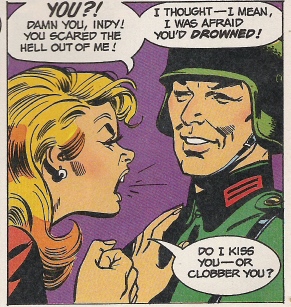
In the last panel of page 4, is it just me, or does Indy
(here in a stolen German soldier uniform) look more like
Leonard Nimoy than Harrison Ford?? |
 |
On page 15, a Nazi soldier says, "Leiber gott!" This is
German for "Dear God!"
On page 16, Kerner says, "Vas zum teufel?" and Übermann
says, "Katastroph!" These are German for
"What the hell?" and "Catastrophe!"
On page 19, when Kerner tries to steal Übermann's chance to
become a god, Übermann refers to Kerner as schweinhund.
This is German for "pig".
As Kerner begins absorbing god power, he declares that he will
rule the world and refers to Hitler as a Bavarian upstart. Bavaria is a
state in Germany. Hitler was not born there, but did spend a couple
years there with this family as a youth and acquired a lower
Bavarian accent in that time which never left him.
After Kerner is destroyed by the power of the god machine,
Übermann takes his turn, proclaiming, "Ahh, Valhalla! Open your
gates! Ich komme! Ich komme!"
"Ich komme!" is German for "I'm coming!"
Valhalla is a hall of honored warriors in the world of Asgard, home
of the Norse gods.
The gun Indy secures from a Nazi
soldier on page 20 is probably meant to be an MP-40, though it looks
a little bit off. The MP-40 is an submachine
gun model developed in Nazi Germany and in use there from 1939-1945.
When Indy manages to get the Atlantean drill vehicle started on
page 22, he shouts "Eureka!" "Eureka"
is an exclamation derived from Greek representing a personal
celebration of having made a discovery, attributed to Archimedes.
The comic book establishes Atlantis as
located about 7.5 miles from Thera, Santorini. But when Indy and
Sophia escape the destruction of Atlantis and emerge on the surface
of the Aegean Sea, Indy claims he sees Crete up ahead. Yet, Crete is
about 50 miles from Thera, so Thera would be much more likely to be
seen on the horizon.
Panel 2 of page 24 shows a brass plaque
mounted on the entry gate of Barnett College that seems to proclaim
its founding in 1823. But in
The Last Crusade, the
establishing shot of the college shows an 1895 founding date on its
signage.
At the end of the story, back in the U.S., Sophie has apparently written an Atlantis paper that has the academic world
buzzing and she has been given a full professorship at Barnett
College and she has ended her professional career as a psychic.
 |
Indiana Jones and the Fate of Atlantis
Video game
Story by Hal Barwood & Noah
Falstein
Developed and published by LucasArts
1992
|
Didja Notice?
At one point in the game, Indy comments
on seeing a sandwich which he calls "worthy of Dagwood Bumstead."
Dagwood Bumstead is the main character of the comic strip Blondie
(Blondie being his wife). Dagwood is known for building himself
skyscraper-like sandwiches filled with layer upon layer of meat,
cheese, tomato, lettuce, condiments, etc.
At another point in the game, Sophia calls Indy a "troglodyte".
"Troglodyte" is a popular generic term for a caveman or -woman.
A pair of in-jokes
occur in the game to George Lucas' 1973 film American
Graffiti: Indy sees some writing carved into the stone walls of
the underwater labyrinth and calls it "Atlantean Graffiti". A bit
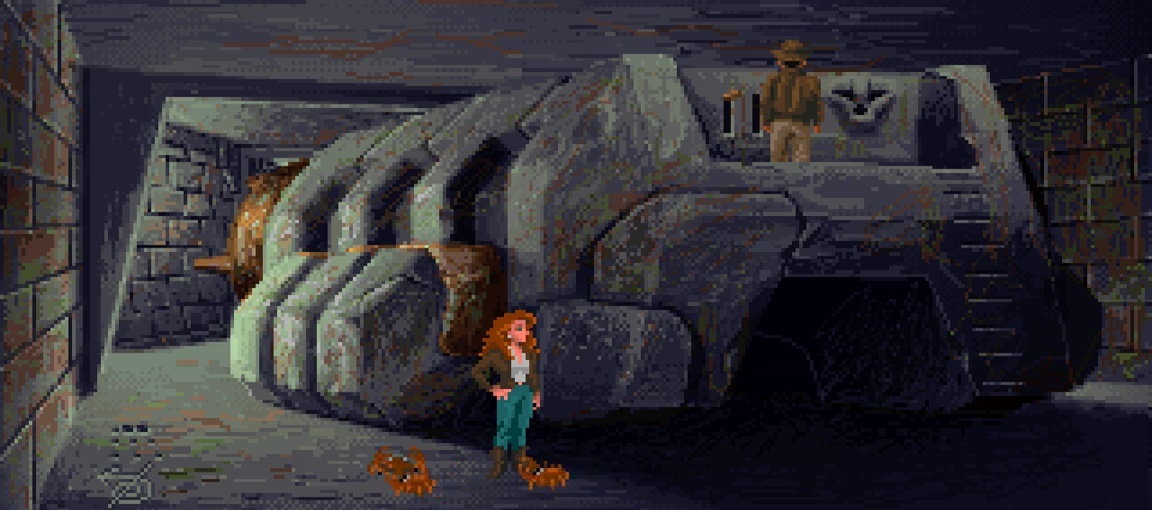
later, he and Sophia enter a chamber housing a giant robotic
transport with a bull motif; on the wall of this chamber he sees
"More Atlantean graffiti", a reference to More American Graffiti,
the 1979 sequel film, in which Lucas was not directly involved.
|
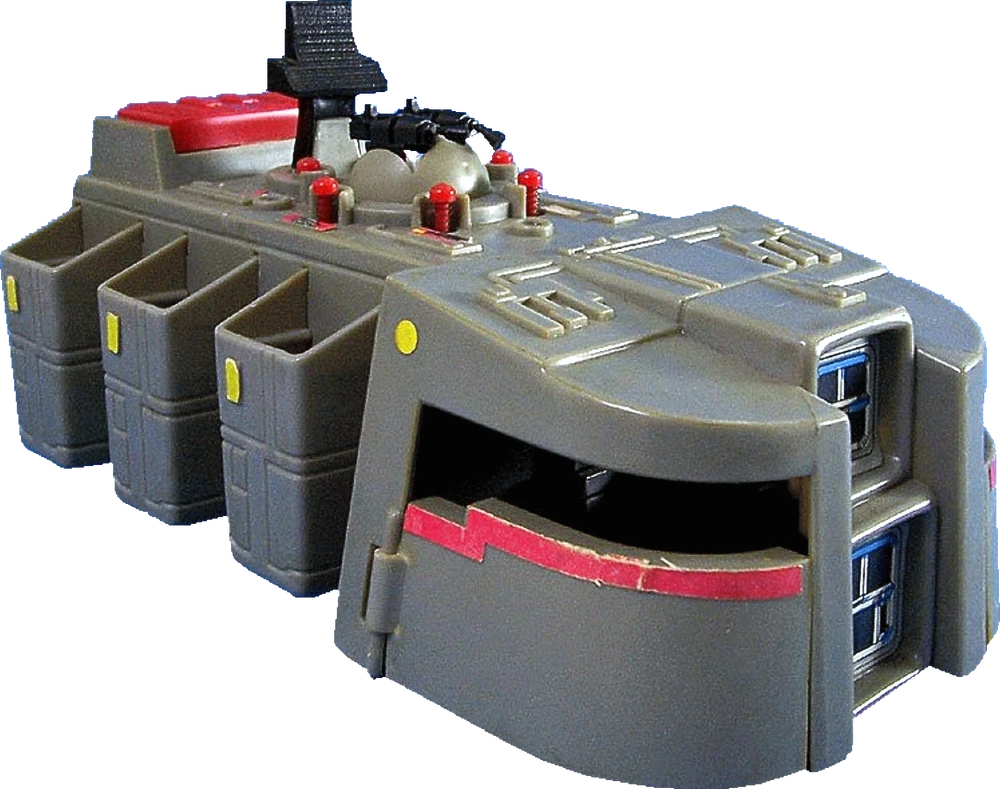
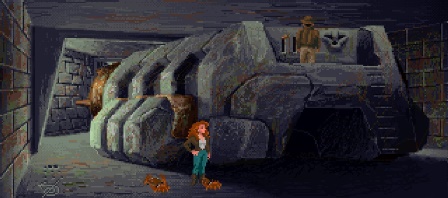
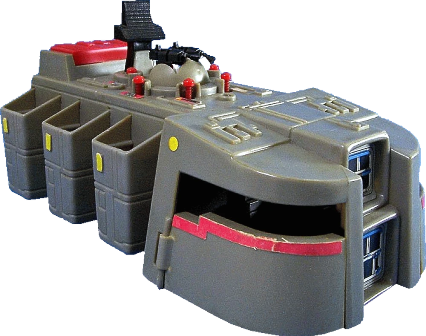
The robotic transport design may be a nod to the Imperial
Troop Transport from the Star Wars toy line
produced by Kenner for the first time in 1979. |
 |
 |
| Atlantean transport |
Imperial Troop
Transport toy by Kenner
(photo from the
Star Wars Merchandise Wiki) |
 |
Notes from the computer
game novelization by Dale Dassel
(pages 268-end roughly
cover the events of
Indiana Jones and the Fate of
Atlantis #4) |
Summary of this portion of the
novelization
The
Nazi expedition successfully penetrates the submerged ruins of
Atlantis, discovering that the legendary city lies sealed within a
massive pressurized air pocket and is still partially powered by its
ancient technology. Sophia Hapgood, long devoted to the myth of
Atlantis, is immediately shaken by the reality: instead of a radiant
utopia, the city is a decaying, industrial labyrinth of mold-stained
stone, rusted mechanisms, and utilitarian architecture. Colonel
Klaus Kerner and physicist Hans Übermann dismiss any disappointment,
focusing instead on the exploitation of orichalcum, the Atlantean
energy source they believe will secure Germany’s technological
dominance. As the Nazis establish a base, deploy radio equipment,
and divide into survey teams, Atlantis is reframed not as a lost
paradise but as the skeletal remains of an extinct technological
superpower.
Using three ancient keystones
recovered from earlier sites, the Nazis open monumental bronze
gateways that lead deeper into the city. Inside, they encounter
astonishing remnants of Atlantean science: motion-sensitive "light
coils", electrically powered systems without visible wiring,
subterranean transit tunnels, and massive industrial chambers.
Übermann theorizes that Atlantis is structured like an atom, with
its greatest power source hidden at its core, and organizes mapping
parties to locate the central refinery. Sophia grows increasingly
cynical as each discovery reinforces the idea that Atlantis was not
a spiritual golden age but an advanced—and ultimately
doomed—industrial civilization that exhausted itself. The city’s
hybrid iconography, blending Egyptian, Minoan, Mesoamerican, and
other ancient motifs, suggests Atlantis as the lost progenitor of
later human cultures.
Indiana Jones, secretly alive
and disguised as a Nazi cartographer, explores Atlantis alongside
German survey teams. While maintaining his cover, he studies the
city’s impossible engineering and confirms that Atlantean technology
surpasses anything known to modern science. He sabotages patrols,
knocks out soldiers, and uses captured radio equipment to manipulate
Nazi movements, all while trying to locate Sophia before the Germans
realize he is alive. Indy and Sophia later reunite independently of
the Nazi groups, and together they navigate flooded corridors,
cave-ins, biological hazards, and bizarre ecosystems—most memorably
a chamber overrun by bioluminescent crabs fed by a malfunctioning
light coil, which Indy destroys to clear their path.
As the Nazi operation begins to
unravel, multiple survey teams go missing, radio contact fails, and
Kerner’s confidence gives way to paranoia and rage. The promised
caches of orichalcum fail to materialize, and the city’s maze-like
design defeats systematic exploration. Internal power struggles
sharpen between Kerner, who wants immediate extraction of resources,
and Übermann, whose obsession with theoretical mastery blinds him to
the collapsing operation. The Nazis’ sense of inevitability erodes
as Atlantis resists being conquered, not through defenses, but
through scale, decay, and indifference.
Sophia is separated from Indy
and captured by Abwehr agent Fleischer, who reveals herself to be
Tristen Fleischer, a woman posing as a man within Nazi intelligence.
Tristen imprisons Sophia in a detention chamber and attempts to
coerce and sexually assault her, exposing the moral rot and
predatory cruelty at the heart of the Nazi expedition. Sophia
resists, both physically and psychologically, reinforcing her
transformation from idealistic mystic to hardened survivor. Indy
ultimately rescues her, further destabilizing Nazi control and
confirming that the city itself has become a battleground of wills
rather than armies.
Indy and Sophia enter a vast
lava-lit sanctuary deep within Atlantis, where Sophia suddenly falls
into a trance. The cursed Atlantean necklace allows the spirit of
the ancient high priest Nur-Ab-Sal to fully possess her, intending
to transfer his soul into her body and reclaim his throne. Using
Sophia’s voice and memories, Nur-Ab-Sal taunts Indy and condemns
modern humanity for denying the old gods. Indy realizes the
possession has been building since Sophia first found the necklace
years earlier and that her soul is in immediate danger.
Thinking quickly, Indy uses orichalcum to overload the necklace,
forcing Sophia to tear it from her neck. He destroys it by hurling
it into the lava pit, severing Nur-Ab-Sal’s hold forever. Sophia
collapses, freed but shaken, and the ancient spirit is finally
silenced. Together, they leave the infernal chamber and continue
toward Atlantis’s inner ring, unaware that the city itself is
nearing catastrophic collapse.
Indy and Sophia discover the orichalcum mines—vast industrial
caverns filled with abandoned Atlantean machines, robotic sentries,
and the colossal drilling device known as the Megataur. Their
exploration is interrupted when Nazi forces capture them. Dr.
Übermann and Colonel Kerner reveal their plan to weaponize
orichalcum and achieve godhood through an ancient Atlantean machine
built into the volcano.
Kerner betrays Übermann, murdering him and initiating the
transformation himself. The experiment grotesquely mutates Kerner,
granting him immense power at the cost of his humanity. The
Atlantean machine overloads and shuts down, rejecting him and
plunging the chamber into darkness. Kerner’s body disintegrates in
agony, and the god machine finally dies after millennia of
operation.
With the machine destroyed, Atlantis begins to collapse. Lava
breaches the mining city as earthquakes tear through the caverns.
Indy and Sophia flee through the collapsing mines, fighting off
remaining Nazis and narrowly escaping avalanching machinery. They
reactivate the ancient subway train and race through the tunnels as
magma floods the passages behind them.
The destruction accelerates as the volcanic chamber housing Atlantis
destabilizes completely. Indy and Sophia escape the mines and race
through the city as bridges collapse, towers crumble, and rivers of
molten orichalcum pour through the streets. Sophia nearly succumbs
to exhaustion and despair, but Indy urges her onward, reminding her
of her promise to deliver Karl Sankt’s final letter to his wife.
They reach the Nazi U-boat just as the city’s sea barrier fails.
Water pours in while lava surges upward, turning the cavern into a
boiling pressure cooker. Indy risks his life to retrieve his fedora
before sealing the hatch, and the submarine dives away moments
before Atlantis is obliterated by a volcanic eruption. The city
vanishes beneath fire, water, and stone—its secrets lost once more.
On the surface, Indy and Sophia stand together on the U-boat’s deck
as the volcano erupts far below the sea, sending a massive plume of
ash skyward that resembles the clenched fist of an angry god.
Watching Atlantis’s final destruction, Indy reflects that Atlantis
may not have been a city at all, but the ancient name of Earth
itself—the birthplace of all human civilization.
Sophia is overwhelmed by the implications, realizing that humanity
shares a forgotten common origin. Indy cautions her that revealing
the truth could destabilize history, religion, and global politics.
Reluctantly, she agrees that Atlantis may be safer as a myth.
As the sun sets over the Aegean, Sophia jokes about writing a book
about their adventure—Indiana Jones and the Fate of Atlantis—and
Indy dismisses it as pulp fiction before admitting it might make a
good story with a happier ending. The epilog closes with the two
sharing a tender kiss, sailing away from the ruins as Atlantis slips
once more into legend, forever just out of reach.
Characters appearing or mentioned in this novel, not in
the video game
Captain Heinrich Wilhelm
Leutnant Holtz
Schulte (dies in this segment of the
novel)
Horst
(dies in this segment of the novel)
Karl Sankt (dies in this segment of the novel)
Torsten/Tristen Fleischer (dies in this segment of the novel)
Adler (German soldier identity taken on by Indy to infiltrate the
Atlantean scouting trip)
Hauptmann Schelker
Melina (mentioned only)
Hofmeister
Eschenfelder
Prisha
(mentioned only)
Mercy Sankt
(mentioned only)
Karl and Mercy's son (mentioned only, not yet born)
Didja Know?
This book is a fan-written novelization of the game and comic book
and was
released online for free from 2010-2013. This book
by Dale Dassel is generally held in high regard for its quality
of writing and research.
Didja Notice?
CHAPTER 18: ANTEDILUVIAN WORLD
The word "antediluvian" in this chapter's title refers
specifically to the period of time in the Bible between the creation
of Earth and the great flood. In a more general sense, it has come
to mean any period of time lost to history.
On page 271, "Lampen! Wir brauchen mehr Licht!" and
"Es gibt hier drin keine Lampen!" are German for "Lamps! We
need more light!" and "There are no lamps in here!"
On page 272, "Jawohl, mein Herr," and "Bringt die
Signalleuchte hoch!" are German for "Yes, sir," and "Raise the
signal light!"
Wilhelm uses a Morse lamp on page 272 to illuminate the area
beside the docked sub. A Morse lamp is normally used as a signal
lamp for optical communication via the opening and closing of the
slats built into the lamp case. The signals are normally in Morse
code, hence the name.
On page 273, kaleun is another German term for
"captain".
Speaking of the Germans' portable backpack phone system, Shulte
remarks, "The portable telephone, surely the wave of the future!"
This is probably a joking nod by the author to the modern cell phone
addiction.
On page 275, hell is a German word for "bright".
On page 276, Übermann calls out to the U-boat crew,
"Achtung!" This is German for "Attention!"
After a "rousing" speech by Übermann on the German victory of the
discovery of Atlantean orichalcum, Sophia cracks, "I’ll contact the
Nobel Prize committee when I get back to New York."
The Nobel
prizes are awarded once a year by a committee of the
Scandinavian countries for work in the studies of Physics,
Chemistry, Physiology or Medicine, Literature, and Peace and are
considered the top prizes in the world in each field.
Übermann comments he has calculated that
one kilogram of orichalcum is equivalent to tenfold the amount of
uranium and "Even a fraction of the mineral supply in this city will
render our mines in Joachimsthal obsolete."
Joachimsthal
is a resort town in the Czech Republic (at the time called
Czechoslovakia), a nation which was under the control of Germany
from 1938-1945, where the Nazis had control of many mineral mines,
including mines of uranium ore.
Übermann's statement that the curvature of particle trajectory
is proportional to the charge, but inversely proportional to its
momentum is correct according to the laws of physics.
On page 285, hauptmann is another German word for
"captain".
Among Indy's ruminations on page 285, the Celts were diverse,
interconnected Iron Age European tribes from Central Europe who
spread outward, sharing similar languages, beliefs, and cultures,
with their legacy still strongly seen today in Ireland, Scotland,
and Wales.
The Anasazi were an ancient Native American culture in the
modern-day Four Corners region of the United States; modern-day
civilization doesn't know what these people called themselves; they
are often called Anasazi in modern times from a Navajo word meaning
"ancient enemy". "Puebloans" is becoming the more accepted term for
this ancient civilization, as the meaning of "Anasazi" is not
particularly complementary.
On page 286, the Waffen SS is
the military branch of the SS (Schutzstaffel).
Page 286 explains that most of the crew of the
Orogeny had not been told where they were really
headed until they arrived in the underwater ruins of Atlantis. The
crew had presumed that "Atlantis" was the operational code word for
an invasion of
Tripoli or Malta.
On page 287, "Unglaublich!" is German for "Incredible!"
Infiltrating the German scouting troop with a military uniform,
Indy assumes the role of Sturmmann Adler.
Sturmmann
is German for "Storm man", a paramilitary rank in the Nazis'
Sturmabteilung and SS. It was a junior rank, similar to a
soldier or stormtrooper.
When Schelker becomes suspicious of Indy, Indy says he is
originally from the Rhineland-Pfalz 5th Infantry recently assembled
in the Hunsrück.
Rhineland-Pfalz is
a state in western Germany. Hunsrück is an upland region in
Rhineland-Pfalz.
On page 290, Übermann wonders if Sophia is as gifted as the
Nazi's own Fraulein Orsic. This is a reference to Maria Orsic,
supposedly one of the founders of the Vril Society and mystic
contactee of extraterrestrials from Aldebaran to build an
anti-gravity device. Historians have found no legitimate proof that
she actually existed, and her story is believed to have been
concocted by right-wing extremist esotericist neo-Nazis in more
modern times.
The Nazis and their prisoner come upon a gigantic pyramid in the
Atlantean ruins, and Torsten goggles, "What the Hohenzollern is
that?"
"Hohenzollern" refers to the House of Hohenzollern, a royal
German dynasty whose members formerly ruled Prussia, the German
Empire, and Romania.
On page 293, "Gott im Himmel," is German for "God in
Heaven."
On page 294, Sophia seems to see a vision from the upcoming
August 1939 release of the film The Wizard of Oz, the scene of
Dorothy's family's house being carried through the air by a tornado.
This vision also appears in the computer game.
On page 295, Herr Oberst is German for "Colonel".
On page 296, Kerner says "Auf Wiedersehen," to Sophia.
This is German for "Goodbye."
On page 297, Abwehr agent Torsten Fleischer reveals "he" is
actually a woman, Tristen Fleischer. She tells Sophia she
finds her gorgeous and says, "Given the choice between yourself and
Marlene Dietrich, I would be hard-pressed to choose." Marlene
Dietrich (1901-1992) was a German-American actress and singer. She
was a popular sex symbol in the 1930s.
CHAPTER 19: GATEWAY TO ETERNITY
On page 303, "Hey, Amerikaner! Komm her!", "Was
machst du hier, Cowboy? Hast du dich verlaufen?", "Was?",
and "Geht das auch auf Deutsch, kleiner Mann?" are German
for "Hey, American! Come here!", "What are you doing here, cowboy?
Are you lost?", "What?", and "Can you say that in German, little
man?"
Indy tells the suspicious Horst he's selling "these fine leather
jackets", indicating his own well-worn coat. This line first
appeared in the LucasArts video game of Indiana Jones and the
Last Crusade.
On page 304, the Luftwaffe is the German air force.
Also on page 304, "Jetzt nehm ich dich auseinander, du
dreckiges kleines Weichei. Steh auf und wehr dich!" and
"Träum schön, Cowboy. Zeit zurück auf deine Ranch zu gehen,"
are German for "Now I'm going to take you apart, you dirty little
wimp. Get up and fight back!" and "Sweet dreams, cowboy. Time to go
back to your ranch."
On page 305, Indy refers to the unconscious Horst and Tristen as
"Hansel and Gretel". Hansel and Gretel is the title of a
Brothers Grimm fairy tale about a young brother and sister menaced
by a child-eating witch in the forests of Germany.
When Sophia grimaces at the mold-blackened walls of Atlantis
gleaming with decay and remarks, "What kind of place is this?", Indy
chides her, saying, "It’s the oldest civilization in the world. What
did you expect to find, a perfect city under a glass dome?" She
doesn't respond directly to that, but page 203 had revealed that she
had envisioned, in her wildest dreams, a great glass dome protecting
the city.
On page 308, Indy comments on Schliemann discovering the ancient
city of Troy and
finding
it
wasn’t exactly in the sparkling condition advertised by Homer.
Heinrich Schliemann (1822-1890) was a German amateur archeologist
who excavated the ground of what is now believed to be the site of
the lost city of Troy. Homer was an Ancient Greek writer and
author of numerous works about that culture's history and mythology,
including the Iliad, telling of the last year of the Trojan
War.
On page 309, Indy points out to Sophia
that the walls of the Atlantean city are constructed of polished
drystone without mortar and the shape and fit are exactly the same
as the ruins at Sacsayhuamán and Tiahuanaco, with the blocks melted
together.
Sacsayhuamán is an ancient Incan citadel in Peru. Tiahuanaco is
a pre-Columbian archeological site in Bolivia. In neither case are
the stone building blocks "melted together", but the huge stone
sections are very precisely cut and fitted to each other such that
there is virtually no seam.
When Indy fishes a tin of waterproof matches from his satchel,
Sophia asks if there is anything he doesn't carry in that bag, and
he tells her that it always helps to be prepared. She responds that
he sounds like a Boy Scout and he says he was one.
Indy was a member of the Boy
Scouts of America,
attaining the highest rank, Eagle Scout. The motto of the Boy Scouts
is "Be prepared." Some of Indy's Boy
Scout adventures are recorded in
"The Cross of Coronado" and
"The Mountains of
Superstition".
On page 314, Indy eliminates most the ravenous crabs in the
Atlantean labyrinth by using the city's fluorescent lighting liquid
as fuel across the surface of the flooded passage, setting it afire
and burning or boiling the crabs. He tells Sophia it's a trick he
learned in
Venice last summer. This refers to the rats burned by flaming
oil in the catacombs beneath an old Venecian church in
The Last Crusade.
On page 315, Waffenamt is German for "Weapons Office".
On page 316, "Wasser, bitte," "Mein Herr",
"Beeilung!" and "Jawohl, Herr Oberst," are German for
"Water, please," "Sir," "Hurry!" and "Yes, Colonel."
On page 317, Kerner ruminates that he must not fail the Führer
after Hitler had broken the shackles of the Weimar Republic and
assured the nation that the crippling humiliation of the
Versailles Treaty would never be repeated again. "Weimar Republic"
was the name of the German nation after its defeat in WWI from
1918-1933. The Versailles Treaty is the peace treaty signed by
Germany with the Allied nations in 1919 after the end of the war.
Kerner believes that when he succeeds in bringing orichalcum to
the Reich, Himmler will bestow upon him the coveted rank of
Obergruppenführer on behalf of the Ahnenerbe and as a
member of the elite Oberste SA-Führung, he would return to
Berlin in glory and oust Walther von Brauchitsch as head of the
German Army.
Obergruppenführer
means "Senior Group Leader", similar to lieutenant general in
the regular army.
Oberste SA-Führung
means "Supreme SA-Command & Control".
On page 322, "Ihr drei, überprüft den Gang. Beide Seiten.
Seht in jeden Raum," is German for "You three, check the
corridor. Both sides. Look in every room."
On page 323, "In diesem Raum ist nichts, Herr Hauptmann,"
and "Los, zum nächsten," are German for "There's nothing in
this room, Captain," and "Let's move on to the next one."
On page 325, Sophia explains to Indy that she used the fake ghost
as part of her psychic act at the theatre in New York because she
can’t summon an Atlantean god to appear in front of 2,000 people on
a nightly basis and she had to sell herself as a spook act otherwise
the management would not let her book the hall, adding a dignified
lecture on the subject of Atlantis is too high-brow for "those
Broadway showbiz hacks."
Broadway is a road running through the New York borough of Manhattan
and is world famous as a center of the theatrical arts; the name of
the road, Broadway, has become synonymous with the theatrical
productions originating there.
On page 327, the legend of Talus that
Indy tells to Sophia is accurate from Greek mythology.
Finding a statue that looks just like Sophia holding a sphere in
the underwater city, Indy speculates that it is Selene, a moon
goddess. Selene is the Greek goddess and personification of the
moon.
On page 335, Sophia claims the statue is
Atlantis, daughter of Atlas.
In Greek mythology, Atlas is the Titan god condemned to hold the
heavens up upon his shoulders for eternity after the war against the
Olympians that toppled the Titans. He is not said to have a daughter
named Atlantis, though he had several other daughters.
Sophia thinks the sphere looks like the Perisphere from the
World’s Fair until she realizes it is a depiction of the Earth, with
miniscule gems dotted on it marking the locations of pyramids. The
Perisphere was an actual large spherical structure at the 1939
New York World's Fair.
The World's
Fair is an international exhibition of scientific,
technological, and artistic achievements of the world's nations,
generally taking place every two or three years in a different city
around the world. In 1939, the World's Fair did take place in New
York.
Speculating on Plato's "three rings"
of Atlantis, Indy points out that the Tropic of Cancer and the
Tropic of Capricorn are divided by the equator.
The Tropic of Cancer (23.5°N) and
Tropic of Capricorn (23.5°S) are the northernmost and southernmost
latitudes where the sun appears directly overhead at noon, marking
the boundaries of the tropical zone. They define Earth's seasonal
shifts, experiencing maximum direct sunlight during the June and
December solstices, respectively.
Although phrased awkwardly, Sophia's
statement on page 333 is correct. It takes 26,000 years for the
Earth to complete an axial wobble.
Atlas was the founder of astrology in Greek
myth, just as Indy states on page 337.
On page 338, Sophia says that yesterday was
the summer solstice. On page 216, she had said the day was June 22.
Summer solstice always takes place between June 20-22 and in 1939 it
took place on the 20th, so the days do not quite line up here.
CHAPTER 20:
SUBTERRANEAN DEATH
On page 343, Nur-Ab-Sal says, "Nobody can steal my power, for I
am the almighty Belial, guardian of the ancient sea-fire."
Belial is a name used in the Old Testament of
the Bible for the devil.
On page 344, Sophia quotes some lines from Edgar Allan Poe's 1845
poem "The Raven".
After Indy saves her from the possessing power of the amulet of
Nur-Ab-Sal, Sophia remarks that from now on, she'll buy her jewelry
at Tiffany’s.
She is referring to Tiffany
& Co.,
a U.S. luxury retailer, specializing in diamond jewelry.
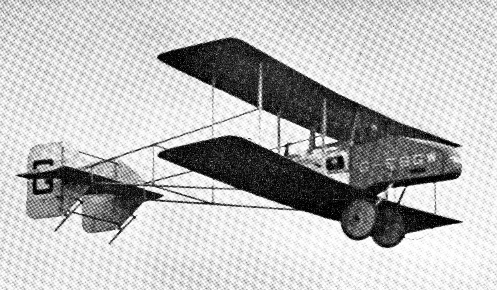
| Page 346 describes the face of the
Atlantean transport as sloped elegantly backwards like the
nose of a Zephyr. I presume the author is referring to the
custom built RAE Zephyr, a single-seater biplane built by
the Royal Aircraft Establishment in 1923. (Photo from
Wikipedia.) |
 |
Sophia tells Indy she wrote an article about levitation a few
years ago for Atlantis Quarterly and Indy sarcastically
replies, "I must’ve missed that issue."
Atlantis Quarterly was an actual journal of Atlantean
and occult studies that published five issues from June 1932 to
October 1933. As far as I can tell, none them had articles about
levitation or were written by a Sophia Hapgood. There is an article about
the occult in China by Dr. Strange though! (Dr. John Strange, but
still...)
On page 351, a Nazi soldier shouts at Indy and Sophia, "Halt! Ihr
zwei, Hände hoch! Sofort!" This is German for "Stop! You two, hands
up! Now!"
On page 352, the soldier says to Indy, "Sarkastisches
Amerikaner-Schwein." This is German for "Sarcastic American pig."
On pages 353-354, the Nazi soldier and Karl have a bit of a
conversation: "Nein," "Sie haben nicht viel Zeit.
Kerner sucht in diesem Moment nach Ihnen. Aber ich werde Ihnen
helfen, zu entkommen," "Weil ich weiß, was Dr. Übermann mit
diesem neuartigen Mineral, das er sucht, bauen will. Ich weiß,
welche Greueltaten mein Land in Europa begeht, und es muss aufhören,
bevor den Rest der Welt dasselbe Schicksal ereilt,"
"Verdammter Verräter!", "Tut mir leid," "Sowas
mache ich nicht gern," "Vielen Dank, mein Freund," and
"Nicht alle von uns sind Nazis. Wir haben immer noch einen
freien Willen," are German for "No," "You don't have much time.
Kerner is looking for you right now. But I will help you escape,"
"Because I know what Dr. Übermann intends to build with this new
type of mineral he's looking for. I know the atrocities my country
is committing in Europe, and they must stop before the rest of the
world suffers the same fate," "Damn traitor!", "I'm sorry," "I don't
like doing things like that," "Thank you very much, my friend," and
"Not all of us are Nazis. We still have free will."
On page 353, the soldier tells Karl, "You may outrank me in
Berlin, but not in the field. These are my prisoners, and if you
don’t like it then go and bitch to Admiral Canaris about protocol
when you get back." Wilhelm Canaris (1887-1945) was a German admiral
who was the head of the Abwehr military-intelligence service from
1935-1944. He was a clandestine member of the German resistance
against Hitler.
On page 355, Karl says, "Bitte…" and "Ja! Meine süße Mercy!
Sie kennen sie?" This is German for "Please..." and "Yes! My
sweet Mercy! Do you know her?"
On page 356, before dying, Karl says,
"Ich habe einen Sohn?" "Ist das wirklich die Zukunft, die Sie
sehen?" "Ich habe einen Brief…" "Bitte schicken Sie ihn meiner
Liebsten," and "Sie sind wahrlich eine Seherin. Gott segne
Sie, Fräulein Hapgood." These are German for "I have a son?"
"Is that really the future you see?" "I have a letter..." "Please
send it to my sweetheart," and "You are truly a seer. God bless you,
Miss Hapgood."
On page 360, Tristen swears, "Verfluchte Scheiße!" This
is German for "Fucking shit!"
When Sophia tries to hit Tristen on page 361, Tristen
sarcastically laughs, "So it’s true what they say about a lover
scorned." The full phrase is "Hell hath no fury like a woman
scorned," from the 1697 play The Mourning Bride by William
Congreve.
CHAPTER 21: THE GOD MACHINE
On page 376, Indy compares the fiery volcanic cavern he and Sophie are in
to a Thuggee temple he’d once seen in India beneath Pankot Palace.
Further, he realizes that a misstep would have him falling to his
death, with no invisible bridge to catch him this time. The
Thuggee temple beneath Pankot Palace refers to his adventure in
The Temple of Doom. There
was no "invisible bridge" in that movie; he seems to be jumping to a
later adventure he had in
The Last Crusade,
where an "invisible bridge" allowed him to
cross a chasm to complete his quest for the chamber holding the Holy
Grail.
Sophia tells Indy that Atlantean libraries did not contain books,
but instead crystals which can store untold volumes of information.
She refers to it as the akashic record, a telepathic compendium of
universal knowledge, located in the Hall of Wisdom. In the
Theosophic religion, the Akashic Records are a non-physical,
metaphysical "library" of energetic, vibrational records containing
every thought, word, action, and emotion experienced by every soul
throughout its entire existence.
On page 381, Sophia says that Chronos is the keeper of the
Holonothic record. In Greek mythology, Chronos is personification of
time. "Holonothic" appears to be a made-up
term, perhaps related to "holonomic", a term referring to a system
that can move in any direction independent of its orientation.
On page 385, Mein Kampf (My Fight) is Adolf
Hitler's 1925 manifesto and autobiography.
Übermann says the Atlantean colossus is worthy of the great Fritz
Lang himself. Lang (1890-1976) was an Austrian film director,
screenwriter and producer who made films in Germany before he moved
to the United States in 1934 and continued his career there. He is
considered one of the most influential film makers of all time.
Übermann's comment comparing the colossus to Lang's work probably
refers largely to his most well-known film, Metropolis (1927), an
expressionist science-fiction film with dramatic noirish/art decco
production design.
When Indy announces that the giant Atlantean machine is a device
for manufacturing higher beings, Kerner exclaims, "The
Übermensch! It all makes sense now. Ancient prophecy ordained
that the fifth Root Race shall arise in the fourth cosmic round. Now
the time of the Aryan has come!"
Übermensch is German for "Superman", a term used by
German philosopher Friedrich Nietzsche in his 1883 book, Thus
Spoke Zarathustra, with the Übermensch being a goal for
humanity to set for itself. The Nazis twisted this idea into a
racial ideal of a master race who are empowered to dominate
"inferior" forms of humanity. The "Fifth Root Race" refers to a
concept in Theosophy, identifying the current stage of human
spiritual evolution characterized by developing intellect and
individuality, following the Atlantean Fourth Root Race.
Kerner's use of the term "original Aryan sun" on page 387 refers
to various sun myths common to most cultures, as cultures shared
their myths when they made contact, with many pagan religions thus
having similar general sun myths to represent the same story of
humanity's creation and development across the planet.
Übermann's term Überbombe on page 388 means "Superbomb".
CHAPTER 22: ATLANTIS RISING
On page 397, Indy runs, guiding Sophia, from the Atlantean
volcano that threatens to erupt at any second, that singular terror
propelling him faster than he's run in his life. Indy has experience
running from volcanoes, just check out
"Indy vs. the Volcano".
Aboard the Atlantean "Zephyr" train, Sophia wonders if they have
enough orichalcum to power the vehicle. Indy says, "I hope so, or
this is gonna be a real short trip!" This line is a nod to an
exchange in Star Wars: A New Hope, where Han Solo says,
"Sure hope the old man got that tractor beam out of commission or
this is gonna be a real short trip!" as he and his friends attempt
to escape from the Death Star aboard the Millennium Falcon.
Captain Wilhelm shouts, "Raus! Raus!" as his crew
frantically exits the quaking city to the sub. This is German for
"Out! Out!"
As the U-boat rides the shockwaves of the dying underwater city,
Indy remarks to Wilhelm, "I think we’re going to need a bigger
U-boat." This is a nod to the 1975 film, Jaws, directed by
Steven Spielberg, in which the character of police chief Martin
Brody aboard shark hunter Quint's boat says, after seeing the size
of the shark they're after, "You're gonna need a bigger boat."
Page 410 references Indy's guardian eagle. The
eagle is said to be his spirit guardian in The
Peril at Delphi and
which he also saw in a vision in Dance
of the Giants.
EPILOGUE
On page 413, Indy tells Sophia he thinks that "Atlantis" was
actually the ancient name of our planet. This brings Sophia to
realize, "That means…we’re all Atlanteans. Every one of us. The
whole
human race."
Memorable Dialog
you sound like you're possessed.mp3
Atlantean graffiti.mp3
More Atlantean graffiti.mp3
I knew I smelled a rat.mp3
a lot of my discoveries seem like tall tales.mp3
Back to Indiana Jones Episode
Studies